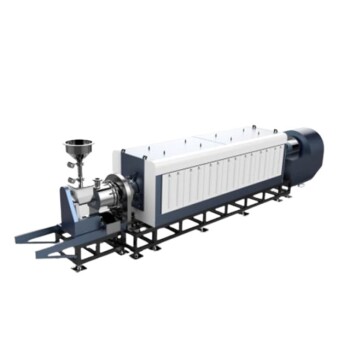
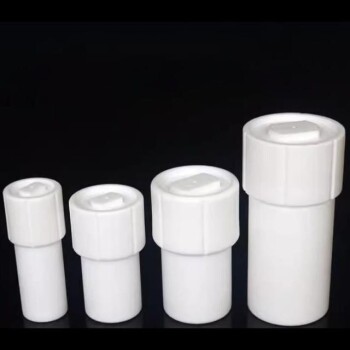
The successful synthesis of Nb-Ti alloys via magnesiothermic reduction relies on a dual-barrier system comprising a stainless steel reactor and a high-purity graphite crucible. The stainless steel vessel functions as the primary airtight pressure container to maintain the necessary reaction environment. Inside this vessel, the high-purity graphite crucible holds the reactants—oxide powders and magnesium blocks—serving as a chemically inert barrier that withstands high temperatures without contaminating the final product.
This configuration separates the mechanical requirements of pressure containment from the chemical requirements of purity. The stainless steel manages the external environment, while the graphite ensures the internal reaction yields uncontaminated metallic powders.
The Role of the Stainless Steel Reactor
The outer shell of the reduction apparatus is constructed from industrial-grade stainless steel. Its primary function is mechanical and environmental rather than chemical.
Airtight Pressure Containment
The reduction process requires a strictly controlled environment. The stainless steel reactor serves as a pressure vessel that isolates the internal process from the outside atmosphere.
Maintaining the Reaction Environment
By creating an airtight seal, the reactor ensures that the conditions necessary for the magnesiothermic reduction are maintained throughout the cycle. It prevents external gases from entering and reaction byproducts from escaping uncontrollably.
The Role of the High-Purity Graphite Crucible
Inside the stainless steel reactor, a high-purity graphite crucible is used to physically hold the reactant load, which consists of oxide powders and magnesium blocks.
Exceptional Thermal Resistance
The reduction process generates significant heat. Graphite is selected because it possesses exceptional high-temperature resistance, allowing it to maintain structural integrity under thermal stress that might degrade other containment materials.
Chemical Stability and Purity
The most critical function of the graphite is its chemical stability. It does not react with the magnesium reducing agent, the oxide precursors, or the resulting metallic products.
Prevention of Contamination
Because the graphite remains inert, it ensures the final Niobium (Nb) or Nb-Ti alloy powders remain free from container-derived contamination. Using a reactive crucible material would introduce impurities, compromising the quality of the alloy.
Critical Considerations and Trade-offs
While this setup is effective, understanding the specific interaction between materials is vital for process success.
Reliance on Material Inertness
The system relies entirely on the passive nature of graphite. If low-purity graphite were used, or if the process temperature exceeded the graphite's stability limits in the presence of specific reactants, carbon contamination could occur.
The Limits of Stainless Steel
Stainless steel provides excellent structural strength, but it is not suitable for direct contact with the hot reactants. If the graphite crucible fails or leaks, the reactants could contact the steel, leading to catastrophic contamination of the alloy and potential damage to the pressure vessel.
Optimizing the Reduction Process
To ensure high-quality alloy production, you must match the material properties to your specific processing goals.
- If your primary focus is Alloy Purity: Prioritize the use of high-purity graphite to ensure absolutely no chemical interaction occurs between the crucible and the metallic powders.
- If your primary focus is Process Safety: Ensure the stainless steel reactor is certified for the specific pressure and temperature gradients of your reduction cycle to maintain an airtight seal.
The combination of a robust pressure vessel and a chemically inert crucible is the definitive standard for producing contamination-free Nb-Ti alloys.
Summary Table:
| Component | Material | Primary Function | Key Advantage |
|---|---|---|---|
| Outer Vessel | Stainless Steel | Pressure containment & airtight sealing | Maintains controlled reaction environment |
| Inner Container | High-Purity Graphite | Reactant containment & thermal barrier | Chemical inertness and high-temperature resistance |
| Reduction Agent | Magnesium (Mg) | Chemical reduction of oxide powders | Efficient conversion to metallic powders |
| Final Product | Nb-Ti Alloy | High-performance material output | Superior purity and structural integrity |
Elevate Your Material Synthesis with KINTEK Precision
Achieving the perfect Niobium-Titanium alloy requires equipment that balances structural integrity with chemical purity. At KINTEK, we specialize in providing the high-performance tools necessary for complex magnesiothermic reductions. Our expertise in high-temperature high-pressure reactors and autoclaves ensures a secure reaction environment, while our high-purity graphite and ceramic crucibles guarantee your final products remain free from contamination.
Whether you are performing CVD/PECVD research or metallurgical crushing and milling, KINTEK offers a comprehensive range of laboratory equipment—from induction melting furnaces and hydraulic presses to specialized electrolytic cells—designed to meet the rigorous demands of advanced material science.
Ready to optimize your lab’s reduction process? Contact KINTEK today to discuss our tailored solutions for your research and production needs.
References
- Jiwon Hong, Dong‐Won Lee. Comparison of the Magnesiothermic Reduction Behavior of Nb2O5 and Ti2Nb10O29. DOI: 10.3390/met13101743
This article is also based on technical information from Kintek Solution Knowledge Base .
Related Products
- Stainless High Pressure Autoclave Reactor Laboratory Pressure Reactor
- Mini SS High Pressure Autoclave Reactor for Laboratory Use
- Customizable Laboratory High Temperature High Pressure Reactors for Diverse Scientific Applications
- Customizable High Pressure Reactors for Advanced Scientific and Industrial Applications
- Custom PTFE Teflon Parts Manufacturer for Hydrothermal Synthesis Reactor Polytetrafluoroethylene Carbon Paper and Carbon Cloth Nano-growth
People Also Ask
- Why is a laboratory high-pressure reactor used in the hydrothermal synthesis of hydroxyapatite catalysts?
- What role does a laboratory high-pressure reactor play in the leaching process of spent cathode materials? Optimize Recovery
- Why is a laboratory high-pressure reactor necessary for synthesizing fly ash-based zeolite? Achieve Pure Crystallization
- What conditions do laboratory high-pressure reactors provide for HTC? Optimize Your Biochar Production Processes
- What is the function of a high-pressure reactor autoclave? Enhancing Cu/N Co-Doped Carbon Catalyst Synthesis