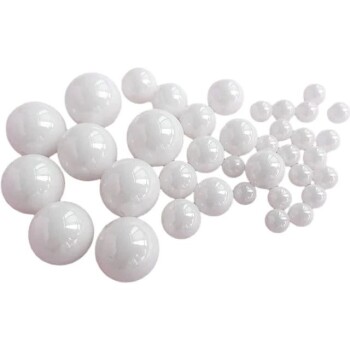
Zirconia grinding balls are the definitive choice for processing sulfide solid electrolytes because they solve the dual challenge of mechanical efficiency and chemical purity. Their high density and hardness generate the intense impact energy needed to synthesize the material, while their chemical inertness prevents the fatal metallic contamination often caused by other grinding media.
The Core Reality Success in sulfide electrolyte synthesis relies on achieving high ionic conductivity. Zirconia is preferred because it delivers the kinetic energy required for amorphization without introducing conductive impurities that degrade electrochemical stability.
The Mechanical Advantage: Energy Transfer
High Density Drives Amorphization
Sulfide solid electrolytes typically require a structural transformation from a crystalline state to an amorphous (glassy) state to function correctly.
Zirconia balls possess extremely high density. This mass allows them to generate significant kinetic energy during the milling process. Upon collision, this energy is transferred to the precursor materials, effectively driving the mechanochemical reaction required for amorphization.
Hardness for Efficient Pulverization
The precursor materials for solid electrolytes can be hard and resistant to breakdown.
Zirconia exhibits exceptional hardness, surpassing that of the precursor materials. This ensures the grinding media does not deform upon impact. Instead, it efficiently pulverizes the precursors, shortening the reaction time necessary to achieve a homogeneous mixture.
The Chemical Advantage: Purity and Stability
Preventing Metallic Contamination
The most critical risk in ball milling is contamination from the grinding media itself. Standard stainless steel balls shed metallic iron particles due to wear.
In a battery context, metallic impurities are catastrophic. They can cause short circuits and degrade the electrolyte's electrochemical performance. Zirconia is a ceramic; it eliminates the introduction of metallic contaminants like iron, ensuring the synthesized electrolyte remains electrically insulating where it needs to be.
Superior Wear Resistance
High-energy milling is an aggressive process that inevitably causes abrasion.
Zirconia offers superior wear resistance compared to softer alternatives. This means less material is scraped off the balls and mixed into your electrolyte. By minimizing the volume of foreign particles introduced into the batch, you maintain the high purity essential for optimal ionic conductivity.
Chemical Inertness
Sulfide electrolytes are highly reactive and sensitive to their environment.
Zirconia is chemically inert. It does not react with the sulfide materials during the milling process. This stability prevents unwanted side reactions that could alter the stoichiometry of the electrolyte or introduce non-conductive phases.
Understanding the Pitfalls of Contamination
The Nature of "Wear"
It is important to understand that no grinding media is completely immune to wear. High-energy collisions will eventually produce microscopic debris.
However, the "trade-off" strongly favors zirconia. If microscopic zirconia particles enter the mixture, they are ceramic and insulating. Unlike conductive metal shavings from steel media, ceramic debris does not cause internal short circuits or promote parasitic side reactions during battery cycling.
Sensitivity to Environment
While zirconia balls are chemically stable, the sulfide materials they process are often air- and moisture-sensitive.
Using zirconia balls alone is not a cure-all for environmental sensitivity. They must be used in conjunction with high-quality sealed zirconia jars (often in an argon environment) to prevent hydrolysis or oxidation. The inertness of the ball is wasted if the jar allows atmospheric moisture to degrade the electrolyte.
Making the Right Choice for Your Goal
When setting up your milling protocol, align your media choice with your specific electrochemical targets.
- If your primary focus is Ionic Conductivity: Choose zirconia to strictly eliminate metallic impurities that impede ion flow and degrade performance.
- If your primary focus is Reaction Kinetics: Rely on the high density of zirconia to provide the impact energy needed to shorten synthesis time and ensure complete amorphization.
- If your primary focus is Battery Safety: Use zirconia to prevent the introduction of conductive contaminants that could lead to internal short circuits during cycling.
By selecting zirconia, you ensure that the mechanical energy used to create the electrolyte does not compromise its chemical integrity.
Summary Table:
| Feature | Zirconia Grinding Balls | Impact on Sulfide Electrolytes |
|---|---|---|
| Density | High (approx. 6.0 g/cm³) | Maximizes kinetic energy for amorphization. |
| Hardness | Exceptional (HV >1200) | Efficiently pulverizes hard precursors quickly. |
| Chemistry | Ceramic / Inert | Prevents short-circuiting metallic contamination. |
| Wear Rate | Ultra-low | Maintains high purity and ionic conductivity. |
| Stability | Non-reactive | Ensures stoichiometric precision during milling. |
Elevate Your Battery Research with KINTEK
Precision in sulfide solid electrolyte synthesis starts with the right materials. KINTEK provides high-purity zirconia grinding media and sealed jars specifically designed for air-sensitive applications.
Our extensive laboratory portfolio includes:
- High-Performance Milling: Zirconia balls, crushing systems, and planetary ball mills.
- Thermal Processing: Muffle, tube, and vacuum furnaces for sintering and amorphization.
- Cell Characterization: Electrolytic cells, electrodes, and high-pressure reactors.
- Sample Prep: Pelleting presses (hot/isostatic) and precision crucibles.
Don't let metallic contamination compromise your ionic conductivity. Contact KINTEK today to discuss your specific milling requirements and secure the high-purity tools your research demands.
Related Products
- Laboratory Jar Ball Mill with Alumina Zirconia Grinding Jar and Balls
- Precision Machined Zirconia Ceramic Ball for Engineering Advanced Fine Ceramics
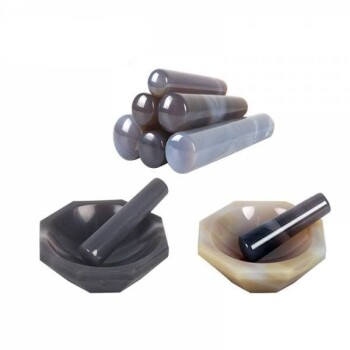
- Laboratory Jar Mill with Agate Grinding Jar and Balls
- Laboratory Ball Mill Jar Mill with Metal Alloy Grinding Jar and Balls
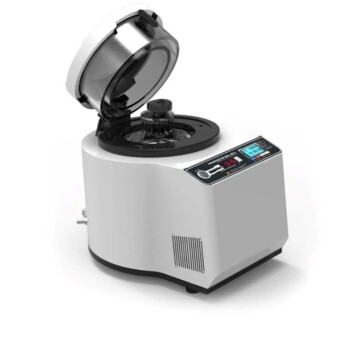
- Laboratory Micro Tissue Grinding Mill Grinder
People Also Ask
- What are the primary functions of using a ball mill for BZCY72 powder? Achieve High Purity and Enhanced Sintering
- In what way does a laboratory ball mill affect material properties when modifying PHBV/pulp fiber composites?
- Why is a laboratory ball mill required for ultra-fine fly ash? Unlock Nano-Scale Adsorption Power
- What is the function of a laboratory ball mill in the preparation of AMMCs? Optimize Dispersion & Grain Refinement
- What is the function of a laboratory ball mill in the pretreatment of waste tire char (WTC)? Optimize Material Reactivity