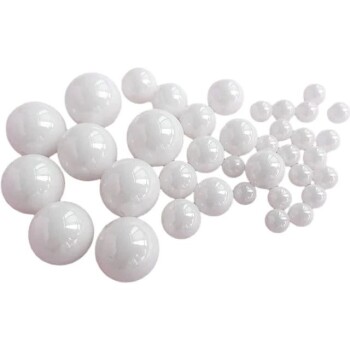
Zirconia grinding balls are the standard choice for the mixing stage of graphene-reinforced ZrB2-SiC composites due to their unique combination of high density, hardness, and stability. They provide the physical force required to homogenize difficult powder mixtures while ensuring the chemical integrity of the final product remains uncompromised.
Core Takeaway Achieving high-performance ultra-high temperature ceramics requires a delicate balance of aggressive mixing and absolute purity. Zirconia media solves this by delivering high-impact energy to disperse graphene and ceramic powders without shedding contaminants that would degrade the material's properties.
Achieving Uniform Dispersion
The Role of High Density
Zirconia balls possess a significantly high density, which translates directly into kinetic energy during the milling process.
When the milling jar rotates, the heavy zirconia balls generate substantial impact energy as they collide with the powder mixture.
Breaking Down Agglomerates
This high impact energy is critical for ensuring the uniform dispersion of the three distinct components: graphene, silicon carbide (SiC), and zirconium diboride (ZrB2).
Without this intense physical force, materials like graphene tend to clump together, leading to weak points in the final composite structure.
Maintaining Material Purity
Superior Wear Resistance
Grinding processes, particularly those involving hard ceramics like SiC and ZrB2, are abrasive and can rapidly degrade softer grinding media.
Zirconia balls exhibit superior wear resistance, meaning they do not easily chip or erode even during long-duration mixing cycles.
Chemical Stability
In addition to physical toughness, zirconia is chemically stable.
This prevents the introduction of external impurities into the powder mixture, which is vital for maintaining the high purity required for ultra-high temperature applications.
Common Pitfalls to Avoid
The Risk of Media Contamination
A critical error in processing these composites is selecting grinding media that is softer than the ceramic powders being mixed (such as steel or lower-grade ceramics).
If the media wears down, it introduces foreign debris into the mixture.
Impact on Composite Performance
Any introduced impurities act as defects within the ceramic matrix.
Preserving the high purity of the mixture is not just a cosmetic preference; it is essential to ensure the final composite retains its theoretical mechanical and thermal properties.
Making the Right Choice for Your Goal
To maximize the performance of graphene-reinforced ZrB2-SiC composites, align your processing parameters with your material requirements:
- If your primary focus is Homogeneity: Rely on the high density of zirconia to generate the impact energy needed to fully disperse graphene within the ceramic matrix.
- If your primary focus is Purity: Leverage the wear resistance of zirconia to prevent cross-contamination during extended mixing durations.
Zirconia media acts as the critical enabler for processing advanced ceramics, converting raw potential into structural reliability.
Summary Table:
| Feature | Benefit for ZrB2-SiC-Graphene Composites |
|---|---|
| High Density | Increases kinetic energy to break down graphene agglomerates effectively. |
| Superior Hardness | Resists abrasion from hard ceramic powders like SiC and ZrB2. |
| Chemical Stability | Prevents contamination, ensuring high material purity for thermal applications. |
| Wear Resistance | Minimizes media erosion during long-duration mixing cycles. |
Elevate Your Material Research with KINTEK Precision Solutions
Achieving the perfect dispersion in advanced ceramic composites requires more than just high-quality powders—it requires the right processing tools. KINTEK specializes in high-performance laboratory equipment, providing the crushing and milling systems and high-purity zirconia grinding media essential for graphene-reinforced ZrB2-SiC research.
From high-temperature vacuum furnaces for sintering to hydraulic presses for pellet preparation, our comprehensive portfolio supports every stage of your material science workflow. Ensure the structural reliability and purity of your composites by partnering with a leader in lab consumables and equipment.
Ready to optimize your milling process? Contact our technical experts today to find the perfect solution for your lab.
Related Products
- Laboratory Jar Ball Mill with Alumina Zirconia Grinding Jar and Balls
- Precision Machined Zirconia Ceramic Ball for Engineering Advanced Fine Ceramics
- Laboratory Jar Mill with Agate Grinding Jar and Balls
- Laboratory Ball Mill Jar Mill with Metal Alloy Grinding Jar and Balls
- High Energy Planetary Ball Mill Milling Machine for Laboratory
People Also Ask
- What are the primary functions of using a ball mill for BZCY72 powder? Achieve High Purity and Enhanced Sintering
- In what way does a laboratory ball mill affect material properties when modifying PHBV/pulp fiber composites?
- Why is a laboratory ball mill required for ultra-fine fly ash? Unlock Nano-Scale Adsorption Power
- What is the function of a laboratory ball mill in the preparation of AMMCs? Optimize Dispersion & Grain Refinement
- What is the function of a laboratory ball mill in the pretreatment of waste tire char (WTC)? Optimize Material Reactivity