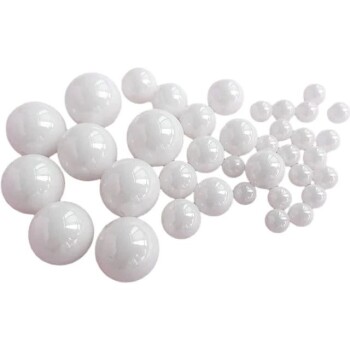
Zirconia grinding balls are the preferred media for processing La0.6Sr0.4CoO3-δ powders because they balance extreme physical hardness with chemical inertness. In wet ball milling environments, typically utilizing ethanol, zirconia generates the high impact force necessary to crush hard perovskite oxides. Crucially, it achieves this without introducing metallic impurities that would degrade the purity and performance of the final catalyst.
The selection of zirconia media is driven by the need to apply high-energy impact forces to hard oxide particles while strictly preventing contamination. This ensures the material retains its precise electrochemical properties after extended processing durations.
The Mechanics of Efficient Particle Reduction
Overcoming Material Hardness
La0.6Sr0.4CoO3-δ is a hard perovskite oxide that resists fracturing. To effectively reduce its particle size, the grinding media must possess significantly higher hardness than the powder itself.
Zirconia provides this extreme hardness. This allows the media to crush the oxide particles and break down soft agglomerates effectively, rather than the media suffering damage or deforming upon impact.
Maximizing Impact Energy
Efficiency in ball milling is largely a function of kinetic energy. Zirconia is a high-density ceramic, which translates to greater weight per ball compared to other ceramic alternatives.
This high density allows the balls to carry more kinetic energy as they tumble. Upon collision, this energy is transferred to the powder, ensuring a thorough crushing effect that is vital for achieving a homogeneous mixture.
Preserving Chemical Purity
Preventing Metallic Contamination
The most significant risk in milling oxide catalysts is contamination from the grinding media. Traditional steel balls introduce iron impurities via wear, which can drastically alter the electrical and catalytic properties of the powder.
Zirconia is chemically distinct from metals. Its use effectively eliminates the introduction of metallic impurities, which is essential when the final application relies on precise material composition.
Stability in Ethanol Media
Wet ball milling processes for La0.6Sr0.4CoO3-δ often utilize ethanol as a solvent to facilitate dispersion. Zirconia exhibits excellent chemical inertness in this medium.
Even during extended high-energy milling processes—which can last up to 48 hours—zirconia remains stable. This prevents chemical reactions between the media and the solvent that could otherwise compromise the purity of the catalyst.
Understanding the Trade-offs
Managing Trace Wear
While zirconia is exceptionally wear-resistant, no grinding medium is completely impervious to abrasion over long durations.
In rare instances of extreme milling, trace amounts of zirconium dioxide (ZrO₂) may be introduced into the mixture. However, because zirconia is chemically stable, this trace contamination is generally far less detrimental to the performance of oxide ceramics than conductive metallic contaminants like iron.
Making the Right Choice for Your Goal
To ensure your milling process aligns with your project requirements, consider the following priorities:
- If your primary focus is Catalyst Purity: Select zirconia to strictly prevent the introduction of metallic species that could interfere with electrochemical reactions.
- If your primary focus is Process Efficiency: Leverage the high density of zirconia to generate sufficient impact energy, reducing the time required to break down hard agglomerates.
Zirconia remains the definitive choice for processing sensitive perovskite oxides, offering the necessary durability to pulverize hard materials without compromising their chemical integrity.
Summary Table:
| Feature | Zirconia Grinding Media | Impact on La0.6Sr0.4CoO3-δ Processing |
|---|---|---|
| Hardness | Extremely High | Effectively crushes hard perovskite oxide particles. |
| Density | High Density | Maximizes kinetic energy for faster particle reduction. |
| Chemical Stability | Inert in Ethanol | Prevents contamination during long-duration wet milling. |
| Contamination Risk | Non-Metallic | Eliminates iron/metallic impurities that degrade catalysts. |
Elevate Your Material Synthesis with KINTEK Precision Solutions
Achieving the perfect particle size distribution without compromising chemical integrity is critical for advanced catalyst research. KINTEK specializes in high-performance laboratory equipment designed for the most demanding applications.
Whether you are processing sensitive perovskite oxides or developing next-generation battery materials, our comprehensive range of crushing and milling systems, zirconia grinding media, and high-temperature furnaces provides the reliability you need. From planetary ball mills to hydraulic pellet presses and high-pressure reactors, we offer the tools to ensure your research yields reproducible, high-purity results.
Ready to optimize your milling process and enhance your lab's efficiency? Contact us today to find the ideal equipment for your specific application!
Related Products
- Laboratory Jar Ball Mill with Alumina Zirconia Grinding Jar and Balls
- Precision Machined Zirconia Ceramic Ball for Engineering Advanced Fine Ceramics
- Laboratory Jar Mill with Agate Grinding Jar and Balls
- Laboratory Ball Mill Jar Mill with Metal Alloy Grinding Jar and Balls
- High Energy Planetary Ball Mill Milling Machine for Laboratory
People Also Ask
- What are the primary functions of using a ball mill for BZCY72 powder? Achieve High Purity and Enhanced Sintering
- In what way does a laboratory ball mill affect material properties when modifying PHBV/pulp fiber composites?
- Why is a laboratory ball mill required for ultra-fine fly ash? Unlock Nano-Scale Adsorption Power
- What is the function of a laboratory ball mill in the preparation of AMMCs? Optimize Dispersion & Grain Refinement
- What is the function of a laboratory ball mill in the pretreatment of waste tire char (WTC)? Optimize Material Reactivity