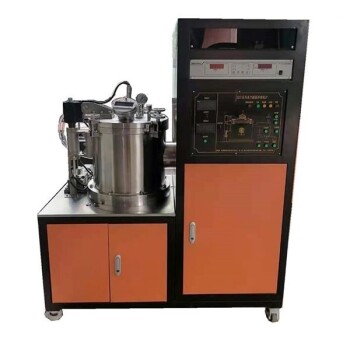
A double vacuum resistance furnace is the structural safeguard for industrial magnesium recovery. Its primary function is to balance the pressure difference between the inner distillation tank and the outer chamber. This equalization is critical because it prevents the inner tank from collapsing or deforming when the metal's structural strength is significantly reduced by the extreme heat required for sublimation.
High-temperature vacuum sublimation softens metal reactor walls, making them susceptible to crushing under external pressure. The double vacuum design eliminates this mechanical stress by maintaining a vacuum on both the interior and exterior of the reaction tank, ensuring stability even for large-scale operations.
The Engineering Challenge of Magnesium Recovery
The High-Temperature Environment
Recovering magnesium from waste alloys relies on vacuum sublimation. This process requires heating the material to temperatures between 900°C and 1000°C while maintaining a low-pressure environment of 5 to 100 Pa.
The Phase Change Mechanism
Under these conditions, magnesium bypasses the liquid phase and sublimates directly from solid to gas. This utilizes the difference in saturated vapor pressure between magnesium and impurities like aluminum, iron, and silicon to achieve purification.
The Structural Risk
At temperatures approaching 1000°C, the metal used to construct the reaction tank loses a significant amount of its structural strength. In a standard furnace, the inside is a vacuum while the outside is at atmospheric pressure. This creates a powerful crushing force against the weakened tank walls, leading to potential deformation or implosion.
How the Double Vacuum Design Solves the Problem
Pressure Equalization
The "double vacuum" configuration places the reaction tank (inner tank) inside a second vacuum chamber (outer tank). By evacuating the space between the two tanks, the system ensures that the pressure on the outside of the inner tank is roughly the same as the pressure on the inside.
Eliminating Deformation
Because the pressure is balanced, there is virtually no net force acting on the walls of the inner tank. This effectively prevents the distillation tank from deforming, even though the material is hot and relatively soft.
Enabling Large-Scale Recovery
This design is particularly important for industrial applications using large-diameter distillation tanks (e.g., those approaching 1 meter). Without the double vacuum support, larger tanks would require impractically thick walls to resist collapsing, making the equipment inefficient and costly.
Understanding the Trade-offs
Operational Complexity
While the double vacuum design offers superior stability, it increases the complexity of the system. Operators must manage two distinct vacuum zones, which may require more sophisticated control instrumentation compared to a simple single-chamber furnace.
Maintenance Requirements
The dual-chamber architecture introduces more seals and vacuum feedthroughs. This increases the potential points of failure, requiring a more rigorous maintenance schedule to ensure both vacuum environments remain compromised-free.
Making the Right Choice for Your Goal
When selecting equipment for magnesium recovery, align the furnace design with your production scale:
- If your primary focus is small-scale R&D: A simple vertical vacuum furnace is often sufficient, as smaller diameters can inherently withstand the pressure differential.
- If your primary focus is industrial mass production: The double vacuum resistance furnace is mandatory to ensure equipment longevity and safety when using large vessels.
The double vacuum system transforms magnesium recovery from a structural risk into a reliable, scalable industrial process.
Summary Table:
| Feature | Single Vacuum Furnace | Double Vacuum Resistance Furnace |
|---|---|---|
| Pressure Balance | High pressure differential | Equalized pressure (Inner & Outer) |
| Structural Risk | High risk of tank collapse | No deformation risk |
| Operating Temp | Up to 1000°C (Small scale) | 900°C - 1000°C (Industrial scale) |
| Scalability | Limited to small diameters | Ideal for large-diameter tanks |
| Maintenance | Low complexity | Higher (requires dual-zone control) |
Maximize Your Recovery Yield with KINTEK
Scaling up your magnesium alloy recovery requires engineering precision and safety. KINTEK specializes in advanced laboratory equipment, offering high-performance double vacuum resistance furnaces and high-temperature reactors designed to withstand the rigors of industrial sublimation. Whether you need muffle furnaces, crushing systems, or specialized consumables like crucibles and ceramics, our solutions ensure structural integrity and thermal efficiency. Contact KINTEK today to equip your facility with the robust tools needed for high-purity metal recovery.
Related Products
- Multi Heating Zones CVD Tube Furnace Machine Chemical Vapor Deposition Chamber System Equipment
- Vacuum Arc Induction Melting Furnace
- 2200 ℃ Tungsten Vacuum Heat Treat and Sintering Furnace
- Vacuum Heat Treat Sintering Brazing Furnace
- Vacuum Dental Porcelain Sintering Furnace
People Also Ask
- What are the advantages of a multi-zone tube furnace for Sb2S3? Unlock Superior Semiconductor Thin Film Purity
- What are the advantages of using a Multi-zone Tube Furnace? Enhanced Thermal Uniformity for Diffusion Research
- What is a CVD tube furnace? A Complete Guide to Thin-Film Deposition
- What are the technical advantages of using a CVD tube furnace? Optimize Silicon-Carbon Battery Anodes
- What is the function of a high-temperature CVD tube furnace in 3D graphene foam prep? Master 3D Nanomaterial Growth