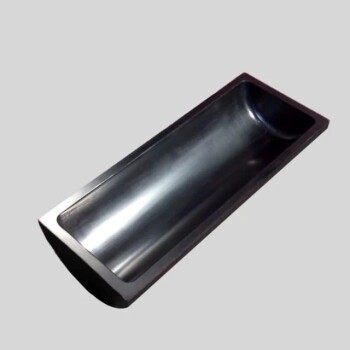
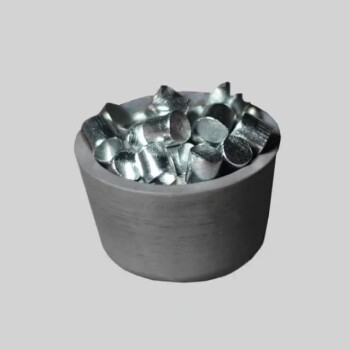
Graphite crucibles are the preferred choice for melting Copper-Silver (Cu-Ag) alloys because they offer a unique combination of extreme thermal resilience and active purification properties. They are capable of withstanding melting temperatures up to 1200°C without structural failure, while simultaneously creating a chemical environment that prevents contamination and reduces oxygen levels in the final alloy.
The selection of a crucible is not merely about holding molten metal; it is about process control. Graphite is utilized for Cu-Ag alloys because it serves a dual function: it physically contains the melt at high temperatures and chemically contributes to a purer alloy by minimizing oxygen and metallic impurities.
Thermal and Chemical Stability
Withstanding Extreme Temperatures
The melting phase of Copper-Silver alloys requires sustained temperatures reaching up to 1200 degrees Celsius.
Graphite is selected specifically for its excellent high-temperature resistance. It maintains structural integrity under these intense thermal loads, ensuring the safety and reliability of the melting process.
Preventing Metallic Contamination
Achieving high purity is the primary goal when processing Cu-Ag alloys.
Graphite possesses superior chemical stability relative to the alloy components. Unlike metal crucibles, graphite does not leach metallic impurities into the melt, ensuring the alloy's composition remains uncompromised.
The Role of Atmosphere Control
Creating a Reductive Environment
Graphite does more than passively hold the liquid metal; it interacts favorably with the processing environment.
At high temperatures, graphite naturally provides a reductive atmosphere. This chemical characteristic helps strip oxygen from the environment, acting as a safeguard against oxidation during the melt.
Synergy with Vacuum Systems
To maximize alloy purity, the crucible is often integrated into a broader purification system.
The reductive nature of the graphite works in conjunction with vacuum systems. Together, they effectively minimize the initial oxygen content of the alloy, which is critical for maintaining the material's mechanical and electrical properties.
Operational Considerations
System Dependency
While graphite is effective on its own, it is not a standalone solution for total oxygen elimination.
The primary reference highlights that graphite works best when paired with vacuum systems. Relying solely on the crucible without the supporting vacuum infrastructure may not achieve the lowest possible oxygen levels required for high-specification applications.
Making the Right Choice for Your Process
To ensure the highest quality Copper-Silver alloy production, consider how the crucible interacts with your wider system setup.
- If your primary focus is alloy purity: Ensure your graphite crucible is paired with a functional vacuum system to fully leverage the reductive atmosphere and minimize oxygen content.
- If your primary focus is equipment durability: Rely on graphite’s proven ability to withstand 1200°C temperatures without introducing metallic contaminants into the melt.
By leveraging the thermal stability and reductive properties of graphite, you ensure a cleaner, more controlled melting phase for your alloys.
Summary Table:
| Feature | Benefit for Cu-Ag Melting |
|---|---|
| Temperature Resistance | Operates safely at sustained temperatures up to 1200°C |
| Chemical Stability | Prevents metallic leaching and contamination of the melt |
| Reductive Atmosphere | Naturally strips oxygen to minimize oxidation during melting |
| Vacuum Compatibility | Works with vacuum systems for maximum alloy purity |
| Durability | High thermal shock resistance ensures process reliability |
Elevate Your Metallurgy with KINTEK Precision Solutions
Don't let impurities compromise your Copper-Silver alloys. KINTEK provides high-performance graphite crucibles and advanced thermal processing equipment designed to meet the rigorous demands of material science.
Whether you require induction melting furnaces, vacuum systems, or specialized ceramics and crucibles, our team of experts is ready to help you optimize your melting phase for maximum purity and efficiency.
Ready to upgrade your laboratory or production line? Contact KINTEK Today to discover how our comprehensive range of high-temperature solutions can transform your results.
References
- Jiaxiang Li, Yong Liu. Ultrahigh Oxidation Resistance and High Electrical Conductivity in Copper-Silver Powder. DOI: 10.1038/srep39650
This article is also based on technical information from Kintek Solution Knowledge Base .
Related Products
- High Purity Pure Graphite Crucible for Evaporation
- High Purity Pure Graphite Crucible for Electron Beam Evaporation
- Carbon Graphite Boat -Laboratory Tube Furnace with Cover
- Arc-Shaped Alumina Ceramic Crucible High Temperature Resistant for Engineering Advanced Fine Ceramics
- Engineering Advanced Fine Ceramics Alumina Al2O3 Crucible With Lid Cylindrical Laboratory Crucible
People Also Ask
- Why are high-purity graphite crucibles preferred for sulfide solid electrolytes? Achieve Superior Material Purity
- Why is a high-purity graphite crucible required for Chromel-TaC composites? Ensure Peak Purity at 1400°C
- What role do high-purity graphite crucibles play in molten salt corrosion research? Ensure Reactor-Grade Precision
- Why are high-purity graphite crucibles used for magnesium distillation? Ensure 3N8 Purity & Thermal Stability
- Why is a high-purity graphite crucible ideal for nitrogen-doped graphene at 1500 °C? Maximize Purity and Stability