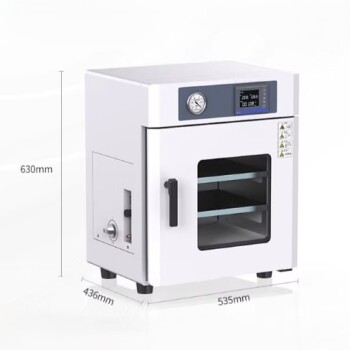
A high-precision laboratory oven is the fundamental tool for establishing a reliable baseline in corrosion research. Its primary function is to maintain a stable, uniform environment at 105°C, which is critical for the complete removal of moisture from coal, biomass, and metal specimens prior to testing. Without this specific pre-treatment, the integrity of subsequent kinetic data is compromised from the start.
The validity of the Weight Gain Method depends entirely on precise mass measurements. By utilizing a high-precision oven to eliminate moisture-induced errors, researchers ensure that any measured increase in mass is caused exclusively by corrosion products, providing an accurate picture of the corrosion kinetic process.
The Role of Precision in Sample Pre-Treatment
Establishing a Dry Baseline
In corrosion kinetics research, the starting state of the sample dictates the accuracy of the final results.
A high-precision oven is necessary to dry samples—specifically coal, biomass, and metal specimens—to a constant weight.
By maintaining a strict temperature of 105°C, the oven drives off physical moisture without chemically altering the sample, creating a standardized starting point for experimentation.
Facilitating the Weight Gain Method
The primary technique used to measure corrosion in this context is the Weight Gain Method.
This method tracks how much mass a metal specimen accumulates as it corrodes (oxidizes) and forms reaction products.
If a sample contains residual moisture, the evaporation of water (weight loss) competes with the formation of oxides (weight gain), making accurate calculation impossible.
Eliminating Data Variability
Removing Random Errors
Moisture content in raw samples is rarely uniform; it fluctuates based on humidity and storage conditions.
If these fluctuations are not addressed, they introduce random errors into mass measurements.
A high-precision oven eliminates this variable completely, ensuring that every sample begins the experiment in an identical, moisture-free state.
Isolating the Corrosion Variable
To understand the kinetics of corrosion, you must isolate the formation of corrosion products as the single variable affecting mass.
Any weight change recorded after pre-treatment must reflect only the corrosion process.
High-precision drying removes the "noise" of water evaporation, allowing for a clear, uncontaminated view of the chemical reaction rates.
Risks of Inadequate Pre-Treatment
The Danger of Temperature Fluctuation
While the goal is simple—drying the sample—the execution requires the stability of a high-precision unit.
An oven that fluctuates significantly below 105°C may fail to remove bound moisture, leading to underestimated corrosion rates later in the process.
Conversely, temperature spikes could prematurely alter the chemical composition of biomass or coal samples, introducing new variables before the actual experiment begins.
Data Ambiguity
Without high-precision pre-treatment, researchers cannot confirm if a specific data point is an outlier or a genuine result.
Moisture interference often looks like inconsistent kinetic behavior.
This ambiguity can lead to false conclusions regarding the corrosion resistance of the metal heating surface being tested.
Ensuring Data Integrity in Your Research
If your primary focus is Accurate Kinetic Modeling:
- You must prioritize the complete removal of moisture to ensure that weight gain curves reflect pure oxidation rates, not water evaporation.
If your primary focus is Material Comparison:
- Standardize the pre-treatment of all coal, biomass, and metal samples at exactly 105°C to eliminate environmental variables from your comparative analysis.
Precision in the pre-treatment phase is the only way to guarantee that your findings are a result of chemistry, not humidity.
Summary Table:
| Feature | Requirement in Corrosion Research | Impact on Kinetic Data |
|---|---|---|
| Temperature Stability | Constant 105°C (±0.5°C) | Ensures complete moisture removal without chemical alteration. |
| Uniform Heating | Even airflow distribution | Standardizes the baseline for coal, biomass, and metal specimens. |
| Moisture Elimination | Drive off physical water | Prevents weight loss interference during Weight Gain Method testing. |
| Error Reduction | Removes random variables | Eliminates 'noise' from humidity for clear, accurate reaction rates. |
Elevate Your Research Precision with KINTEK
In the rigorous world of corrosion kinetics, the integrity of your data begins with the perfect baseline. KINTEK specializes in high-precision laboratory equipment designed to eliminate variables and ensure repeatability. Whether you are drying biomass samples or preparing metal heating surfaces, our advanced laboratory ovens provide the thermal stability necessary for flawless Weight Gain Method analysis.
Our comprehensive portfolio supports your entire workflow—from high-precision ovens and crushing systems for sample prep, to high-temperature furnaces (tube, muffle, vacuum) and high-pressure reactors for simulating extreme corrosion environments.
Don't let moisture compromise your kinetic modeling. Contact our technical experts today to find the ideal thermal solution for your laboratory and ensure your findings are a result of chemistry, not environmental noise.
References
- Yongzheng Wang, Yungang Li. Reaction Kinetics of Chlorine Corrosion to Heating Surfaces during Coal and Biomass Cofiring. DOI: 10.1155/2020/2175795
This article is also based on technical information from Kintek Solution Knowledge Base .
Related Products
- Laboratory Scientific Electric Heating Blast Drying Oven
- 23L Laboratory Vacuum Drying Oven
- 56L Vertical Laboratory Vacuum Drying Oven
- 1200℃ Muffle Furnace Oven for Laboratory
- 1700℃ Muffle Oven Furnace for Laboratory
People Also Ask
- How does a laboratory electric drying oven contribute to the formation of the initial coating? Expert Insights
- What role does a precision laboratory drying oven play in the synthesis of GO-PANI nanocomposites? Protect Material Integrity
- What role does a laboratory drying oven play in the preparation of zinc oxide nanoparticle precursors?
- What is the necessity of using a laboratory drying oven when processing MoO3/GO composite nanopowders? Find out here.
- What is the role of a laboratory drying oven in cellulose citrate production? Ensure Material Stability & Purity