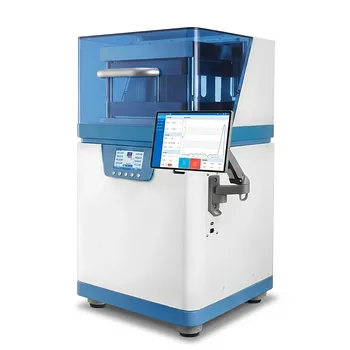
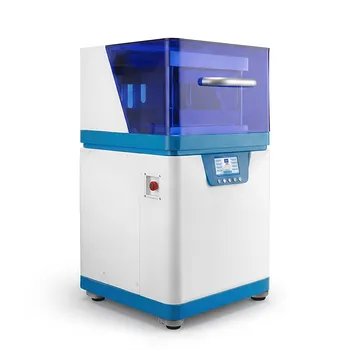
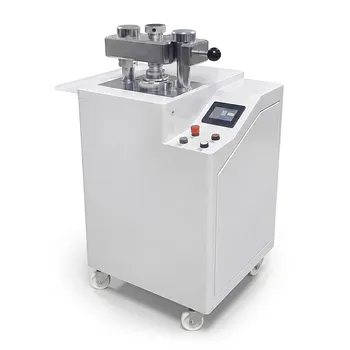
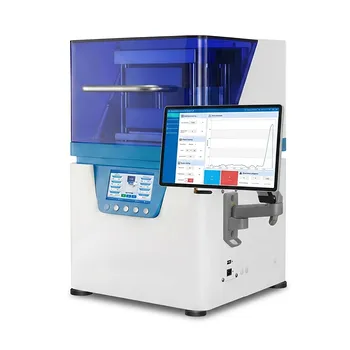
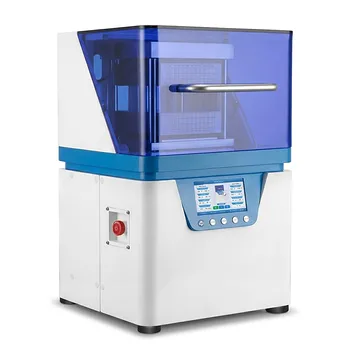
The utilization of a 600 MPa high-pressure servo hydraulic press is essential for overcoming the low plasticity of titanium alloy powders to achieve a high-density green compact. This extreme pressure forces the particles to undergo immediate plastic deformation and displacement rearrangement, maximizing the contact area between them. By creating these intimate connections, the press establishes the necessary mechanical interlocking and diffusion paths required for successful solid-phase sintering and the elimination of residual porosity.
High-pressure compaction at 600 MPa serves as the critical bridge between loose alloy powder and a high-performance solid, ensuring the structural integrity and chemical homogeneity of the final titanium alloy through maximized particle contact and reduced internal voids.
Mechanisms of High-Pressure Particle Transformation
Inducing Plastic Deformation and Rearrangement
Ternary titanium alloys often exhibit low plasticity at room temperature, meaning they resist shaping under standard pressures. Applying 600 MPa of axial pressure forces these stubborn particles to flatten and shift into a more efficient packing arrangement. This stage is vital for transforming a loose collection of powder into a cohesive "green compact" that can be handled without crumbling.
Establishing Mechanical Interlocking and Cold-Welding
The high force generated by the servo hydraulic press promotes "cold-weld" bonding between the fresh metal surfaces of the particles. As particles deform, they interlock mechanically, significantly increasing the splitting tensile strength of the compact. This structural stability is necessary to prevent cracks or fragmentation during the transition from the press to the sintering furnace.
Impact on Sintering and Final Densification
Maximizing Diffusion Paths
Solid-state diffusion, the process where atoms move between particles during heating, requires a high degree of surface contact. Compaction at 600 MPa maximizes this contact area, providing the "highways" needed for atoms to migrate effectively. Without this high-pressure foundation, the sintering process would be inefficient, leading to weak bonds and structural defects.
Reducing Residual Porosity
High-pressure compaction minimizes the size and number of internal voids within the green body before it ever enters the furnace. By reaching high initial densities (often exceeding 90% relative density), the subsequent sintering process can achieve near-theoretical densification, sometimes as high as 99.5%. Reducing this porosity is the primary factor in ensuring the final alloy meets industrial standards for strength and fatigue resistance.
Understanding the Trade-offs and Constraints
Tooling Wear and Mechanical Stress
Operating at 600 MPa places immense stress on the dies and punches of the hydraulic press. This high-pressure environment accelerates tool wear, requiring the use of specialized, high-strength materials for the compaction hardware itself. Frequent maintenance and monitoring are necessary to ensure dimensional accuracy is maintained over long production runs.
The Risk of Elastic Recovery (Springback)
When the 600 MPa pressure is released, the metal particles may experience "springback" as they attempt to return to their original shape. If not managed through precise servo-control of the decompression cycle, this internal tension can cause "lamination" or horizontal cracking in the compact. A servo hydraulic press is specifically used because it can control the speed and consistency of the pressure application to mitigate these internal stresses.
How to Apply High-Pressure Compaction to Your Project
Making the Right Choice for Your Goal
- If your primary focus is achieving near-theoretical final density: Utilize pressures in the 600-800 MPa range to minimize initial voids and maximize solid-state diffusion kinetics.
- If your primary focus is preventing green body breakage during handling: Ensure the press is capable of inducing sufficient mechanical interlocking and cold-welding to enhance splitting tensile strength.
- If your primary focus is extending tool life and reducing costs: Experiment with high-efficiency lubricants and optimized powder particle sizes to achieve target densities at the lower end of the high-pressure spectrum.
- If your primary focus is processing highly brittle titanium-aluminide alloys: Use a servo-controlled press to apply pressure gradually and manage the decompression phase to avoid catastrophic cracking from springback.
By mastering the precise application of 600 MPa of pressure, you ensure that the foundational physical state of your titanium alloy is optimized for peak performance and structural reliability.
Summary Table:
| Compaction Stage | Mechanism at 600 MPa | Impact on Final Alloy |
|---|---|---|
| Powder Transformation | Induces plastic deformation and particle rearrangement | Creates cohesive green compacts from low-plasticity powders |
| Structural Bonding | Promotes mechanical interlocking and "cold-welding" | Increases splitting tensile strength and prevents handling cracks |
| Sintering Efficiency | Maximizes particle contact area and diffusion paths | Accelerates atomic migration for solid-phase densification |
| Densification | Minimizes internal voids and residual porosity | Enables near-theoretical final density (up to 99.5%) |
Optimize Your Material Performance with KINTEK Precision
Achieving 99.5% density in ternary titanium alloys requires more than just force—it requires the precise control found in KINTEK’s high-pressure servo hydraulic presses. Whether you are performing pelletizing, hot pressing, or isostatic pressing, our systems provide the stability needed to manage elastic recovery and eliminate internal defects.
From high-temperature furnaces and crushing systems to specialized high-pressure reactors and hydraulic pellet presses, KINTEK provides the laboratory equipment and consumables essential for cutting-edge metallurgy and battery research.
Ready to elevate your lab's efficiency and material integrity?
Contact KINTEK Experts Today to find the perfect high-pressure solution for your project.
References
- Manash K. Paul, L. Bolzoni. New ternary powder metallurgy Ti alloys via eutectoid and isomorphous beta stabilisers additions. DOI: 10.1038/s41598-023-28010-7
This article is also based on technical information from Kintek Solution Knowledge Base .
Related Products
- Automatic High Temperature Heated Hydraulic Press Machine with Heated Plates for Lab
- Manual High Temperature Heated Hydraulic Press Machine with Heated Plates for Lab
- Automatic Laboratory Hot Press 400x400 mm with Programmable High Temperature and Hydraulic Force Control
- Automatic Hydraulic Hot Press with 500x500mm Heating Plates and Multi Stage PLC Control for Material Sintering
- Automatic Heated Hydraulic Press Machine with Heated Plates for Laboratory Hot Press
People Also Ask
- Why is a heated hydraulic press used for warm pressing NASICON green tapes? Optimize Your Solid Electrolyte Density
- What is a heated hydraulic press used for? Essential Tool for Curing, Molding, and Laminating
- Why is a heated laboratory hydraulic press necessary for composite laminates? Achieve Void-Free Structural Integrity
- What is a hot hydraulic press? Harness Heat and Pressure for Advanced Manufacturing
- What role does a heated hydraulic press play in Cold Sintering (CSP)? Enhancing LATP-Halide Densification