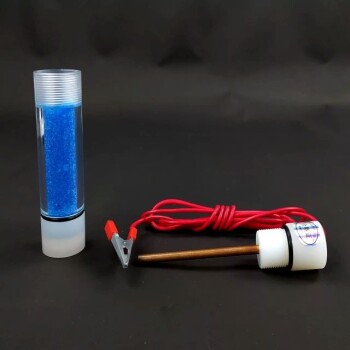
A high-purity Ag/AgCl reference electrode is the cornerstone of accurate diagnostic testing in Microbial Fuel Cells (MFCs). In a three-electrode configuration, this component provides an extremely stable potential baseline that is essential for isolating the performance of specific cell components. Without it, researchers cannot definitively determine whether system changes are driving improvements at the anode or the cathode.
By inserting a stable Ag/AgCl reference into the anode chamber, you transform a general voltage reading into precise, component-level data. This eliminates measurement bias and allows for the independent analysis of microbial activity versus catalytic efficiency.
The Role of the Three-Electrode Configuration
Establishing a Fixed Baseline
To measure electrochemical variations accurately, you must have a static point of comparison.
The Ag/AgCl electrode provides an extremely stable potential that does not fluctuate with the experimental conditions. This stability is critical for generating reliable data that can be compared across different experimental sets.
Isolating Half-Cell Potentials
In a simple two-electrode setup, you only measure the total voltage difference between the anode and cathode. This obscures the internal dynamics of the cell.
By utilizing a reference electrode, you can measure the "half-cell" potential of the anode and cathode independently. This reveals the specific contribution of each electrode to the total voltage of the system.
Diagnosing Performance Improvements
Verifying Anode Modifications
When developing new anode materials, you must prove that performance gains are due to the material itself.
The reference electrode allows you to confirm if improved power output is specifically the result of optimized microbial attachment or enhanced electron transfer at the modified anode surface.
Assessing Cathode Efficiency
Conversely, system improvements might be driven by the reduction reaction at the cathode.
Independent measurement ensures that gains in catalytic efficiency at the cathode are not mistakenly attributed to the biological processes occurring at the anode. This distinction eliminates measurement bias regarding the total system potential.
Understanding the Trade-offs
Reference Electrode Stability
While Ag/AgCl electrodes are high-purity and stable, they are not immune to environmental factors.
In long-term microbial experiments, biofouling of the electrode's porous junction can occur. This creates high impedance or potential drift, which can skew "stable" baseline readings.
Experimental Complexity
Introducing a third electrode increases the complexity of the cell design.
It requires precise placement within the anode chamber to minimize uncompensated resistance (IR drop). Poor positioning can lead to errors in the measured potential, reducing the accuracy of the data despite the high purity of the electrode.
Making the Right Choice for Your Goal
To maximize the utility of your Ag/AgCl reference electrode, consider your specific research objectives:
- If your primary focus is Anode Material Development: Use the independent potential data to correlate surface modifications directly with improved microbial attachment and electron transfer rates.
- If your primary focus is Catalyst Optimization: Monitor the cathode potential relative to the reference to ensure that the cathode reaction is not the rate-limiting step in your total system.
Precise instrumentation transforms a working Microbial Fuel Cell from a "black box" into a fully understood electrochemical system.
Summary Table:
| Feature | Benefit in MFC Research |
|---|---|
| Stable Potential Baseline | Provides a fixed point for accurate, repeatable comparisons across experiments. |
| Half-Cell Isolation | Separates anode microbial activity from cathode catalytic efficiency. |
| Measurement Accuracy | Eliminates bias by pinpointing exact sources of voltage improvement. |
| Diagnostic Precision | Validates if performance gains stem from anode modifications or cathode catalysis. |
Unlock Precise Electrochemical Insights with KINTEK
Don't let measurement bias hinder your renewable energy breakthroughs. KINTEK specializes in premium laboratory solutions, providing the high-purity Ag/AgCl reference electrodes, electrolytic cells, and high-performance electrodes essential for advanced Microbial Fuel Cell (MFC) research.
Whether you are optimizing microbial attachment on anodes or testing new catalysts, our comprehensive range of high-temperature reactors, battery research tools, and precision consumables ensures your data is both accurate and reproducible.
Ready to elevate your lab's diagnostic capabilities? Contact KINTEK today to discover how our expert-grade equipment can transform your research outcomes.
References
- Iwona Gajda, Ioannis Ieropoulos. A new method for urine electrofiltration and long term power enhancement using surface modified anodes with activated carbon in ceramic microbial fuel cells. DOI: 10.1016/j.electacta.2020.136388
This article is also based on technical information from Kintek Solution Knowledge Base .
Related Products
- Reference Electrode Calomel Silver Chloride Mercury Sulfate for Laboratory Use
- Electrolytic Electrochemical Cell Gas Diffusion Liquid Flow Reaction Cell
- Copper Sulfate Reference Electrode for Laboratory Use
- Graphite Disc Rod and Sheet Electrode Electrochemical Graphite Electrode
- Glassy Carbon Electrochemical Electrode
People Also Ask
- What is the function of a reference electrode? Master Precision in Three-Electrode Reactor Reconstruction
- What is the recommended maintenance for the filling solution of a reference electrode? A Guide to Stable & Accurate Readings
- Which electrode is used as a ground reference? Master the Key to Accurate Electrochemical Measurements
- What is the reference electrode in potentiometry? The Key to Stable & Accurate Measurements
- Which electrode is used as a reference? A Guide to Accurate Electrochemical Measurements