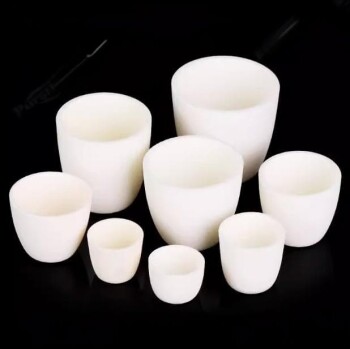
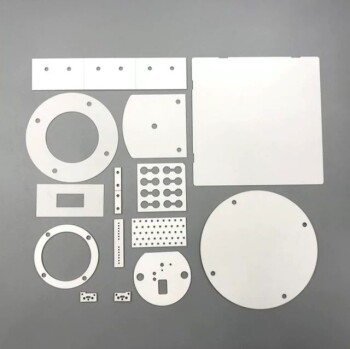
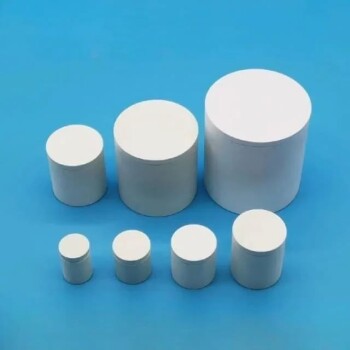
High-purity alumina crucibles are mandatory during the melting process of Cantor alloys primarily because they offer exceptional chemical inertness combined with high-temperature resistance. By withstanding the extreme heat required to melt these alloys without chemically reacting with the molten metal, the crucible prevents foreign materials from leaching into the mix, thereby preserving the alloy's purity and the accuracy of subsequent electrochemical testing.
The success of creating a high-entropy alloy relies on maintaining precise elemental ratios. High-purity alumina acts as a neutral vessel that isolates the melt from contamination, ensuring that the physical and chemical properties of the final alloy are derived solely from its constituent elements, not the container.
The Critical Role of Chemical Inertness
Preventing Cross-Contamination
In the high-temperature environment required for alloy melting, many standard crucible materials become reactive.
High-purity alumina is chemically inert, meaning it refuses to interact with the metal melt. This characteristic is vital to ensure that the crucible material does not dissolve into the alloy, which would introduce impurities and alter the alloy's composition.
Ensuring Electrochemical Accuracy
One of the primary uses of these alloys is in electrochemical applications, such as electrocoagulation.
If the crucible contaminates the alloy electrode, the electrochemical behavior will be skewed. Using high-purity alumina ensures that the data collected reflects the true performance of the Cantor alloy, rather than artifacts caused by impurities.
Thermal Stability at Extremes
Withstanding High Melting Points
Cantor alloys require significant heat to reach a molten state.
Alumina possesses superior thermal stability, maintaining its structural integrity in environments exceeding 1000°C. This ensures the vessel does not degrade, warp, or fail during the intense melting process.
Mass Stability for Monitoring
Beyond just holding the melt, the stability of the material is crucial for process monitoring.
Just as with alumina hangers used in similar high-heat contexts, high-purity alumina maintains a constant mass at high temperatures. This stability ensures that any weight changes observed during related processes are due to reactions within the sample itself, not the degradation of the equipment.
Common Pitfalls to Avoid
The "Purity" Distinction
It is critical to distinguish between standard alumina and high-purity alumina.
Standard industrial alumina may contain trace elements that can leach out at high temperatures. For sensitive applications like Cantor alloys, only high-purity variants provide the necessary chemical isolation to guarantee the integrity of the melt.
Reactivity with Base Materials
While alumina is inert to the alloy, one must ensure it does not react with other base materials in the furnace setup.
The material is specifically chosen because it does not react with the specific base materials used in these alloy experiments, but this compatibility must be verified if the experimental setup changes.
Ensuring Process Integrity
To maximize the success of your melting process and the validity of your data, consider the following regarding your equipment selection:
- If your primary focus is Alloy Composition: Ensure you use high-purity alumina to prevent the crucible material from leaching into the melt and altering the stoichiometry.
- If your primary focus is Data Accuracy: Rely on the inertness of alumina to guarantee that electrochemical reaction results are not skewed by foreign contaminants.
Ultimatley, the use of high-purity alumina is not just a safety measure, but a fundamental requirement for validating the true properties of high-entropy alloys.
Summary Table:
| Key Feature | Benefit for Cantor Alloy Processing |
|---|---|
| Chemical Inertness | Prevents cross-contamination and maintains exact elemental ratios. |
| Thermal Stability | Maintains structural integrity at extreme melting points exceeding 1000°C. |
| Mass Stability | Provides a constant mass at high heat, ensuring accurate process monitoring. |
| High-Purity Grade | Eliminates trace element leaching common in standard industrial alumina. |
| Electrochemical Isolation | Guarantees that testing data reflects the alloy properties, not impurities. |
Elevate Your Material Research with KINTEK Precision
Achieve unrivaled purity in your high-entropy alloy production with KINTEK's premium laboratory solutions. We understand that the success of your research depends on the integrity of your materials. KINTEK specializes in laboratory equipment and consumables, offering a comprehensive range of high-temperature furnaces (muffle, tube, rotary, vacuum, CVD, PECVD, MPCVD, atmosphere, dental, induction melting), crushing and milling systems, sieving equipment, and hydraulic presses (pellet, hot, isostatic).
Our extensive portfolio also features high-temperature high-pressure reactors and autoclaves, electrolytic cells and electrodes, battery research tools, cooling solutions (ULT freezers, cold traps, freeze dryers), and high-quality consumables like high-purity alumina crucibles, PTFE products, and ceramics.
Ensure your Cantor alloys meet the highest standards of purity and electrochemical accuracy. Contact KINTEK today to discuss your specific laboratory needs and discover how our advanced equipment can drive your innovation forward.
References
- Gülizar Kurtoğlu Akkaya, Gökhan Polat. Treatment by Electrocoagulation of Congo red from Aqueous Solution Using Cantor Alloy. DOI: 10.31590/ejosat.1041536
This article is also based on technical information from Kintek Solution Knowledge Base .
Related Products
- Arc-Shaped Alumina Ceramic Crucible High Temperature Resistant for Engineering Advanced Fine Ceramics
- High Purity Alumina Granulated Powder for Engineering Advanced Fine Ceramics
- High Purity Pure Graphite Crucible for Evaporation
- Engineering Advanced Fine Alumina Al2O3 Ceramic Crucible for Laboratory Muffle Furnace
- High Purity Pure Graphite Crucible for Electron Beam Evaporation
People Also Ask
- Why Use Alumina Crucibles & Powder Burial for NaSICON? Ensure Phase Purity and Prevent Elemental Volatilization
- What is the primary purpose of using alumina crucibles for LLTO ceramics? Optimize Your High-Temperature Sintering
- Why are alumina crucibles and mother powder essential for LATP sintering? Optimize Your Solid Electrolyte Performance
- Why are high-purity alumina crucibles used for liquid lead corrosion experiments? Ensure Data Accuracy at 550°C
- Primary considerations for choosing alumina crucibles and quartz tubes in indium intercalation: Ensure Material Purity