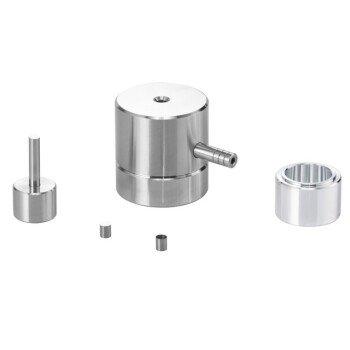
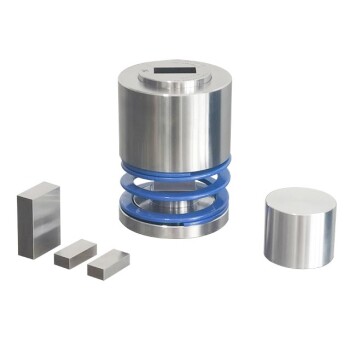
A high-strength pressure die is strictly required during cold pressing to mechanically restrict the lateral displacement of the composite powder. By confining the material within a rigid boundary, the die ensures that the hydraulic force is directed vertically rather than dissipating sideways. This confinement guarantees that pressure is effectively transferred to both the rigid NCM811 active material particles and the softer electrolyte coating, resulting in a unified structure.
The die acts as a critical containment vessel that converts applied force into structural density. Without this specific mechanical restriction, the pressure transfer would be uneven, leading to porous, unstable electrodes that degrade rapidly during battery operation.
The Mechanics of Powder Densification
Restricting Lateral Displacement
When loose composite powder is subjected to vertical hydraulic pressure, its natural tendency is to spread outwards horizontally.
A high-strength pressure die counters this physical behavior.
It creates an immovable barrier that forces the powder to compact upon itself rather than flowing sideways.
Optimizing Pressure Transfer
In an all-solid-state battery electrode, you are compressing two very different materials: rigid active material particles (NCM811) and softer electrolytes.
If the die allows any movement, the pressure will not be sufficient to deform the softer electrolyte around the rigid particles.
The high-strength die ensures the pressure is high enough to effectively mold the soft electrolyte into the voids between the hard NCM811 particles.
Ensuring Electrode Integrity and Longevity
Achieving High Density and Smoothness
The immediate goal of cold pressing is to create a cathode electrode that is dense, smooth, and crack-free.
The confinement provided by the die is the primary factor that allows for this level of densification.
Without this constraint, the resulting pellet would likely contain microscopic voids and surface irregularities.
Mechanical Stability at Interfaces
The long-term goal of using a high-strength die is to ensure the battery survives repeated cycling.
A dense, well-compacted electrode maintains better mechanical stability at the interfaces between particles.
This stability prevents the electrode from disintegrating or losing electrical contact as the battery expands and contracts during use.
Common Pitfalls to Avoid
Die Deformation
The term "high-strength" is not a suggestion; it is a functional requirement.
If the die material is not strong enough to withstand the hydraulic pressure, the die itself will deform or expand slightly.
Even a microscopic expansion of the die can lead to a significant loss of effective pressure on the powder, resulting in a low-density electrode that fails to meet performance standards.
Making the Right Choice for Your Goal
The use of a high-strength pressure die is about ensuring the physical integrity of the battery's internal structure.
- If your primary focus is Cycle Life: Prioritize the die's rigidity to ensure maximum density, which keeps particle interfaces intact during long-term operation.
- If your primary focus is Manufacturing Yield: Use high-strength tooling to prevent surface cracks and defects that lead to immediate rejection of the electrode.
Ultimately, the die is the tool that transforms a loose mixture of hard and soft powders into a robust, high-performance energy storage component.
Summary Table:
| Feature | Role of High-Strength Pressure Die | Impact on Battery Performance |
|---|---|---|
| Lateral Containment | Prevents powder from spreading horizontally | Maximizes vertical force for full densification |
| Pressure Transfer | Forces soft electrolyte into voids between NCM811 | Ensures intimate contact and high ionic conductivity |
| Surface Quality | Maintains rigid boundary during compression | Produces smooth, crack-free, and uniform electrodes |
| Mechanical Stability | Eliminates microscopic voids | Enhances cycle life and interface integrity during use |
| Die Durability | Resists deformation under hydraulic load | Guarantees consistent manufacturing yield and density |
Elevate Your Battery Research with KINTEK Precision Engineering
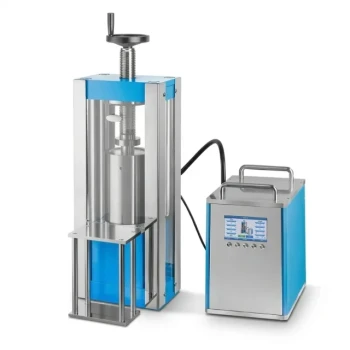
Achieving the perfect energy density in NCM811 all-solid-state batteries starts with the right equipment. KINTEK specializes in high-performance laboratory solutions, providing the high-strength hydraulic presses (pellet, hot, and isostatic) and specialized pressure dies essential for superior electrode densification.
Our extensive portfolio—ranging from crushing and milling systems to battery research tools and consumables—is designed to help researchers and manufacturers maintain mechanical stability at every interface. Don't let die deformation compromise your manufacturing yield or cycle life.
Ready to optimize your cold pressing process? Contact KINTEK experts today to find the ideal tooling and high-pressure solutions for your laboratory needs.
Related Products
- Special Shape Press Mold for Lab
- Ring Press Mold for Lab Applications
- Ball Press Mold for Lab
- Cylindrical Press Mold for Lab Applications
- Desktop Fast High Pressure Laboratory Autoclave Sterilizer 16L 24L for Lab Use
People Also Ask
- How to use a press mold? Master the Art of Creating Consistent Ceramic Forms
- What is the press mould method? A Guide to Consistent, Detailed Ceramic Forms
- Why are pressure molds with non-conductive resin inner walls required for battery testing? Ensure Data Accuracy
- What is the purpose of specialized pressure devices in sulfide solid-state batteries? Ensure Chemo-Mechanical Stability
- What is the function of press molds during the preparation of SiCf/Ti-43Al-9V composites? Achieve Structural Precision