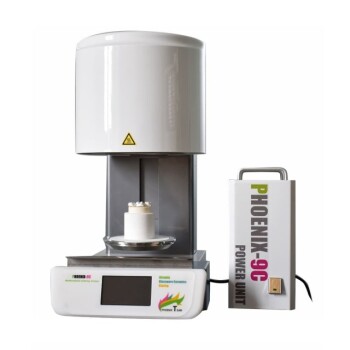
The combination of a high-temperature furnace, crucible, and mother powder acts as a controlled isolation system designed to prevent lithium volatilization. During the final sintering of LLZTO pellets at temperatures around 1150°C, lithium is highly prone to evaporation. This setup creates a contained, lithium-rich environment that suppresses this loss, preserving the material's chemical balance and performance.
High-temperature sintering is necessary for densification but creates a risk of lithium loss, which leads to structural degradation. The "mother powder" technique counteracts this by maintaining a saturated lithium atmosphere within the crucible, ensuring the final electrolyte retains its high ionic conductivity and pure cubic phase structure.
The Critical Challenge: Lithium Volatilization
The Necessity of High Heat
To achieve a functional solid electrolyte, LLZTO pellets must undergo sintering at high temperatures, typically between 1100°C and 1150°C. This extreme heat is required to facilitate particle diffusion and bonding, which densifies the material. Without this densification, the electrolyte cannot achieve the necessary mechanical strength or electrochemical performance.
The Instability of Lithium
The primary downside of this high thermal energy is the volatility of lithium elements. At sintering temperatures, lithium atoms become unstable and tend to evaporate from the pellet surface. This loss disrupts the stoichiometric balance of the material, changing its chemical composition during the process.
Consequences of Stoichiometric Imbalance
If lithium is allowed to escape, the LLZTO suffers from structural decomposition. This loss typically degrades the desired cubic phase structure into less conductive phases. The result is a significant drop in ionic conductivity, rendering the electrolyte ineffective for high-performance battery applications.
How the Mother Powder Solution Works
Creating a Sacrificial Atmosphere
To prevent lithium from leaving the pellet, the sample is surrounded by "mother powder"—loose powder of the same LLZTO composition. As the furnace heats up, the lithium in the mother powder volatilizes first because it has a higher surface area. This saturates the air inside the crucible with lithium vapor.
Suppressing Evaporation via Equilibrium
Because the atmosphere inside the crucible is already rich in lithium from the mother powder, the vapor pressure reaches an equilibrium. This prevents the lithium inside the densified pellet from escaping. The mother powder essentially acts as a buffer, sacrificing its own lithium to protect the integrity of the pellet.
Protecting Against Crucible Reactions
Beyond atmospheric control, the mother powder serves a physical protective role. It prevents the LLZTO pellets from coming into direct contact with the alumina crucible. Direct contact at high temperatures can cause the pellets to stick to or react with the crucible, leading to contamination or physical damage.
Understanding the Trade-offs
Increased Material Consumption
The primary drawback of this method is material efficiency. The mother powder is effectively a sacrificial material used solely to maintain the atmosphere and separate the sample from the container. This increases the total amount of raw material required for each production run.
Process Complexity
Using mother powder adds steps to the manufacturing workflow. The powder must be prepared, carefully arranged around the pellets, and separated after sintering. This requires precise handling to ensure the coverage is uniform without physically deforming the green (unfired) pellets.
Making the Right Choice for Your Goal
To ensure your LLZTO sintering process yields the best results, align your setup with your specific performance targets:
- If your primary focus is Maximizing Ionic Conductivity: Ensure the crucible is well-sealed with ample mother powder to maintain the pure cubic phase by completely suppressing lithium loss.
- If your primary focus is Structural Integrity: Use a uniform bed of mother powder to prevent the pellet from adhering to the alumina crucible, which avoids surface cracking and contamination.
By controlling the atmospheric equilibrium inside the crucible, you transform a destructive high-temperature environment into a stabilizing one.
Summary Table:
| Feature | Role in LLZTO Sintering | Impact on Performance |
|---|---|---|
| High-Temp Furnace | Provides 1100°C - 1150°C heat | Essential for particle diffusion & densification |
| Crucible | Contained isolation environment | Prevents contamination & maintains vapor pressure |
| Mother Powder | Sacrificial lithium source | Suppresses Li-volatilization & maintains cubic phase |
| Equilibrium | Vapor pressure saturation | Prevents structural degradation & loss of conductivity |
Achieve superior densification in your battery research with KINTEK's precision thermal solutions. From high-purity alumina crucibles and PTFE consumables to advanced high-temperature muffle and vacuum furnaces, we provide the specialized tools necessary to control lithium volatilization and ensure the integrity of your LLZTO electrolytes. Elevate your material performance today—contact our laboratory experts for a custom quote!
Related Products
- Vacuum Heat Treat and Sintering Furnace with 9MPa Air Pressure
- Vacuum Dental Porcelain Sintering Furnace
- Dental Porcelain Zirconia Sintering Ceramic Furnace Chairside with Transformer
- Dental Porcelain Zirconia Sintering Ceramic Vacuum Press Furnace
- 2200 ℃ Tungsten Vacuum Heat Treat and Sintering Furnace
People Also Ask
- What is the process of pressure sintering? Achieve Superior Density and Strength for High-Performance Parts
- What is the effect of pressure during sintering? Achieve Higher Density and Finer Microstructures Faster
- Why must green bodies produced via binder jetting undergo treatment in a vacuum sintering furnace?
- What is a vacuum sintering furnace? Unlock Purity and Performance in Advanced Materials
- How does the vacuum environment impact sintering of diamond-copper composites? Protect Against Thermal Damage