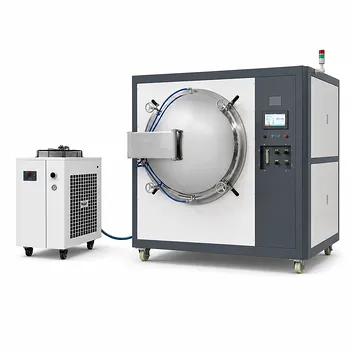
A high vacuum environment is strictly necessary because titanium and aluminum are chemically reactive metals that will instantly form stable oxide layers or brittle compounds if exposed to oxygen or nitrogen at high temperatures. The vacuum environment removes residual gases and prevents these reactions, ensuring the clean metal-to-metal contact required to achieve a strong metallurgical bond.
Core Insight A vacuum environment in hot pressing is not merely about keeping the chamber clean; it is a thermodynamic prerequisite for bonding. By eliminating oxide barriers, the vacuum enables solid-state atomic diffusion, allowing the distinct metal layers to fuse into a unified, high-performance composite.
The Chemical Challenge of Ti/Al Composites
High-Temperature Reactivity
Titanium and aluminum possess a high affinity for oxygen and nitrogen. As the temperature within the furnace rises to the levels required for processing (often around 1000°C), the reactivity of these metals increases exponentially.
The Problem with Oxide Layers
Without a vacuum, trace amounts of air will cause oxidation on the surface of the metal foils or powders. These oxide layers are chemically stable and act as a ceramic barrier between the metal interfaces.
Prevention of Embrittlement
Titanium alloys are particularly susceptible to reacting with interstitial elements like oxygen. This reaction does not just affect the surface; it can lead to material embrittlement, significantly degrading the ductility and fracture toughness of the final composite.
The Role of Vacuum in Bonding Mechanics
Enabling Atomic Diffusion
The primary goal of Vacuum Hot Pressing (VHP) is to induce solid-state diffusion. For the titanium and aluminum atoms to migrate across the boundary and form beneficial reinforcement phases (such as pure Al3Ti), the interface must be atomically clean.
Achieving Metallurgical Bonding
A vacuum level of approximately 10^-3 Pa effectively removes the physical barriers between layers. This direct contact allows the high pressure and temperature to fuse the materials, transforming a stack of foils or powders into a dense, monolithic structure.
Desorption of Impurities
Beyond preventing new oxidation, the vacuum actively cleans the raw materials. It removes moisture and gases that are naturally adsorbed on the surface of powder particles or metal foils before the heating phase seals them inside the composite.
Consequences of Insufficient Vacuum
Weak Interface Strength
If the vacuum is insufficient (e.g., higher than 10^-2 Pa or leaking), oxide layers will persist at the interface. This results in a weak mechanical bond, leading to delamination or failure under stress.
Formation of Defect Zones
Contaminants trapped at the interface effectively become pores or crack initiation sites. In a high-quality composite, the matrix must flow to fill all voids; oxidation prevents this flow and inhibits full densification.
Making the Right Choice for Your Goal
To maximize the performance of your Titanium-Aluminum composites, consider how the vacuum level correlates with your specific manufacturing objectives:
- If your primary focus is Interfacial Strength: Ensure your vacuum system can maintain at least 10^-3 Pa to guarantee the removal of oxide barriers, which facilitates the solid-state diffusion necessary for robust bonding.
- If your primary focus is Material Ductility: Prioritize the elimination of residual leaks to prevent oxygen embrittlement of the titanium matrix, which destroys the material's toughness.
The vacuum environment is the invisible tool that transforms reactive raw powders into a unified, structural component.
Summary Table:
| Requirement | Purpose in Ti/Al Composite Manufacturing | Benefit to Final Material |
|---|---|---|
| High Vacuum (10⁻³ Pa) | Removes residual O₂ and N₂ to prevent surface oxidation. | Ensures clean metal-to-metal contact for bonding. |
| High Temperature | Increases atomic mobility and facilitates solid-state diffusion. | Enables the formation of dense reinforcement phases. |
| Uniaxial Pressure | Eliminates voids and forces the matrix to flow into gaps. | Achieves full densification and prevents porosity. |
| Impurity Desorption | Removes moisture and adsorbed gases from foils or powders. | Prevents crack initiation sites and delamination. |
Elevate Your Material Research with KINTEK Precision
Manufacturing high-performance Titanium-Aluminum composites requires absolute control over atmospheric purity and thermal pressure. KINTEK specializes in advanced Vacuum Hot Pressing furnaces and high-temperature systems designed to meet the rigorous demands of aerospace and industrial research.
From high-temperature furnaces (muffle, tube, vacuum, CVD) to isostatic hydraulic presses and crushing systems, we provide the end-to-end laboratory equipment and consumables (crucibles, ceramics, and PTFE) necessary for cutting-edge metallurgy.
Ready to achieve superior bonding and material density? Contact our technical experts today to find the perfect vacuum solutions for your laboratory's needs!
Related Products
- Vacuum Hot Press Furnace Heated Vacuum Press Machine Tube Furnace
- 600T Vacuum Induction Hot Press Furnace for Heat Treat and Sintering
- Vacuum Hot Press Furnace Machine Heated Vacuum Press
- Vacuum Hot Press Furnace Machine for Lamination and Heating
- Vacuum Heat Treat and Pressure Sintering Furnace for High Temperature Applications
People Also Ask
- What advantages does a vacuum hot press furnace provide for LSLBO ceramic electrolytes? Achieve 94% Relative Density
- What role does a Vacuum Hot Press (VHP) furnace play in the densification of austenitic stainless steel 316 composites?
- What are the advantages of using a vacuum hot pressing furnace? Superior Densification for 2024Al/Gr/SiC Composites
- What are the advantages of a vacuum hot press furnace for LTPO solid electrolytes? Boost Density and Conductivity
- What core processing conditions does a vacuum hot press furnace provide? Achieve High-Density Cu-SiC/Diamond Composites