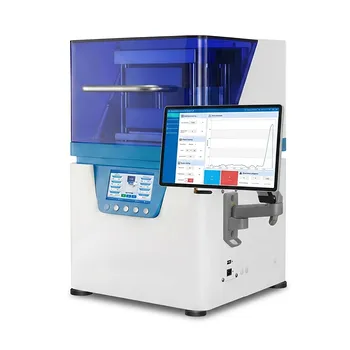
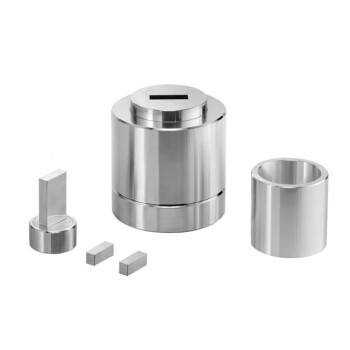
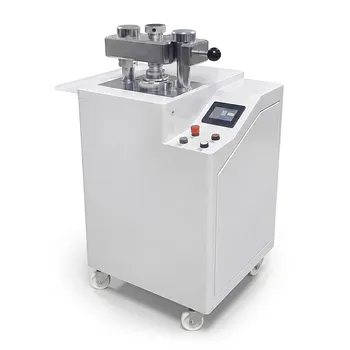
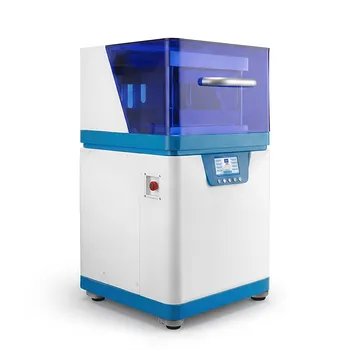
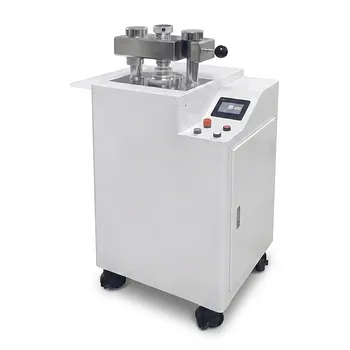
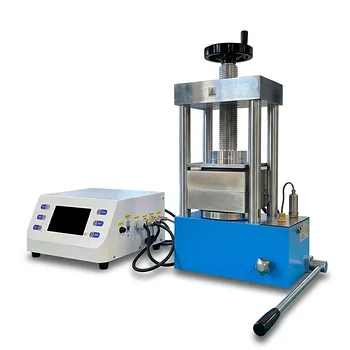
The laboratory hydraulic press is a critical instrument in the synthesis of $K_2ZnV_2O_7$ ceramics because it transforms loose, pre-calcined powder into a cohesive "green body." By applying high tonnage pressure within a mold, the press minimizes the gaps between particles and maximizes the contact area necessary for solid-state reactions. This mechanical consolidation is essential for accelerating mass transfer during the 600 °C sintering process, ultimately resulting in a dense ceramic with stable electrical properties.
Core Takeaway: A laboratory hydraulic press provides the mechanical force required to overcome particle repulsion and void space in $K_2ZnV_2O_7$ powders. This ensures high-density packing, which is the foundational requirement for efficient ion diffusion and structural integrity during subsequent thermal treatments.
The Role of Compaction in Solid-State Reactions
Maximizing Inter-Particle Contact Area
In the production of $K_2ZnV_2O_7$, the raw material is often a finely ground powder that contains significant air gaps. High-pressure compaction forces these particles into intimate contact, creating a large solid-solid interface. This increased contact area is vital because the chemical reactions occurring at 600 °C rely on the movement of ions across these particle boundaries.
Accelerating Reaction Kinetics
The speed of a solid-state reaction is largely governed by the diffusion distance between reactant particles. By using a hydraulic press to achieve high-density pellets, you significantly shorten the distance ions must travel to interact. This leads to more efficient mass transfer and helps in the formation of a well-crystallized ceramic structure in less time.
Reducing Porosity and Voids
Uncompressed powders contain large internal pores that can act as barriers to both heat and ion transport. Mechanical compaction reduces these voids to sub-micrometer levels, which is crucial for achieving high theoretical density. In electronic ceramics like $K_2ZnV_2O_7$, low porosity is mandatory to ensure predictable and stable electrical performance.
Ensuring Structural Integrity and Dimensional Stability
Forming the "Green Body"
The term "green body" refers to the compacted ceramic sample before it has been fired in a furnace. The hydraulic press provides the structural integrity needed for the sample to be handled and moved without crumbling. Precise pressure control ensures that the pellet maintains a specific geometric shape, such as a disk or cylinder, throughout the process.
Controlling Sintering Shrinkage
Ceramics naturally shrink during the high-temperature sintering phase as particles fuse together. If the initial packing density is low or uneven, this shrinkage can lead to warping, cracking, or dimensional deviations. Using a high-tonnage press ensures a uniform initial arrangement, which minimizes internal stresses and results in a more predictable final product.
Enhancing Surface Quality
For applications involving electrical measurements or laser-based analysis, a flat and smooth surface is required. The directional pressure of a hydraulic press, combined with polished mold surfaces, produces a highly uniform sample face. This level of precision is difficult to achieve through traditional casting or manual pressing methods.
Understanding the Trade-offs
Pressure Limits and Material Deformation
While higher pressure generally leads to higher density, there is a point of diminishing returns. Excessive pressure can cause "spring-back" or internal laminations, where the pellet cracks horizontally upon being released from the mold. It is critical to determine the specific tonnage required for $K_2ZnV_2O_7$ to avoid over-stressing the material structure.
Mold Wear and Contamination
The high forces required to compact ceramic powders can cause significant wear on the steel or tungsten carbide molds. Particle abrasion over time may introduce trace metallic contaminants into the $K_2ZnV_2O_7$ sample. Maintaining clean, high-quality tooling is an ongoing operational requirement when using hydraulic presses.
Density Gradients
Pressure is not always distributed perfectly within a deep mold, which can lead to density gradients where the top of the pellet is denser than the middle. This non-uniformity can cause uneven shrinkage during sintering. Using double-action pressing or lubricants can mitigate this, but it adds complexity to the preparation process.
How to Apply This to Your Project
Recommendations for Pressing $K_2ZnV_2O_7$
The success of your ceramic synthesis depends on matching your pressing technique to your final performance goals.
- If your primary focus is electrical stability: Use a high-tonnage press to achieve the lowest possible porosity, as voids directly interfere with ionic conductivity and dielectric properties.
- If your primary focus is dimensional precision: Ensure you use a hydraulic press with a calibrated gauge to apply the exact same pressure across all samples, minimizing variations in sintering shrinkage.
- If your primary focus is structural integrity for analysis: Focus on the "dwell time" (how long the pressure is held) to allow the powder particles to settle into a stable, high-density arrangement that won't crack during handling.
Ultimately, the laboratory hydraulic press is the bridge between a raw chemical mixture and a functional, high-performance ceramic component.
Summary Table:
| Key Role | Benefit for K2ZnV2O7 Ceramics |
|---|---|
| Compaction | Maximizes particle contact for efficient solid-state reactions. |
| Diffusion | Shortens ion travel distance to accelerate 600 °C sintering. |
| Density | Minimizes voids/porosity to stabilize electrical properties. |
| Integrity | Forms a durable "green body" that resists cracking and warping. |
| Surface Quality | Produces uniform, smooth faces for precise electrical analysis. |
Optimize Your Ceramic Synthesis with KINTEK Precision
Achieving the perfect $K_2ZnV_2O_7$ pellet requires more than just pressure—it requires precision and reliability. KINTEK specializes in high-performance laboratory equipment designed for advanced material science. Whether you need high-tonnage hydraulic presses (pellet, hot, or isostatic) for dense sample preparation or high-temperature muffle and tube furnaces for expert sintering, we provide the tools to ensure your research is reproducible and accurate.
Our portfolio also features crushing and milling systems, high-purity ceramic crucibles, and essential laboratory consumables. Let our experts help you select the ideal setup for your specific material requirements.
Ready to enhance your lab's efficiency and sample quality? Contact KINTEK today!
References
- Huina Wei, Jungu Xu. Thermally Induced Oxygen Vacancies and High Oxide Ion Conduction in K<sub>2</sub>ZnV<sub>2</sub>O<sub>7</sub> with a Melilite-Related Structure. DOI: 10.1021/acsmaterialsau.3c00022
This article is also based on technical information from Kintek Solution Knowledge Base .
Related Products
- Automatic Laboratory Hydraulic Pellet Press Machine for Lab Use
- Automatic Laboratory Hydraulic Press for XRF & KBR Pellet Press
- kbr pellet press 2t
- Laboratory Manual Hydraulic Pellet Press for Lab Use
- Laboratory Hydraulic Pellet Press for XRF KBR FTIR Lab Applications
People Also Ask
- What is the role of a laboratory hydraulic pellet press and stainless steel molds in the fabrication of RuO2/NbC anodes?
- What role does a laboratory pellet press play in the enhancement of biomass energy products? Optimize Fuel Efficiency
- What is the purpose of using a laboratory pellet press when evaluating the electronic conductivity of carbon powders? Guide
- How does a laboratory hydraulic pellet press contribute to SiCw/2024 aluminum composite preforms? Optimize Densification
- What is the significance of applying 200 MPa of pressure with a laboratory hydraulic pellet press for composite ceramics?