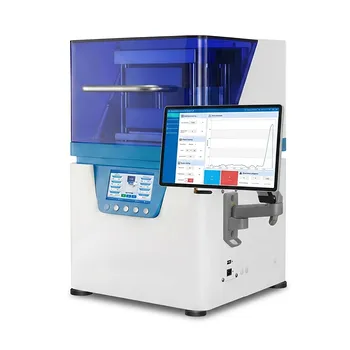
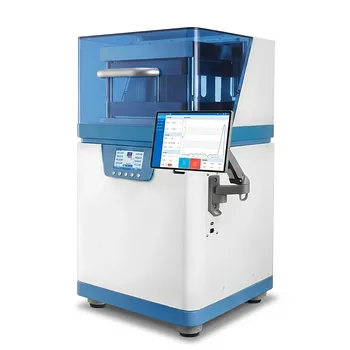
The laboratory hydraulic press is the critical tool for ensuring mechanical and electrical integration in electrode fabrication.
By applying precise, uniform pressure to a mixture of active materials, conductive agents, and binders, the press bonds the material layer onto a current collector like nickel foam or stainless steel mesh. This physical compression minimizes interfacial contact resistance, facilitating the rapid electron transport necessary for high-performance supercapacitors.
A laboratory hydraulic press transforms a loose slurry or powder into a functional electrode by maximizing the physical and electrical contact between the active material and the current collector. This process is essential for reducing internal resistance and ensuring the electrode remains stable during high-rate cycling.
Minimizing Electrical and Ion Transport Resistance
Reducing Interfacial Contact Resistance
The primary function of the hydraulic press is to establish ohmic contact between the active material and the conductive substrate. Without high-pressure compression (typically ranging from 10 to 30 MPa), gaps at the interface create significant resistance that hinders electron flow.
Enhancing Charge Transfer Efficiency
By tightly packing the conductive carbon black and active particles, the press creates a continuous path for charge carriers. This optimization leads to higher rate performance, allowing the supercapacitor to charge and discharge efficiently under high current densities.
Lowering Ion Transport Impedance
Uniform compression ensures that the active material is well-distributed and maintains a consistent internal structure. This organization reduces the impedance for ion transport within the electrode, which is vital for achieving the theoretical capacitance of the material.
Ensuring Mechanical Adhesion and Structural Integrity
Strengthening Mechanical Bonding
The high mechanical pressure forces the active material into the pores of current collectors like nickel foam. This deep integration prevents the material from delaminating or "shedding" during subsequent handling or electrochemical testing.
Resistance to Electrolyte Degradation
During operation, electrodes are submerged in corrosive electrolytes and undergo physical stress during ion intercalation. A pressed electrode possesses the structural strength required to maintain its integrity throughout thousands of charge-discharge cycles.
Achieving Powder Rearrangement
In dry powder methods, pressures as high as 80 MPa cause particles to rearrange and bond through physical interlocking. This results in a self-supporting electrode sheet with sufficient mechanical durability for rigorous laboratory analysis.
Precise Control of Physical Electrode Properties
Regulating Electrode Thickness
The hydraulic press allows researchers to control the final thickness of the electrode layer, often aiming for specific targets like 30 μm. Precise thickness control is necessary for calculating volumetric energy density and ensuring reproducibility across different samples.
Ensuring Uniformity Across the Surface
Manual application of materials often leads to "hot spots" or uneven loading, which skews test results. The hydraulic press provides a uniform force distribution, ensuring that the entire surface area of the current collector contributes equally to the electrochemical reaction.
Understanding the Trade-offs and Pitfalls
The Risk of Over-Compression
While high pressure reduces resistance, excessive force can crush the porous structure of the active material or the current collector itself. If the porosity is lost, the electrolyte cannot penetrate the electrode, leading to a significant drop in accessible surface area and capacitance.
Inconsistent Pressure Application
Using a press without precise gauge control or failing to maintain pressure for a set duration can lead to inconsistent electrode density. These variations make it difficult to isolate the performance of the active material from the effects of the fabrication process.
How to Apply This to Your Fabrication Process
When integrating a hydraulic press into your electrode preparation workflow, align your pressure settings with your specific material requirements:
- If your primary focus is high-rate power performance: Prioritize higher pressures (e.g., 25–30 MPa) to minimize contact resistance and maximize electron transfer speed.
- If your primary focus is maximum energy density: Use moderate pressure (e.g., 10 MPa) to preserve the internal porosity of the active material, ensuring the electrolyte can access all available storage sites.
- If your primary focus is long-term cycling stability: Ensure a consistent "dwell time" under pressure to maximize the mechanical interlocking between the binder and the current collector mesh.
Precise mechanical compression is not merely a final step, but a fundamental requirement for translating material science into a high-performance energy storage device.
Summary Table:
| Key Function | Benefit to Electrode | Recommended Action/Pressure |
|---|---|---|
| Interfacial Compression | Reduces ohmic contact resistance | Apply 10–30 MPa for optimal electron transport |
| Mechanical Bonding | Prevents material delamination | Ensure deep integration into current collector pores |
| Thickness Regulation | Standardizes volumetric energy density | Target specific levels (e.g., 30 μm) for consistency |
| Structural Integrity | Improves cycling life and stability | Maintain consistent dwell time during pressing |
| Powder Rearrangement | Creates self-supporting dry electrodes | Higher pressures (up to 80 MPa) for dry methods |
Elevate Your Energy Storage Research with KINTEK Precision
Achieving the theoretical capacitance of your materials requires more than just a good recipe—it demands precise mechanical execution. KINTEK specializes in high-quality laboratory equipment tailored for advanced material science, including a comprehensive range of laboratory hydraulic presses (manual, electric, and isostatic) designed to ensure uniform electrode density and superior conductivity.
Beyond electrode fabrication, our portfolio supports your entire workflow with:
- High-Temperature Furnaces: Muffle, tube, and vacuum furnaces for material synthesis.
- Advanced Reactors: High-temperature high-pressure reactors and autoclaves.
- Milling & Sizing: Crushing, milling systems, and sieving equipment for powder preparation.
- Battery Research Tools: Specialized consumables, electrolytic cells, and electrodes.
Don’t let inconsistent fabrication hinder your breakthroughs. Contact KINTEK today to discover how our precision tools can enhance your lab's efficiency and ensure the structural integrity of your high-performance supercapacitors.
References
- Peizhi Fan, Lan Xu. Core–Shell Structured Carbon Nanofiber-Based Electrodes for High-Performance Supercapacitors. DOI: 10.3390/molecules28124571
This article is also based on technical information from Kintek Solution Knowledge Base .
Related Products
- Laboratory Hydraulic Press Split Electric Lab Pellet Press
- Laboratory Hydraulic Press Lab Pellet Press Machine for Glove Box
- Laboratory Hydraulic Press Lab Pellet Press for Button Battery
- Automatic Laboratory Hydraulic Pellet Press Machine for Lab Use
- Fully Automatic Heated Hydraulic Lab Press for Materials Sintering and Sample Preparation
People Also Ask
- What are the roles of a laboratory hydraulic press and stainless steel molds in the preparation of graphite samples?
- What is the role of a laboratory hydraulic press in electrode prep? Maximize Energy Density & Sealing Precision
- How does a laboratory hydraulic press ensure the quality of alumina-forming alloy green bodies? Optimize CSP Research
- How is a laboratory hydraulic press used to evaluate the mechanical performance of nano-modified concrete? Expert Guide
- Why is a laboratory hydraulic press used for ASSB assembly? Achieving 392 MPa for Optimal Solid-State Battery Density