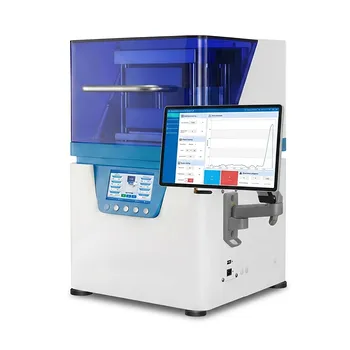
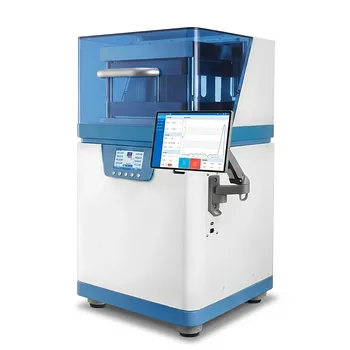
A laboratory hydraulic press is essential for optimizing atomic diffusion during the synthesis of $\text{Na}_2\text{Ga}_7$. By compressing powdered $\text{NaGa}_4$ and $\text{Na}7\text{Ga}{13}$ precursors into high-density "green bodies," the press maximizes the contact area between different phase particles. This physical proximity significantly increases the reaction rate and ensures high phase purity during the solid-state disproportionation process at 300 °C.
The primary role of the hydraulic press is to transform loose precursors into a dense, interconnected solid that facilitates rapid chemical conversion. By minimizing the physical distance between atoms, the press allows the disproportionation reaction to proceed efficiently and uniformly.
Enhancing Solid-State Reaction Kinetics
Maximizing Inter-Phase Contact Area
In solid-state chemistry, reactions occur at the interfaces where different particles touch. Loose powders have high porosity and limited contact points, which act as bottlenecks for chemical transformation.
The hydraulic press applies uniaxial pressure to force $\text{NaGa}_4$ and $\text{Na}7\text{Ga}{13}$ particles together. This eliminates air gaps and creates a continuous physical environment necessary for the precursors to interact.
Accelerating Atomic Diffusion
The disproportionation of precursors into $\text{Na}_2\text{Ga}_7$ is a diffusion-controlled process. Atoms must migrate across phase boundaries to reorganize into the new crystal structure.
By creating a high-density green body, the press shortens the diffusion distance that atoms must travel. At the operating temperature of 300 °C, this proximity allows for a much faster reaction rate than would be possible in a loose powder mixture.
Achieving High Phase Purity
Incomplete reactions often result from localized areas where precursors were not in sufficient contact. This leads to residual "unreacted" phases that contaminate the final product.
The uniform compression provided by the press ensures that the stoichiometric mixture is consistent throughout the sample. This uniformity is critical for achieving the high phase purity required for accurate physical property testing of $\text{Na}_2\text{Ga}_7$.
Structural Integrity and Experimental Consistency
Mechanical Strength of Green Bodies
Compaction facilitates particle rearrangement and mechanical interlocking. This gives the resulting green body enough structural integrity to be handled and moved into a furnace without crumbling.
Without this "green strength," the sample could lose its shape or density during the loading process. Maintaining a stable morphology is vital for consistent heat distribution during the subsequent heating phase.
Improving Data Reproducibility
A hydraulic press allows for the application of precise, quantifiable pressure (such as 10 MPa) to every sample. This standardization eliminates variations in pore distribution and density between different experimental runs.
Ensuring a consistent sample density is a prerequisite for reproducible scientific data. This allows researchers to attribute changes in results to chemical variables rather than physical inconsistencies in the sample preparation.
Understanding the Trade-offs
Risks of Non-Uniform Density
While a hydraulic press improves density, friction between the powder and the mold walls can sometimes create density gradients. The center of the green body may be less dense than the edges, potentially leading to uneven reaction rates.
The Danger of Over-Pressurization
Applying excessive pressure can lead to lamination or internal cracking when the pressure is released. These micro-cracks increase the diffusion distance and can cause the green body to fail during the high-temperature reaction phase.
Contamination Concerns
The use of steel molds and plungers introduces a small risk of surface contamination. Researchers must ensure that molds are highly polished and cleaned to prevent foreign metallic particles from entering the $\text{Na}_2\text{Ga}_7$ precursor mixture.
How to Apply This to Your Synthesis
Making the Right Choice for Your Goal
- If your primary focus is Phase Purity: Use the hydraulic press to ensure maximum contact between $\text{NaGa}_4$ and $\text{Na}7\text{Ga}{13}$, as this prevents unreacted precursors from remaining in the final sample.
- If your primary focus is Kinetic Efficiency: Prioritize high-density compaction to minimize the time required for the disproportionation reaction at 300 °C.
- If your primary focus is Structural Stability: Ensure the pressure applied is sufficient to achieve mechanical interlocking, allowing the green body to survive the transition from the press to the reaction tube.
Proper compaction via a laboratory hydraulic press is the foundational step that ensures the physical environment is optimized for the chemical synthesis of $\text{Na}_2\text{Ga}_7$.
Summary Table:
| Key Benefit | Mechanism | Impact on Synthesis |
|---|---|---|
| Atomic Diffusion | Minimizes distance between particles | Accelerates reaction rates at 300 °C |
| Phase Purity | Maximizes inter-phase contact area | Eliminates unreacted precursor phases |
| Structural Strength | Particle interlocking & rearrangement | Ensures stable morphology during heating |
| Consistency | Quantifiable, standardized pressure | Improves data reproducibility and accuracy |
Elevate Your Material Synthesis with KINTEK Precision
Achieving high phase purity in complex reactions like Na2Ga7 preparation requires more than just chemistry—it requires physical precision. KINTEK specializes in high-performance laboratory equipment designed to optimize your workflow. From manual and automated hydraulic pellet presses that ensure uniform green body density to high-temperature muffle and vacuum furnaces for precise thermal treatment, we provide the tools necessary for groundbreaking research.
Our comprehensive portfolio also includes:
- Crushing and milling systems for perfect precursor blending.
- High-pressure reactors and autoclaves for advanced synthesis.
- Specialized consumables including alumina ceramics and crucibles.
Ready to improve your experimental consistency and kinetic efficiency? Contact KINTEK today to discover how our tailored laboratory solutions can support your next scientific breakthrough.
References
- C. F. Yu, Yuri Grin. Na<sub>2</sub>Ga<sub>7</sub>: A Zintl–Wade Phase Related to “α-Tetragonal Boron”. DOI: 10.1021/acs.inorgchem.3c00790
This article is also based on technical information from Kintek Solution Knowledge Base .
Related Products
- Laboratory Hydraulic Press Split Electric Lab Pellet Press
- Laboratory Hydraulic Press Lab Pellet Press Machine for Glove Box
- Laboratory Hydraulic Press Lab Pellet Press for Button Battery
- Automatic Laboratory Hydraulic Pellet Press Machine for Lab Use
- Fully Automatic Heated Hydraulic Lab Press for Materials Sintering and Sample Preparation
People Also Ask
- What role does a laboratory hydraulic press play in platinum recovery research? Enhancing Sample Precision
- What are the specific applications of a lab hydraulic press in biochar evaluation? Optimize density and data accuracy.
- What are the roles of a laboratory hydraulic press and stainless steel molds in the preparation of graphite samples?
- What is the role of a laboratory hydraulic press in electrode prep? Maximize Energy Density & Sealing Precision
- Why must a laboratory hydraulic press equipped with cylindrical molds be used when preparing BZY green bodies? High Density