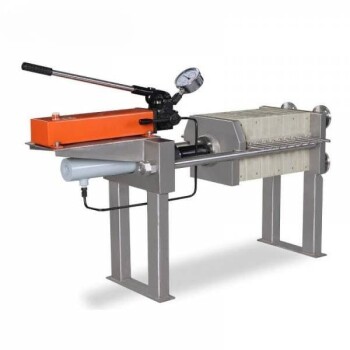
A laboratory hydraulic press is the fundamental tool used to transform loose elemental powders into coherent, dense solids known as "green bodies." By compressing these mixed powders into pellets or briquettes with specific strength and density, the press creates a stable charge or electrode morphology essential for successful vacuum arc melting.
The primary purpose of this pressing stage is to ensure the material serves as a conductive, mechanically stable unit. Without this compaction, the loose powders would fail to maintain the necessary electrical continuity and heat concentration required for uniform alloy formation.
The Critical Link to Vacuum Arc Melting
The hydraulic press is not merely a shaping tool; it is a preparatory device that directly influences the stability of the melting process.
Creating a Stable Electrode
In processes like vacuum arc melting, the raw material often acts as the electrode itself. The hydraulic press compacts loose powders into a rigid, geometric form that can withstand handling and loading.
This structural integrity prevents the material from crumbling during the experimental setup. It ensures the charge maintains its shape, simplifying the loading process and facilitating smoother experimental operations.
Ensuring Electrical Continuity
Loose powders are poor conductors of electricity due to the air gaps between particles. The press forces particles into tight mechanical contact, creating a continuous path for electrical current.
During the initial stages of arc melting, this continuity allows the current to pass stably through the material. This stability prevents erratic arcing and ensures the energy is directed efficiently into melting the alloy components.
Concentrating Heat Distribution
Uniform density leads to uniform heating. By compressing the powder into a dense pellet, the press ensures that thermal energy is concentrated and distributed evenly throughout the charge.
This is vital for refractory alloys, which often contain high-melting-point elements. Proper compaction facilitates the rapid and uniform melting of all components, such as Iron, Chromium, Aluminum, and Silicon mixtures.
The Physics of Compaction
To understand why the press is effective, one must look at the microscopic changes occurring within the powder mixture.
Mechanical Interlocking and Plastic Deformation
The press applies precise uniaxial or isostatic pressure, forcing powder particles to overcome friction and rearrange. At higher pressures (e.g., 400 MPa), particles undergo plastic deformation and mechanical interlocking.
This physical bonding provides "green strength"—the ability of the compacted powder to hold its shape without a binder before any heating occurs.
Expulsion of Air and Porosity Reduction
A critical function of the press is the expulsion of air trapped between powder particles.
By minimizing internal porosity, the press increases the "green density" of the body. Reducing these gaps is decisive for preventing oxidation and ensuring that subsequent processing steps, whether melting or sintering, result in a high-density structure.
Understanding the Trade-offs
While hydraulic pressing is essential, it requires precision to be effective.
The Necessity of Precise Pressure Control
Applying pressure is not enough; the press must offer precise pressure-holding functionality. If the pressure is released too quickly or is insufficient, air may remain trapped, leading to low density or structural weakness.
Balancing Density and Geometry
The goal is to achieve a specific density, but this must be balanced with the geometry of the die. Inconsistent pressure distribution can lead to density gradients within the green body. This can cause the electrode to warp or crack, disrupting the current flow during the subsequent melting phase.
Making the Right Choice for Your Goal
The utility of the hydraulic press depends on the specific requirements of your alloy production process.
- If your primary focus is Process Stability: Prioritize achieving high green strength to ensure the electrode maintains electrical continuity and prevents arc instability during melting.
- If your primary focus is Material Purity: Focus on the press's ability to maximize air expulsion to minimize porosity and reduce the risk of oxidation or contamination between particles.
The laboratory hydraulic press converts a chaotic mixture of powders into a disciplined, conductive solid, laying the foundation for a successful and uniform melt.
Summary Table:
| Feature | Role in Green Body Forming | Impact on Refractory Alloy Production |
|---|---|---|
| Powder Compaction | Expels air and reduces porosity | Minimizes oxidation and ensures high-density structures |
| Electrical Continuity | Creates tight mechanical contact | Enables stable vacuum arc melting without erratic arcing |
| Structural Integrity | Provides "Green Strength" | Prevents crumbling and ensures a stable charge/electrode |
| Uniform Density | Facilitates even heat distribution | Ensures rapid, uniform melting of high-melting-point components |
| Pressure Control | Precise uniaxial/isostatic force | Prevents warping and ensures consistent material geometry |
Elevate Your Materials Research with KINTEK Precision
Maximize the success of your refractory alloy production with KINTEK’s high-performance laboratory hydraulic presses. From pellet and hot presses to advanced isostatic systems, our equipment is designed to deliver the precise pressure and stability required for superior green body formation.
Why choose KINTEK?
- Comprehensive Range: We specialize in laboratory solutions including high-temperature furnaces (CVD, vacuum, dental), crushing and milling systems, and high-pressure reactors.
- Precision Control: Our hydraulic presses ensure optimal density and electrical continuity for your electrodes.
- Total Lab Support: We provide everything from battery research tools and cooling solutions to essential PTFE and ceramic consumables.
Ready to optimize your melting and sintering processes? Contact us today to find the perfect hydraulic press for your lab!
References
- Prashant Singh, Duane D. Johnson. Design of high-strength refractory complex solid-solution alloys. DOI: 10.1038/s41524-018-0072-0
This article is also based on technical information from Kintek Solution Knowledge Base .
Related Products
- Laboratory Hydraulic Press Lab Pellet Press Machine for Glove Box
- Laboratory Hydraulic Press Split Electric Lab Pellet Press
- Laboratory Hydraulic Press Lab Pellet Press for Button Battery
- Automatic Laboratory Hydraulic Press for XRF & KBR Pellet Press
- Automatic Laboratory Hydraulic Pellet Press Machine for Lab Use
People Also Ask
- What is the function of a laboratory hydraulic press in W-Cu composites? Control Porosity and Material Ratio
- What is the role of a laboratory hydraulic press in the initial stages of Li6PS5Cl preparation? Key to Green Pellets
- What role does a laboratory hydraulic press play in triboelectric testing? Achieve Precision Alloy Sample Prep
- How can a laboratory hydraulic press be applied to chitosan for wastewater treatment? Optimize Pores & Strength
- How do a precision laboratory hydraulic press and specialized molds contribute to the fabrication of spherical ceramic samples? Achieving High-Density Material Precision