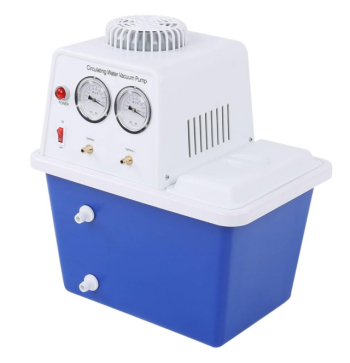
The integration of a vacuum suction system transforms a standard hydraulic press into a specialized tool for moisture-sensitive molding.
This configuration is strictly necessary when processing wet slurries, particularly for thermal insulation materials. It allows for the simultaneous application of mechanical pressure to shape the material and vacuum extraction to remove excess water. This dual action prevents the structural failures common in standard molding processes.
Core Takeaway The vacuum suction system does not just speed up the process; it fundamentally changes the material's stability. By removing water during compression (rather than after), you lock in the fiber alignment and density immediately, preventing the warping and cracking that occur during uneven air drying.
The Mechanics of Simultaneous Molding
Precise Fiber Alignment
The hydraulic press applies a specific, controlled pressure—typically around 1.6 MPa.
This pressure is not just for shaping; it forces the structural alignment of fibrous materials like Tobermorite or Xonotlite.
Proper alignment of these fibers is critical for establishing the mechanical strength of the insulation material.
Real-Time Water Extraction
While the press applies downward force, the vacuum system actively extracts water from the mold in real-time.
This creates a "wet green body" where the solid particles are compacted, but the liquid carrier is largely removed.
This simultaneous action ensures that density increases as water volume decreases, preventing the formation of voids that would occur if water were trapped inside.
Solving the Structural Integrity Challenge
Preventing Deformation and Cracking
Thermal insulation materials are highly susceptible to defects during the drying phase.
If a green body is molded with high water content, subsequent evaporation causes the material to shrink unevenly.
The vacuum press mitigates this by removing the bulk of the water mechanically, significantly reducing the risk of deformation or cracking during final drying.
Ensuring Uniform Pore Structure
Thermal insulation relies on a specific, consistent pore structure to function effectively.
By controlling the water removal rate via vacuum, the equipment produces a body with uniform density.
This prevents density gradients—areas where the material is too dense or too porous—which would compromise both insulation performance and structural stability.
Understanding the Trade-offs
The Limitations of Standard Pressing
Standard hydraulic presses rely solely on overcoming mechanical friction between particles to create density.
In dry powder compaction (common in ceramics and alloys), high pressure (up to 350 MPa) forces particles to rearrange and interlock.
However, for wet insulation mixtures, high pressure alone is insufficient because water is incompressible; without a vacuum exit path, the water acts as a barrier to compaction.
The "Green Strength" Necessity
The ultimate goal of this process is to achieve sufficient "green strength."
This refers to the mechanical integrity required for the molded part to be handled, moved, or sintered without collapsing.
Without the vacuum system, a wet insulation body would likely slump or lose its geometric shape immediately upon ejection from the mold.
Making the Right Choice for Your Goal
- If your primary focus is wet molding fibrous insulation: You must use a vacuum-equipped press to align fibers (Tobermorite/Xonotlite) and prevent drying cracks.
- If your primary focus is dry powder compaction (Ceramics/Metals): A standard high-pressure hydraulic press is superior, as it generates the extreme forces (350+ MPa) needed for particle interlocking.
The vacuum suction system is the critical variable that converts a slurry into a stable solid, bridging the gap between raw liquid mixture and a durable green body.
Summary Table:
| Feature | Vacuum-Equipped Hydraulic Press | Standard Hydraulic Press |
|---|---|---|
| Primary Application | Wet slurries, fibrous insulation materials | Dry powders (Ceramics, Alloys) |
| Pressure Range | Lower (e.g., ~1.6 MPa) | Extremely High (up to 350+ MPa) |
| Moisture Control | Real-time extraction during compression | None (Water remains trapped) |
| Material Integrity | Prevents warping/cracking via even drying | Relies on mechanical particle interlocking |
| Key Outcome | High green strength for wet bodies | High density for dry compacted solids |
Elevate Your Materials Research with KINTEK
Don't let moisture compromise your material integrity. KINTEK specializes in advanced laboratory equipment, including specialized hydraulic presses (pellet, hot, isostatic) and custom vacuum integration for molding thermal insulation materials. Whether you are working with Tobermorite fibers or advanced ceramics, our comprehensive range of crushing and milling systems, high-temperature furnaces, and PTFE consumables ensures consistent, high-quality results.
Ready to optimize your molding process? Contact our technical experts today to find the perfect hydraulic solution for your laboratory’s unique requirements.
References
- R. Šiaučiūnas, Edita Prichockiene. Synthesis of High Crystallinity 1.13 nm Tobermorite and Xonotlite from Natural Rocks, Their Properties and Application for Heat-Resistant Products. DOI: 10.3390/ma15103474
This article is also based on technical information from Kintek Solution Knowledge Base .
Related Products
- Heated Hydraulic Press Machine with Heated Plates for Vacuum Box Laboratory Hot Press
- Heated Hydraulic Press Machine with Heated Plates for Vacuum Box Laboratory Hot Press
- Electric Heated Hydraulic Vacuum Heat Press for Lab
- Laboratory Hydraulic Pellet Press for XRF KBR FTIR Lab Applications
- 30T 40T Split Automatic Heated Hydraulic Press Machine with Heated Plates for Laboratory Hot Press
People Also Ask
- Why is a heated laboratory hydraulic press necessary for composite laminates? Achieve Void-Free Structural Integrity
- Why is the heating function of a laboratory hydraulic press essential for MEA assembly in DEFC? Optimize Cell Bonding
- What are heated hydraulic presses used for? Molding Composites, Vulcanizing Rubber, and More
- How is a heated hydraulic press used for Li-LLZO batteries? Optimize Interfacial Bonding with Thermal-Pressure
- What is the core function of a laboratory heated hydraulic press in CSP? Revolutionize Low-Temp Ceramic Sintering