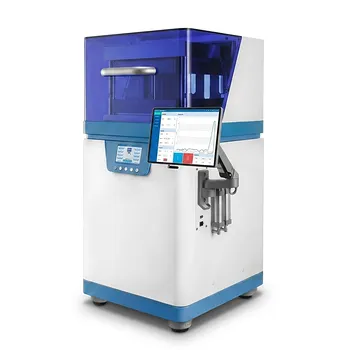
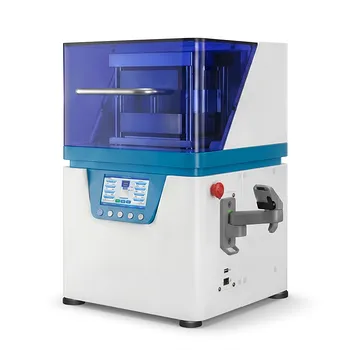
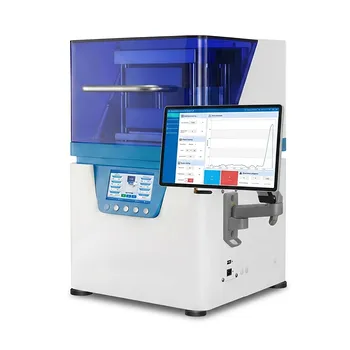
A laboratory press is used to mold H-DRI pellets into compact cylinders primarily to increase the sample's overall thermal mass and simulate the industrial heating characteristics of an Electric Arc Furnace (EAF). This consolidation allows researchers to accurately observe how heat conduction affects the melting process and how autogenous slag is released at the metal-liquid interface when the sample enters a 1923 K molten iron bath.
Using a laboratory press transforms individual, high-porosity H-DRI pellets into a singular, dense volume. This step is critical because it bridges the gap between small-scale laboratory testing and the complex heat transfer dynamics found during the continuous charging of iron into industrial-scale furnaces.
Simulating Industrial Thermal Dynamics
Replicating EAF Charging Conditions
In an industrial Electric Arc Furnace, H-DRI is often charged continuously, creating a localized mass of material that interacts with the molten bath.
By pressing pellets into a cylinder, the laboratory setup mimics this "bulk" behavior, ensuring the sample does not melt instantaneously like a single loose pellet would.
The Role of Increased Thermal Mass
Increasing the thermal mass through compaction ensures that the heat gradient within the sample is realistic.
This allows for a controlled study of how heat conducts from the 1923 K molten bath into the core of the iron sample, which is vital for calculating melting rates.
Enhancing Interface Reactions and Slag Release
Observing Autogenous Slag Release
H-DRI contains gangue materials that form slag during the melting process.
A compacted cylinder provides a stable "metal-liquid interface," making it easier for researchers to observe the autogenous (self-generated) release of slag as the iron melts away.
Maximizing Particle Contact
The high pressure of a laboratory press reduces inter-particle voids and air pockets within the H-DRI sample.
This increased physical contact ensures that chemical reactions between the iron and internal components occur uniformly, preventing the material from stratifying or reacting prematurely.
Optimizing Physical Integrity for Testing
Improving Green Strength
H-DRI pellets can be fragile; pressing them into a cylinder provides the "green strength" necessary for handling and experimental placement.
This ensures the sample remains intact until it makes contact with the molten bath, preventing fragmented data caused by crumbling material.
Reducing Solid-State Diffusion Paths
Compaction significantly shortens the distance between individual iron particles and any residual oxides.
This close contact allows for faster and more uniform solid-state reactions during the heating phase, which more closely resembles the rapid heating found in heavy industrial applications.
Understanding the Trade-offs
Potential for Non-Representative Density
While compaction is necessary for simulation, over-pressing can lead to a density that exceeds what is found in a standard EAF environment.
If the sample is too dense, the inward diffusion of heat may be artificially slowed, or the escape of gases produced during melting could be restricted, leading to sample "bloating" or cracking.
Impact of Mold Geometry
The specific dimensions of the laboratory mold can influence the cooling and heating curves of the sample.
Using a mold that is too thin may prioritize surface reactions, while a mold that is too thick may result in an unreacted core, both of which can skew the data regarding slag release and melting efficiency.
How to Apply This to Your Project
Selecting the Right Preparation Method
The choice to use a laboratory press depends on the specific metrics you need to capture during your simulation.
- If your primary focus is melting kinetics: Use high-tonnage pressing to create a high-density cylinder that allows for precise measurement of heat conduction and melting time.
- If your primary focus is slag chemistry: Ensure the compaction pressure is sufficient to remove air voids, which prevents oxidation that could alter the chemical composition of the autogenous slag.
- If your primary focus is EAF energy efficiency: Use a laboratory press to create samples with varying thermal masses to determine the optimal charging rate for minimizing heat loss in the furnace.
By accurately consolidating H-DRI pellets, you ensure your laboratory results provide a reliable roadmap for optimizing large-scale steel production.
Summary Table:
| Key Objective | Purpose in H-DRI Testing | Impact on Research Accuracy |
|---|---|---|
| Thermal Mass | Increases sample density | Replicates realistic EAF heat conduction rates |
| Bulk Simulation | Mimics continuous charging | Prevents unrepresentative instantaneous melting |
| Slag Observation | Creates stable metal-liquid interface | Allows clear tracking of autogenous slag release |
| Particle Contact | Eliminates internal air voids | Ensures uniform chemical and solid-state reactions |
| Green Strength | Improves structural integrity | Prevents sample crumbling during handling |
Elevate Your Steel Research with KINTEK’s Precision Hydraulic Presses
To bridge the gap between laboratory testing and industrial production, consistent sample preparation is non-negotiable. KINTEK provides a comprehensive range of laboratory hydraulic presses (pellet, hot, and isostatic) engineered to create high-density H-DRI cylinders with the structural integrity your simulations demand.
Beyond compaction, we support your entire thermal processing workflow with high-temperature furnaces (CVD, vacuum, atmosphere), crucibles, and cooling solutions. Partner with KINTEK to achieve the precision and repeatability your research deserves.
Contact our technical team today to optimize your lab setup!
References
- Amanda Vickerfält, Du Sichen. Reaction Mechanisms During Melting of H-DRI Focusing on Slag Formation and the Behavior of Vanadium. DOI: 10.1007/s11663-023-02827-z
This article is also based on technical information from Kintek Solution Knowledge Base .
Related Products
- Laboratory Hydraulic Press Split Electric Lab Pellet Press
- Laboratory Hydraulic Press Lab Pellet Press Machine for Glove Box
- Large Format Automatic Laboratory Hot Press 400x400 Plate for Industrial Material Sintering and Polymer Lamination
- Automatic Laboratory Hot Press Machine with Heated Platens 200x200mm Program Control Dual Heating Plates
- Laboratory Hydraulic Press Lab Pellet Press for Button Battery
People Also Ask
- What are the roles of a laboratory hydraulic press and stainless steel molds in the preparation of graphite samples?
- What is the role of a laboratory hydraulic press in electrode prep? Maximize Energy Density & Sealing Precision
- How does a laboratory hydraulic press ensure the quality of alumina-forming alloy green bodies? Optimize CSP Research
- How is a laboratory hydraulic press used to evaluate the mechanical performance of nano-modified concrete? Expert Guide
- Why is a laboratory hydraulic press used for ASSB assembly? Achieving 392 MPa for Optimal Solid-State Battery Density