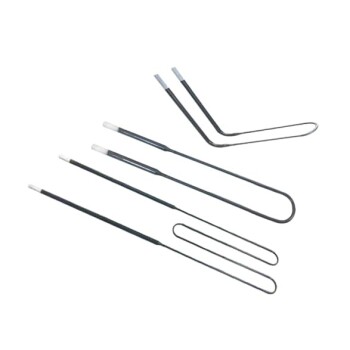
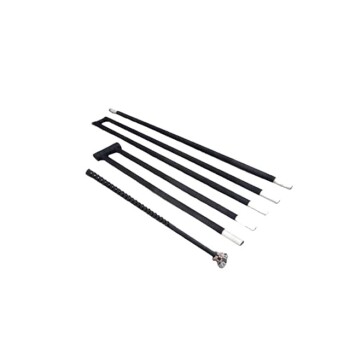
A molybdenum heating furnace serves as a precision preheating instrument designed to regulate the initial temperature of reactant samples in Self-propagating High-temperature Synthesis (SHS) experiments. By elevating the sample temperature above room temperature prior to ignition, this setup allows researchers to control the starting thermal conditions of the TiB2-Al2O3 composite formation.
The furnace leverages molybdenum's exceptional thermal stability to establish specific initial temperature baselines, enabling the isolation of thermal variables to determine their exact impact on reaction speed and process sustainability.
The Role of Material Selection in High-Temperature Synthesis
Leveraging High Melting Points
The primary reason for selecting molybdenum is its extremely high melting point.
In experimental setups involving ceramic composites like TiB2-Al2O3, the heating element must endure intense thermal environments without structural failure. Molybdenum maintains its integrity where other materials might degrade or melt.
Ensuring Thermal Stability
Beyond just resisting melting, the furnace must provide consistent thermal output.
Molybdenum possesses excellent thermal stability at high temperatures. This ensures that the preheating process remains uniform, preventing fluctuations that could skew the experimental data regarding the sample's initial state.
Investigating Reaction Dynamics
Controlling Combustion Wave Propagation
A key objective of using this furnace is to study the combustion wave propagation rate.
By varying the preheating temperature, researchers can observe how faster or slower the synthesis reaction travels through the sample. This data helps map the relationship between initial thermal energy and reaction kinetics.
Determining Process Sustainability
The setup allows for the evaluation of the sustainability of the self-propagating process.
Some SHS reactions may fail to sustain themselves at room temperature. By using the furnace to increase the initial temperature, researchers can identify the specific thermal threshold required to keep the reaction self-sustaining.
Understanding the Operational Logic
The Necessity of Preheating
This specific furnace setup is not merely for heating; it is a tool for variable isolation.
Without the ability to regulate the initial temperature, researchers are limited to room-temperature data points. The molybdenum furnace introduces the "initial temperature" as a controllable variable, essential for a comprehensive understanding of the synthesis mechanism.
Making the Right Choice for Your Goal
When designing experiments for TiB2-Al2O3 composites, the use of a molybdenum furnace allows for specific targeted outcomes:
- If your primary focus is Reaction Kinetics: Use the furnace to incrementally increase preheating temperatures to measure how the combustion wave speed accelerates with added thermal energy.
- If your primary focus is Process Reliability: Use the furnace to identify the minimum preheating temperature required to prevent the reaction from extinguishing mid-process.
This experimental setup transforms temperature from a passive environmental factor into an active, tunable parameter for optimizing composite synthesis.
Summary Table:
| Feature | Role in TiB2-Al2O3 Synthesis |
|---|---|
| High Melting Point | Ensures structural integrity during intense SHS thermal environments. |
| Thermal Stability | Provides uniform preheating to eliminate experimental fluctuations. |
| Variable Control | Allows isolation of the initial temperature to study reaction kinetics. |
| Process Sustainment | Helps identify thermal thresholds for self-propagating synthesis. |
| Kinetics Analysis | Enables precise measurement of combustion wave propagation rates. |
Elevate Your Material Research with KINTEK Precision
Are you looking to master the thermal dynamics of TiB2-Al2O3 composites or advanced ceramic synthesis? KINTEK provides the high-performance laboratory solutions you need to transform temperature from an environmental factor into a tunable parameter.
From molybdenum-element high-temperature furnaces and vacuum/atmosphere systems to our specialized crushing and milling equipment, we offer the complete toolkit for cutting-edge material science. Whether you require precise preheating for SHS experiments, high-pressure reactors, or essential ceramics and crucibles, KINTEK's experts are ready to support your lab's unique requirements.
Maximize your synthesis reliability and reaction kinetics today. Contact us now to discuss your custom setup!
References
- З. А. Мансуров, Nikolay Kochetov. Peculiarities of Self-Propagating High-Temperature Synthesis and Structure Formation of TiB2-Al2O3 and CrB2-Al2O3 Composites. DOI: 10.18321/ectj.80
This article is also based on technical information from Kintek Solution Knowledge Base .
Related Products
- Molybdenum Disilicide (MoSi2) Thermal Elements Electric Furnace Heating Element
- Vacuum Heat Treat and Molybdenum Wire Sintering Furnace for Vacuum Sintering
- Molybdenum Vacuum Heat Treat Furnace
- Molybdenum Tungsten Tantalum Special Shape Evaporation Boat
- Vacuum Heat Treat Furnace with Ceramic Fiber Liner
People Also Ask
- What is the temperature range of molybdenum disilicide heating elements? Choose the Right Grade for Your High-Temp Needs
- What is molybdenum disilicide used for? Powering High-Temperature Furnaces Up to 1800°C
- What is the temperature range of a MoSi2 heating element? Unlock 1900°C Performance for Your Lab
- What is MoSi2 heating element? A High-Temp Solution with Self-Healing Power
- What is the best heating element for a furnace? A Guide to Selecting the Right Material for Your Temperature Needs