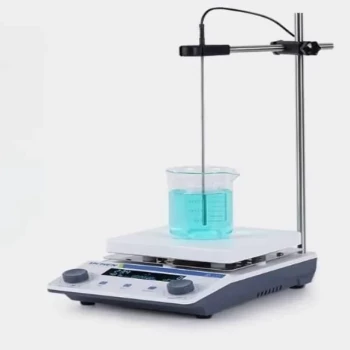
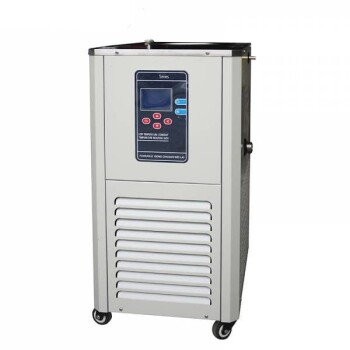
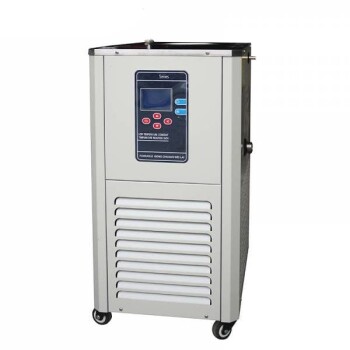
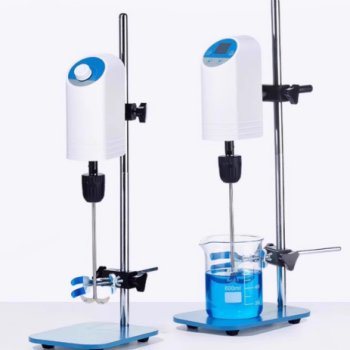
A reaction vessel with constant temperature stirring is the critical infrastructure required to synthesize Dual-Acid Deep Eutectic Solvents (DADES) successfully. It provides the necessary thermal stability and mechanical force to merge distinct hydrogen bond donors and acceptors into a single, cohesive liquid phase.
The combination of specific heat and continuous agitation overcomes the natural dissolution resistance of raw materials. This process forces the components to establish a stable hydrogen bond network, resulting in a transparent and uniform homogeneous liquid.
The Mechanism of Synthesis
Overcoming Dissolution Resistance
The raw materials used to create DADES do not naturally or instantly combine. Continuous mechanical force provided by the stirring device is required to physically break down the barriers between these materials.
This agitation ensures that the components interact frequently and effectively. Without this force, the materials would likely remain separate or mix unevenly.
The Role of Thermal Energy
The reaction vessel creates a controlled environment, typically maintaining a specific temperature such as 60 degrees Celsius. This constant heat provides the energy required to facilitate the physical interactions between components.
If the temperature fluctuates, the reaction may stall or proceed inconsistently. The vessel ensures that thermal energy is distributed evenly throughout the mixture.
Forming the Hydrogen Bond Network
The synthesis of DADES relies on the interaction between hydrogen bond donors (such as boric acid and acetic acid) and acceptors.
The combination of heat and stirring drives these molecules to align correctly. This alignment is necessary to build a robust hydrogen bond network, which is the structural foundation of the solvent.
Achieving Phase Stability
Creating a Homogeneous Liquid
The ultimate goal of this process is to produce a single-phase homogeneous liquid. The stirring device prevents sedimentation or separation during the critical formation phase.
By maintaining constant motion, the vessel ensures that the liquid becomes uniform in composition.
Visual Indicators of Success
When the process is managed correctly, the result is a transparent and stable liquid.
Turbidity or separation would indicate that the hydrogen bond network failed to form completely, likely due to insufficient heat or agitation.
Common Pitfalls to Avoid
Inconsistent Agitation
If the mechanical force is intermittent or too weak, the dissolution resistance will not be fully overcome. This leads to a heterogeneous mixture where raw materials may remain undissolved.
Temperature Variance
Failing to maintain the specific target temperature (e.g., 60 degrees Celsius) disrupts the physical interactions between donors and acceptors. A drop in temperature can halt the formation of the hydrogen bond network, rendering the solvent unstable.
Making the Right Choice for Your Goal
To ensure the successful synthesis of DADES, you must prioritize the precision of your equipment settings.
- If your primary focus is Product Uniformity: Ensure your vessel provides vigorous, continuous stirring to completely eliminate dissolution resistance.
- If your primary focus is Chemical Stability: Verify that the vessel can hold the target temperature (e.g., 60°C) without fluctuation to maintain the hydrogen bond network.
Precision in physical processing is the absolute requirement for transforming raw acids into a stable, transparent eutectic solvent.
Summary Table:
| Feature | Function in DADES Synthesis | Impact on Final Product |
|---|---|---|
| Constant Temperature | Provides thermal energy to facilitate molecular interaction | Ensures stable hydrogen bond network & phase stability |
| Continuous Stirring | Overcomes natural dissolution resistance of raw materials | Achieves a transparent, single-phase homogeneous liquid |
| Controlled Environment | Maintains uniform heat distribution (e.g., 60°C) | Prevents turbidity, sedimentation, or material separation |
Elevate Your Chemical Synthesis with KINTEK Precision
Achieving the perfect homogeneous liquid phase in Dual-Acid Deep Eutectic Solvents (DADES) requires uncompromising control over thermal and mechanical energy. KINTEK specializes in high-performance laboratory equipment designed to meet the rigorous demands of chemical research and material science.
From our precision high-temperature high-pressure reactors and autoclaves to advanced crushing, milling, and stirring systems, we provide the tools necessary to overcome dissolution resistance and stabilize complex hydrogen bond networks. Whether you are focusing on battery research, electrolytic cells, or advanced solvent synthesis, our comprehensive portfolio—including furnaces, cooling solutions, and specialized consumables like PTFE and ceramics—ensures your lab achieves repeatable, high-quality results.
Ready to optimize your DADES synthesis? Contact KINTEK today to discover how our expert solutions can enhance your product uniformity and chemical stability.
References
- Dongao Zhu, Wei Jiang. Designing Inorganic–Organic Dual-Acid Deep Eutectic Solvents for Synergistically Enhanced Extractive and Oxidative Desulfurization. DOI: 10.3390/molecules28237743
This article is also based on technical information from Kintek Solution Knowledge Base .
Related Products
- Laboratory Small Constant Temperature Heated Magnetic Stirrer Heater and Stirrer
- High Temperature Constant Temperature Heating Circulator Water Bath Chiller Circulator for Reaction Bath
- 10L Chilling Circulator Cooling Water Bath Low Temperature Constant Temperature Reaction Bath
- 5L Chilling Circulator Cooling Water Bath Circulator for Low Temperature Constant Temperature Reaction Bath
- 30L Chiller Water Bath Cooling Circulator Low Temperature Constant Temperature Reaction Bath
People Also Ask
- What role does a magnetic stirrer with heating play in ZnO nanoparticle synthesis? Precision Control for Quality Results
- What role does a constant temperature heating magnetic stirrer play in MFC-HAp synthesis? Achieve Material Homogeneity
- What is the function of a laboratory magnetic stirrer in Ni–Cr–P electrodeposition? Optimize Ion Transport & Coating
- Why is a laboratory magnetic stirrer required for benzoic acid esters? Boost Reaction Speed & Yield with High RPM
- What role does a laboratory magnetic stirrer play in TiO2 and TiO2-Ag sol preparation? Master Chemical Kinetics