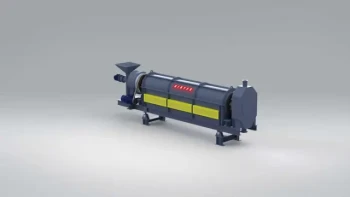
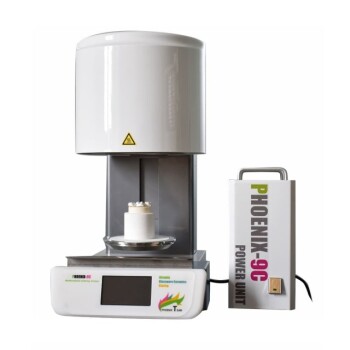
The secondary heat treatment is the defining activation step that transforms your prepared material from a physical mixture into a functional catalyst. After loading silver onto a Ce-Mn oxide carrier, you must introduce the material to a calcination furnace—typically around 573 K—to drive the thermal decomposition of silver nitrate. This process eliminates the precursor compounds and converts the silver into the highly dispersed metallic or oxidized species necessary for catalytic reactions.
This thermal treatment does more than just clean the surface; it engineers the catalyst's atomic structure. By fostering a Strong Metal-Support Interaction (SMSI), this step creates the critical interface required for efficient oxygen transfer and maximum oxidative activity.
The Chemistry of Activation
Breaking Down the Precursor
When you impregnate the support, the silver is deposited as silver nitrate. This is a precursor, not an active catalyst.
The secondary heat treatment provides the thermal energy required to chemically decompose this nitrate.
Creating Active Species
Upon decomposition, the silver is converted into its active forms.
Depending on the specific conditions, this results in highly dispersed metallic or oxidized species. These dispersed sites are where the actual chemical reactions will take place.
Engineering the Microstructure
Strong Metal-Support Interaction (SMSI)
The most critical outcome of the calcination phase is the establishment of the SMSI.
This is not merely physical adhesion; it is a chemical linking between the silver component and the Ce-Mn oxide support.
Enhancing Oxidative Activity
The SMSI directly influences how the catalyst performs.
By strengthening the connection between the metal and the support, the heat treatment facilitates an efficient oxygen transfer mechanism. This mechanism is the primary driver behind the enhanced oxidative activity of the finished catalyst.
Understanding the Stakes
The Cost of Skipping This Step
It is crucial to view this heat treatment as non-negotiable.
If this step is omitted or performed at insufficient temperatures (below 573 K), the silver nitrate will not decompose. Consequently, the Strong Metal-Support Interaction will not form, and the material will lack the oxygen transfer capabilities required for high performance.
Making the Right Choice for Your Goal
To ensure your catalyst performs as intended, apply these principles during the preparation phase:
- If your primary focus is maximizing reaction rates: Ensure the furnace reaches 573 K to fully decompose the nitrate and expose the active silver species.
- If your primary focus is catalyst longevity and efficiency: Prioritize the heat treatment duration to fully establish the Strong Metal-Support Interaction (SMSI) for superior oxygen transfer.
The heat treatment is the bridge between a raw chemical mixture and a high-performance oxidative catalyst.
Summary Table:
| Process Phase | Transformation | Impact on Catalyst |
|---|---|---|
| Precursor Decomposition | Silver Nitrate $\rightarrow$ Active Silver | Removes inactive nitrates; creates active sites |
| Species Dispersion | Agglomerates $\rightarrow$ High Dispersion | Maximizes surface area for chemical reactions |
| Interface Engineering | Physical Mix $\rightarrow$ SMSI | Establishes Strong Metal-Support Interaction |
| Thermal Activation | Ambient $\rightarrow$ 573 K | Drives the oxygen transfer mechanism |
Maximize Your Catalyst Yield with KINTEK Precision
Transitioning from a physical mixture to a high-performance catalyst requires uncompromising thermal accuracy. At KINTEK, we specialize in the advanced laboratory equipment necessary for critical activation steps, including high-temperature muffle and tube furnaces optimized for calcination, as well as high-pressure reactors for advanced synthesis.
Whether you are engineering silver-based catalysts or developing complex Ce-Mn oxide supports, our precision tools ensure the uniform heat distribution required to establish Strong Metal-Support Interaction (SMSI) and perfect oxygen transfer.
Ready to elevate your research efficiency? Contact our laboratory specialists today to find the ideal furnace or processing solution tailored to your specific catalytic applications.
References
- David Alami, V.I. Bulavin. Synthesis and Characterization of Ag/Ce1-xMnxO2-δ Oxidation Catalysts. DOI: 10.9767/bcrec.8.1.4718.83-88
This article is also based on technical information from Kintek Solution Knowledge Base .
Related Products
- Electric Rotary Kiln Pyrolysis Furnace Plant Machine Calciner Small Rotary Kiln Rotating Furnace
- Electric Rotary Kiln Continuous Working Small Rotary Furnace Heating Pyrolysis Plant
- Non Consumable Vacuum Arc Induction Melting Furnace
- Vertical High Temperature Graphite Vacuum Graphitization Furnace
- Ultra-High Temperature Graphite Vacuum Graphitization Furnace
People Also Ask
- What is a rotary kiln electric furnace? Achieve Superior Uniform Heating for Your Materials
- What are the characteristics of the slipping, slumping, and rolling modes of bed motion? Optimize Your Rotary Process
- What are the advantages of rotary kiln furnace? Achieve Superior Uniformity & Efficiency
- What is the temperature of a rotating kiln? It Depends on Your Material and Process Goal
- What are the principles of a rotary kiln? Master the Mechanics of High-Temperature Processing