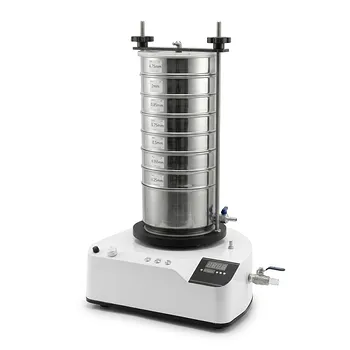
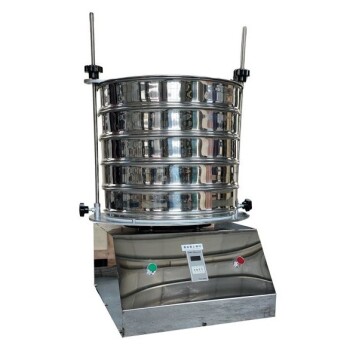
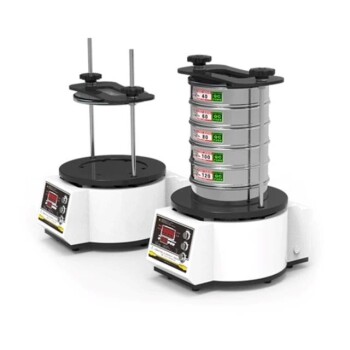
Precision is the prerequisite for reliable material characterization. A standard laboratory sieving system is required to segregate graphite flakes into specific, controlled size ranges prior to composite fabrication. This separation allows you to isolate variables and ensure that the filler material meets exact dimensional specifications.
The use of a standard sieving system is critical for isolating specific mesh components (such as +500 or -30 mesh) to optimize internal packing density and accurately correlate filler dimensions with the thermal conductivity of the final anisotropic composite.
The Necessity of Particle Size Control
Isolating Variables for Research
To understand how a composite material behaves, you must control the input variables. A standard sieving system allows you to separate graphite flakes into distinct groups, such as +500 mesh or -30 mesh.
By isolating these specific components, you remove the noise created by a broad distribution of particle sizes. This creates a controlled environment where the specific effects of flake size can be observed without interference.
Ensuring Consistency
Reliability in material science depends on repeatability. If the graphite filler contains random variations in particle size, the resulting composite will exhibit inconsistent properties.
Sieving ensures that every batch of composite is created using fillers of a consistent, known dimension. This is the only way to validate that changes in performance are due to the material design, not random fluctuations in the raw ingredients.
Optimization of Composite Properties
Impact on Thermal Conductivity
The primary goal in creating anisotropic graphite composites is often to manipulate how heat moves through the material. The dimensions of the graphite fillers directly influence this thermal conductivity.
Sieving allows researchers to select the optimal flake size that promotes the most efficient heat transfer for a specific application. Without this selection process, thermal performance would be unpredictable and likely suboptimal.
Optimizing Packing Density
The physical structure of the composite is determined by how well the fillers fit together, known as internal packing density.
If particles are not sized correctly, large gaps or voids may form within the matrix. By using a sieving system to select the right size distribution, you can maximize how tightly the graphite flakes pack together, improving the overall integrity and density of the mixture.
Understanding the Implications
The Cost of Inconsistency
Skipping the sieving process introduces uncontrolled variables into your formulation. Without defined particle sizes, it becomes impossible to pinpoint why a composite succeeded or failed.
Precision vs. Effort
While sieving adds a step to the preparation process, it is a necessary investment for high-performance materials. The trade-off is a slight increase in preparation time for a massive gain in data reliability and material performance.
Making the Right Choice for Your Goal
To apply this to your project, align your sieving strategy with your end goals:
- If your primary focus is fundamental research: Prioritize sieving to isolate distinct mesh sizes to accurately map the relationship between particle dimension and thermal conductivity.
- If your primary focus is material performance: Use sieving to select the specific particle size range that maximizes internal packing density and structural integrity.
Control the input to guarantee the output.
Summary Table:
| Factor | Impact of Precise Sieving | Benefit to Graphite Composites |
|---|---|---|
| Particle Size | Isolates specific mesh sizes (e.g., +500/-30) | Removes noise and isolates research variables |
| Consistency | Ensures repeatable filler dimensions | Guarantees batch-to-batch material reliability |
| Thermal Conductivity | Enables selection of optimal flake dimensions | Maximizes heat transfer efficiency and predictability |
| Packing Density | Optimizes internal filler distribution | Reduces voids for superior structural integrity |
Elevate Your Material Research with KINTEK Precision
Consistency in particle size is the foundation of high-performance composite engineering. KINTEK specializes in advanced sieving equipment and crushing and milling systems designed to give you total control over your material variables.
Whether you are optimizing thermal conductivity in graphite flakes or developing complex alloys, our comprehensive portfolio—including high-temperature furnaces, hydraulic presses, and PTFE consumables—provides the reliability your laboratory demands.
Ready to achieve superior packing density and data accuracy? Contact our technical experts today to find the perfect sieving and material processing solution for your application.
Related Products
- Laboratory Vibratory Sieve Shaker Machine for Dry and Wet Three-Dimensional Sieving
- Laboratory Test Sieves and Sieving Machines
- Laboratory Vibratory Sieve Shaker Machine Slap Vibrating Sieve
- Laboratory Wet Three-Dimensional Vibratory Sieve Shaker Machine
- Laboratory Test Sieves and Vibratory Sieve Shaker Machine
People Also Ask
- How does a laboratory vibratory sieve shaker facilitate the microstructural study of gas-atomized alloy powders?
- What role does a laboratory vibrating sieve shaker play in the LiFePO4 powder processing workflow? Ensure Batch Quality
- Why use a vibratory sieve shaker for PET powder? Achieve Precise Particle Size Control for Chemical Research
- What is the principle of vibratory sieve shaker? Achieve Accurate Particle Size Analysis
- What is the function of a vibratory sieve shaker? Achieve Precise Particle Size Analysis