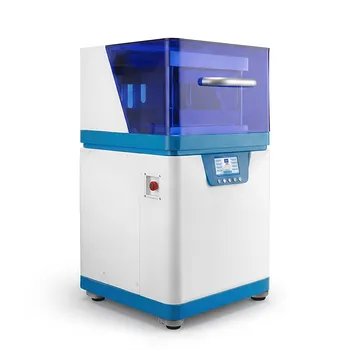
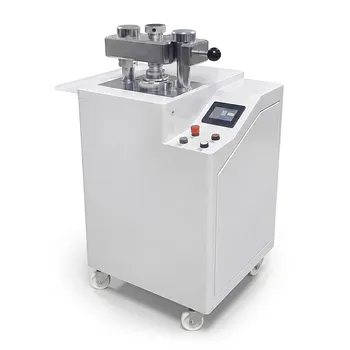
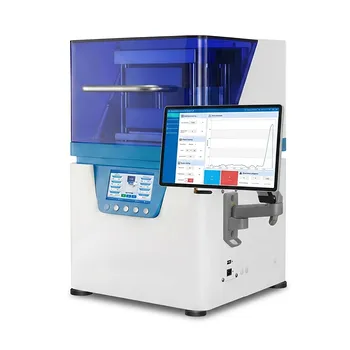
The uniaxial hydraulic press and steel mold system provides the mechanical force and structural rigidity necessary to transform loose powders into high-density, geometrically stable "green bodies." This equipment is essential for GdBCO+Ag preforms and liquid source pellets because it ensures uniform particle rearrangement and eliminates internal voids. By achieving a specific target density and shape, the process prevents the preform from collapsing or deforming during the intense heat of the subsequent infiltration growth (IG) process.
The primary function of the uniaxial hydraulic press is to establish a high-density, uniform microstructure that can withstand high-temperature processing without structural failure. This pre-compaction step is critical for ensuring the dimensional stability and material homogeneity required for high-performance superconductors.
Achieving Structural Integrity through Densification
Eliminating Internal Porosity
Loose powders contain significant amounts of entrapped air and large voids between particles. The uniaxial hydraulic press applies precisely controlled pressure to expel this air and force particles into a tighter arrangement.
Reducing this porosity is critical because internal gaps can lead to cracks or structural failure during the sintering phase. A dense, pore-free pellet ensures better mechanical strength and consistent material properties.
Particle Rearrangement and Contact
High-pressure compaction, often reaching levels like 700 MPa, increases the physical contact points between powder particles. This close contact is vital for the chemical reactions and bonding that occur during high-temperature treatments.
In GdBCO+Ag mixtures, this initial arrangement dictates the microstructural refinement of the final product. Better particle contact leads to clearer grain boundaries and more efficient superconducting paths.
The Role of the Steel Mold and Uniaxial Pressure
Precision Geometry and Diameter Control
The steel mold acts as a rigid container that defines the final dimensions of the pellet, typically ranging from 25 mm to 31 mm. This precision is necessary to ensure the preform fits correctly within the furnace and matches the design requirements of the superconducting application.
The mold’s high rigidity prevents the powder from expanding outward during compression. This forces the energy of the press to focus entirely on vertical densification, resulting in a highly compacted cylindrical shape.
Ensuring Uniform Density
By applying axial pressure, the press ensures that the powder is compressed evenly across its cross-section. This uniformity prevents "soft spots" within the pellet that could lead to uneven shrinking or warping.
A consistent green density is the foundation of a predictable manufacturing process. It allows researchers to calculate exactly how the material will behave when subjected to the infiltration growth heat profile.
Stability During Infiltration Growth
Preventing Heat-Induced Deformation
GdBCO+Ag preforms must endure extreme temperatures during the infiltration growth process. If the initial compaction is insufficient, the preform may collapse or suffer from severe deformation as the liquid phase moves through the material.
The high-pressure treatment provides the "green body" with the structural integrity needed to maintain its shape. This ensures the final superconductor retains the intended geometry after the liquid source has been absorbed.
Facilitating Liquid Phase Infiltration
The density achieved by the press creates a specific capillary network within the GdBCO preform. This network controls how the liquid source pellets melt and infiltrate the preform.
Proper compaction ensures the liquid moves through the preform at a controlled rate. This leads to a more homogeneous grain growth and prevents the formation of large, undesirable secondary phases.
Understanding the Trade-offs
Pressure Limits and Material Stress
While high pressure increases density, exceeding the mechanical limits of the steel mold or the powder itself can cause "capping" or laminations. These are horizontal cracks that form when internal stresses are released after the pressure is removed.
Friction and Density Gradients
Friction between the powder and the steel mold walls can lead to density gradients, where the top of the pellet is denser than the bottom. This is a common pitfall that requires careful lubrication of the mold or optimized height-to-diameter ratios to mitigate.
Making the Right Choice for Your Goal
How to Apply This to Your Project
- If your primary focus is dimensional precision: Utilize a high-rigidity steel mold to ensure the green body maintains a specific diameter and resists lateral expansion during pressing.
- If your primary focus is superconducting performance: Prioritize higher compaction pressures to maximize particle contact and minimize the porosity that can obstruct grain growth.
- If your primary focus is structural stability during heat treatment: Ensure the uniaxial press is calibrated to achieve a uniform density that prevents the preform from collapsing when the liquid phase forms.
A properly executed uniaxial pressing stage is the single most important factor in ensuring the geometric and functional success of GdBCO+Ag superconducting preforms.
Summary Table:
| Feature | Function in GdBCO+Ag Preparation | Key Benefit |
|---|---|---|
| Uniaxial Pressing | Applies high-pressure axial force | Eliminates internal porosity and increases particle contact. |
| Steel Mold | Provides rigid lateral containment | Ensures precision geometry and prevents deformation under load. |
| High Densification | Creates a controlled capillary network | Facilitates uniform liquid phase infiltration during heat growth. |
| Green Body Formation | Establishes structural integrity | Prevents preform collapse during high-temperature sintering processes. |
Elevate Your Materials Research with KINTEK Precision
Achieving the perfect green body density is critical for high-performance superconductors. KINTEK specializes in high-quality laboratory equipment designed to meet the rigorous demands of material science. Our comprehensive range of uniaxial hydraulic presses (pellet, hot, and isostatic) and precision-engineered steel molds provide the mechanical force and structural rigidity necessary for consistent GdBCO+Ag preform preparation.
Beyond compaction, KINTEK offers a full ecosystem of laboratory solutions, including:
- High-Temperature Furnaces: Muffle, tube, and vacuum furnaces for infiltration growth.
- Processing Equipment: Crushing, milling systems, and sieving tools for powder preparation.
- Consumables: High-purity ceramics, crucibles, and PTFE products.
Don't let structural instability compromise your superconducting research. Contact KINTEK today to discover how our advanced laboratory solutions can enhance your efficiency and ensure material homogeneity.
References
- Pablo Cayado, B. Holzäpfel. Transport measurements in single-grain GdBCO+Ag bulk superconductors processed by infiltration growth. DOI: 10.1007/s00339-023-06402-w
This article is also based on technical information from Kintek Solution Knowledge Base .
Related Products
- Automatic Hydraulic Hot Press with 500x500mm Heating Plates and Multi Stage PLC Control for Material Sintering
- Automatic Laboratory Hydraulic Press for XRF & KBR Pellet Press
- Laboratory Hydraulic Pellet Press for XRF KBR FTIR Lab Applications
- Automatic XRF Pellet Press 40 Ton Hydraulic Sample Preparation Press for Fluorescent Spectroscopy Analysis
- Laboratory Hydraulic Press Split Electric Lab Pellet Press
People Also Ask
- How do hydraulic presses facilitate material solidification in Low-Temperature LPS? Optimize Your Material Densification
- Why is 800 MPa required for TiNiPdCu alloy green bodies? Master High-Density Compaction for Superior Material Strength
- How does KBr pellet preparation facilitate FTIR of high-ash mud? Precision Sample Prep for Structural Analysis
- Why is an industrial hydraulic press with precision stainless steel molds used? For Uniform Mo-Fe Precursor Compacts.
- Purpose of Coaxial Ring Molds & Presses in EM Testing? Achieve Precise VNA Data & Fit