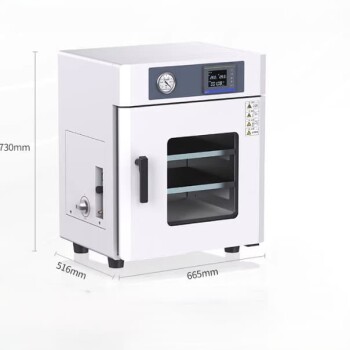
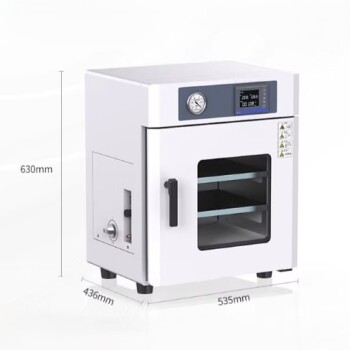
The use of a vacuum drying oven is non-negotiable for the preparation of high-performance Pt/Nb-TiO2 catalysts because it decouples drying from high thermal stress and oxygen exposure. Specifically, it facilitates the removal of residual moisture and solvents at significantly lower temperatures while creating an oxygen-deprived environment. This prevents the oxidation of platinum (Pt) nanoparticles and inhibits powder agglomeration, ensuring the final material retains the high specific surface area and electrochemical activity required for its application.
The Core Advantage Standard thermal drying often forces a compromise between thorough drying and material degradation. By lowering the boiling point of solvents, vacuum drying eliminates this trade-off, preserving the metallic state of the platinum and the delicate nanostructure of the support material that would otherwise be compromised by heat and oxidation.
Preserving Chemical Activity
The primary challenge in synthesizing platinum-based catalysts is maintaining the platinum in its highly active, metallic state.
Preventing Platinum Oxidation
Platinum nanoparticles are highly reactive, which makes them effective catalysts, but also susceptible to degradation during preparation.
Drying in a standard oven exposes these nanoparticles to oxygen at elevated temperatures, accelerating oxidation. A vacuum oven removes air from the chamber, creating an inert environment that locks in the metallic nature of the platinum required for electrochemical reactions.
Low-Temperature Solvent Evaporation
Efficient drying typically requires heat to evaporate solvents, but high heat can alter the chemical properties of the catalyst.
Under vacuum, the environmental pressure is reduced, which significantly lowers the boiling point of water and other solvents. This allows for rapid, thorough evaporation at much lower temperatures (e.g., 60°C instead of 105°C), protecting the catalyst from thermal degradation.
Maintaining Physical Structure
The physical architecture of the catalyst—specifically its porosity and surface area—is just as critical as its chemical composition.
Avoiding Powder Agglomeration
When solvents evaporate slowly or at high temperatures under atmospheric pressure, capillary forces can pull nanoparticles together.
This leads to agglomeration, where distinct particles fuse into larger clumps. Vacuum drying promotes a drying profile that minimizes these forces, keeping the powder loose and dispersible.
Retaining Specific Surface Area
Catalytic performance is directly tied to how much surface area is available for reaction.
By preventing agglomeration and high-temperature sintering, vacuum drying preserves the high specific surface area of the Nb-TiO2 support. This ensures maximum exposure of the active platinum sites in the final application.
Understanding the Trade-offs
While vacuum drying is chemically and physically superior for this specific application, it introduces operational considerations that differ from standard convection drying.
Throughput Limitations
Vacuum drying is inherently a batch process, whereas convection drying can sometimes be continuous.
This makes vacuum drying slower for large-scale manufacturing. However, for high-value nanomaterials like Pt/Nb-TiO2, the drop in throughput is an acceptable cost to avoid the catalyst deactivation that occurs in faster, high-heat convection ovens.
Equipment Complexity
Vacuum ovens require pumps, seals, and pressure monitoring, making them more complex to maintain than standard laboratory ovens.
Operators must ensure the vacuum seal is perfect; a leak during the drying stage introduces oxygen at the worst possible moment, potentially ruining the batch by inducing rapid oxidation.
Making the Right Choice for Your Goal
When finalizing your catalyst preparation protocol, align your drying method with your specific performance metrics.
- If your primary focus is Electrochemical Activity: You must use vacuum drying to prevent the oxidation of platinum nanoparticles and preserve their metallic active sites.
- If your primary focus is Structural Integrity: Vacuum drying is essential to minimize agglomeration and maximize the specific surface area available for reactions.
By controlling both temperature and atmosphere, vacuum drying transforms the drying step from a simple cleaning process into a critical preservation stage for your catalyst's performance.
Summary Table:
| Feature | Vacuum Drying Oven | Standard Convection Oven |
|---|---|---|
| Atmosphere | Oxygen-deprived (Inert) | Oxygen-rich (Oxidative) |
| Drying Temp | Low (e.g., 60°C) | High (e.g., 105°C+) |
| Pt State | Preserves metallic state | Risk of oxidation |
| Structure | Prevents agglomeration | High risk of clumping |
| Surface Area | Maximized retention | Potential loss due to heat |
Elevate Your Catalyst Synthesis with KINTEK Precision
Don't let oxidation or thermal degradation compromise your research. KINTEK specializes in advanced laboratory solutions, offering high-performance vacuum drying ovens and high-temperature furnaces specifically designed for sensitive nanomaterial preparation. Whether you are developing fuel cells or hydrogen technologies, our equipment—ranging from vacuum and CVD systems to crushing and milling tools—ensures your catalysts maintain maximum electrochemical activity and structural integrity.
Ready to achieve superior material performance? Contact our laboratory equipment experts today to find the perfect drying and thermal processing solution for your Pt/Nb-TiO2 projects!
References
- Xin Fu, Yucang Zhang. High electrocatalytic activity of Pt on porous Nb-doped TiO<sub>2</sub>nanoparticles prepared by aerosol-assisted self-assembly. DOI: 10.1039/d2ra03821h
This article is also based on technical information from Kintek Solution Knowledge Base .
Related Products
- 56L Vertical Laboratory Vacuum Drying Oven
- 23L Laboratory Vacuum Drying Oven
- Laboratory Scientific Electric Heating Blast Drying Oven
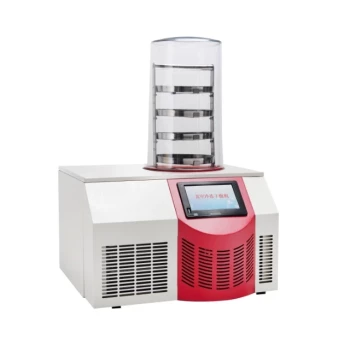
- Benchtop Laboratory Vacuum Freeze Dryer
- Dental Porcelain Zirconia Sintering Ceramic Vacuum Press Furnace
People Also Ask
- Why is a laboratory vacuum drying oven recommended for rice straw residues? Protect Your Biomass Integrity
- What role does a laboratory vacuum drying oven play in the preparation of modified multi-walled carbon nanotubes?
- What is the importance of using a laboratory vacuum drying oven? Preserving Slow-Release Microcapsule Integrity
- Why is a Laboratory Vacuum Drying Oven recommended for PBAT microspheres? Protect Sensitive Polymer Integrity
- What role does a laboratory vacuum drying oven play in processing nanoparticle powder samples? Protect Sample Integrity