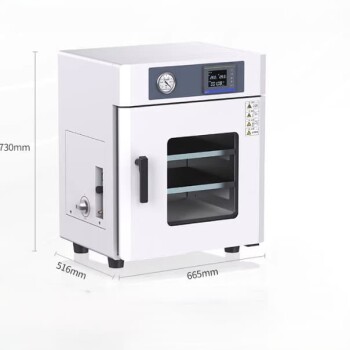
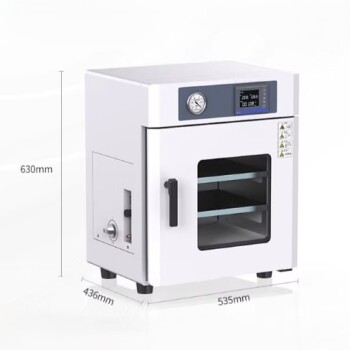
A vacuum drying oven is strictly required to eliminate adsorbed water and residual moisture from raw material powders, typically at temperatures around 80°C. This pre-treatment is essential because azide combustion reactions are chemically volatile and highly sensitive to moisture.
Core Takeaway Vacuum drying ensures the precise stoichiometric accuracy of your mixture by removing moisture that would otherwise alter reaction thermodynamics. Without this step, trapped water vapor can trigger unpredictable side reactions and destabilize the propagation of the combustion wave, compromising the quality of the final composite material.
The Critical Role of Moisture Removal
The primary function of the vacuum drying oven in this context is to stabilize the thermodynamics of the combustion synthesis. Azide reactions rely on specific energy release profiles that moisture disrupts.
Preventing Thermodynamic Alteration
Water acts as a variable in the energy equation. Even trace amounts of moisture can absorb heat during the combustion process, altering the expected thermodynamic output.
Stabilizing the Combustion Wave
For a successful synthesis, the combustion wave must propagate stably through the powder mixture. Moisture can interrupt this flow, causing inconsistent burning rates or incomplete reactions.
Avoiding Unwanted Side Reactions
Azides are highly reactive. The presence of water can trigger unwanted side reactions that compete with the main combustion pathway. This leads to impurities in the final product rather than the intended TiN-BN composite structure.
Ensuring Stoichiometric Precision
Beyond reaction dynamics, moisture removal is a matter of fundamental formulation accuracy.
Eliminating "False" Mass
When weighing powders that have adsorbed moisture, you are weighing water rather than the reactant. Vacuum drying ensures that the mass you measure is purely the reactant, guaranteeing the accurate stoichiometric ratio required for the synthesis.
Preventing Component Segregation
As noted in broader applications, moisture can lead to agglomeration or separation of components. Drying ensures the precursors remain a homogeneous mix, which is vital for the uniform structure of the final composite.
Why Vacuum? Understanding the Advantages
You might ask why a standard drying oven is insufficient. The vacuum environment offers specific advantages that protect the integrity of reactive powders.
Lowering the Boiling Point
By reducing the pressure, a vacuum oven lowers the boiling point of water and solvents. This allows for efficient drying at lower temperatures (e.g., 80°C), preventing thermal stress or degradation that might occur at higher heat settings.
Preventing Oxidation
Standard ovens expose powders to heated air, which increases the risk of oxidation—particularly for reactive metal powders often used in these mixtures. A vacuum environment isolates the material from oxygen, preserving the chemical purity of the precursors.
Making the Right Choice for Your Goal
The necessity of this step depends on which aspect of the experiment is most critical to your outcome.
- If your primary focus is Reaction Stability: Vacuum drying is non-negotiable to prevent moisture from acting as a heat sink that stalls the combustion wave.
- If your primary focus is Material Purity: The vacuum environment is essential to prevent oxidation of raw powders and avoid byproduct formation from side reactions.
Ultimately, omitting the vacuum drying step introduces an uncontrolled variable that undermines the reproducibility and safety of the entire azide combustion experiment.
Summary Table:
| Feature | Impact of Vacuum Drying | Risk Without Drying |
|---|---|---|
| Thermodynamics | Stable energy release profiles | Moisture acts as a heat sink, stalling reactions |
| Chemical Purity | Prevents oxidation and side reactions | Formation of impurities and unwanted byproducts |
| Stoichiometry | Accurate mass measurement of reactants | "False" mass due to water adsorption |
| Material Quality | Homogeneous mix; uniform composite | Agglomeration and component segregation |
| Process Safety | Controlled combustion wave propagation | Unpredictable reactions and volatile instability |
Elevate Your Research Precision with KINTEK Solutions
Don't let moisture compromise your material synthesis. KINTEK specializes in high-performance laboratory equipment designed for the most sensitive chemical processes. From our advanced vacuum drying ovens that ensure oxidation-free powder preparation to our precision crushing and milling systems and high-temperature furnaces, we provide the tools necessary for perfect stoichiometric accuracy and reaction stability.
Whether you are working on azide combustion, battery research, or advanced ceramics, our comprehensive range of laboratory consumables (PTFE, ceramics, crucibles) and thermal processing solutions ensures your experiments are reproducible and safe.
Ready to optimize your lab's workflow? Contact our technical experts today to find the perfect equipment solution for your specific application requirements.
References
- А. П. Амосов, Irina Kerson. Combustion Synthesis of TiN-BN Nanostructured Composite Powder with the Use of Sodium Azide and Precursors of Titanium and Boron. DOI: 10.5539/mas.v9n3p133
This article is also based on technical information from Kintek Solution Knowledge Base .
Related Products
- 56L Vertical Laboratory Vacuum Drying Oven
- 23L Laboratory Vacuum Drying Oven
- Laboratory Scientific Electric Heating Blast Drying Oven
- Benchtop Laboratory Vacuum Freeze Dryer
- Dental Porcelain Zirconia Sintering Ceramic Vacuum Press Furnace
People Also Ask
- Why is a laboratory vacuum drying oven recommended for rice straw residues? Protect Your Biomass Integrity
- What role does a laboratory vacuum drying oven play in the preparation of modified multi-walled carbon nanotubes?
- What is the importance of using a laboratory vacuum drying oven? Preserving Slow-Release Microcapsule Integrity
- Why is a Laboratory Vacuum Drying Oven recommended for PBAT microspheres? Protect Sensitive Polymer Integrity
- What role does a laboratory vacuum drying oven play in processing nanoparticle powder samples? Protect Sample Integrity