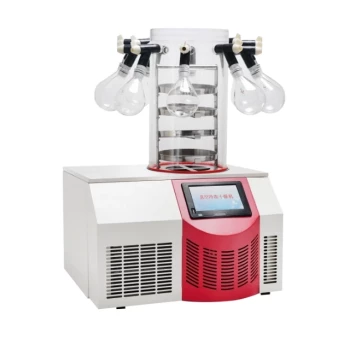
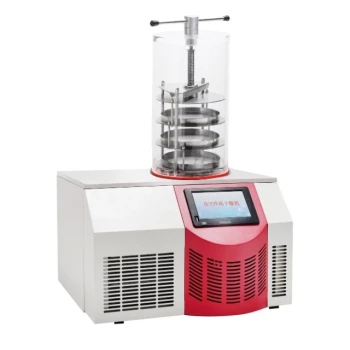
Vacuum drying is a critical preservation technique. It is utilized during the post-processing of Polydivinylbenzene (PDVB) to remove residual solvents—specifically tetrahydrofuran and ethanol—from solid cakes without subjecting the material to destructive heat. By operating under reduced pressure, this method safeguards the polymer's microscopic structure, ensuring it remains viable for further processing.
By lowering the boiling point of residual solvents, the vacuum drying system enables effective drying at reduced temperatures. This prevents thermal degradation, preserving the essential chemical activity and porosity required to fragment the material into functional nanoclusters.
The Mechanism of Solvent Removal
Lowering the Boiling Point
The primary function of the vacuum system is to alter the physical properties of the solvents trapped within the PDVB filtration cakes.
By creating a low-pressure environment, the boiling points of solvents like tetrahydrofuran and ethanol are significantly reduced.
Efficient Extraction at Low Temperatures
This reduction in boiling point allows the solvents to evaporate rapidly without requiring high thermal energy.
Operators can thoroughly dry the material at reduced temperatures, avoiding the harsh conditions typically required for atmospheric drying.
Preserving Microscopic Integrity
Preventing Thermal Damage
PDVB is sensitive to high temperatures, which can irreversibly alter its polymer microscopic structure.
Standard drying methods involving high heat pose a risk of thermally damaging the polymer matrix.
Vacuum drying mitigates this risk entirely by maintaining a thermal environment that is safe for the polymer.
Retaining Chemical Activity
The goal of the drying process is not merely to remove liquid, but to maintain the material's original chemical properties.
Vacuum processing ensures that the final solid material retains its original chemical activity.
This preservation of state is non-negotiable for high-performance applications where surface chemistry drives functionality.
Enabling Future Processing
Maintaining Porosity
The physical structure of the dried PDVB, specifically its porosity, is determined during this drying stage.
If the material collapses or degrades due to heat, the pore structure is lost.
Vacuum drying preserves this porosity, which is a critical physical characteristic for the material's intended use.
Facilitating Fragmentation into Nanoclusters
The ultimate reason for this careful drying is to prepare the PDVB for physical fragmentation.
To successfully break the material down into nanoclusters, the precursor material must possess specific structural qualities.
If the drying process damages the structure, the subsequent generation of nanoclusters will fail or yield inferior results.
Understanding the Process Trade-offs
Process Speed vs. Control
While vacuum drying is effective, it is generally a batch process that can be slower than continuous high-heat methods.
It requires precise control of vacuum levels; applying a vacuum too aggressively can cause solvent "bumping," potentially physically disrupting the cake structure.
Equipment Complexity
Unlike simple convection ovens, vacuum systems require seals, pumps, and pressure regulators that demand higher maintenance.
However, for sensitive materials like PDVB, the cost of equipment complexity is outweighed by the necessity of structural preservation.
Making the Right Choice for Your Goal
To optimize the preparation of PDVB nanoparticles, align your drying parameters with your specific outcomes:
- If your primary focus is Structural Integrity: Prioritize maintaining the lowest possible temperature that still allows for evaporation, ensuring the microscopic polymer structure remains intact.
- If your primary focus is Purity: Ensure the vacuum cycle is sufficiently long to fully extract tetrahydrofuran and ethanol, as residual solvents can interfere with fragmentation.
- If your primary focus is Nanocluster Yield: Verify that the dried cake retains high porosity, as this directly correlates to the ease and success of physical fragmentation.
The vacuum drying stage is not just a cleaning step; it is a foundational process that defines the quality and utility of the final PDVB nanoclusters.
Summary Table:
| Feature | Vacuum Drying Impact on PDVB | Benefit |
|---|---|---|
| Boiling Point | Lowered under reduced pressure | Enables rapid solvent removal at low temperatures |
| Thermal Stress | Minimal heat exposure | Prevents degradation of microscopic polymer structure |
| Surface Chemistry | High retention of activity | Ensures material remains viable for high-performance use |
| Porosity | Preserves pore architecture | Crucial for effective fragmentation into nanoclusters |
| Solvent Removal | Efficient extraction of THF/Ethanol | High purity without risking structural collapse |
Elevate Your Material Research with KINTEK's Advanced Solutions
Precision is the backbone of successful nanotechnology. At KINTEK, we understand that preserving the integrity of sensitive polymers like PDVB requires high-performance laboratory equipment. Whether you need a sophisticated vacuum drying system, high-temperature furnaces, or crushing and milling systems to achieve perfect nanocluster fragmentation, our comprehensive portfolio is designed to meet the rigorous demands of modern research.
Our value to you:
- Comprehensive Laboratory Range: From pellet presses to freeze dryers and ult-freezers, we provide the tools to control every variable.
- Quality Consumables: High-purity ceramics, crucibles, and PTFE products to ensure zero contamination.
- Expert Support: Solutions tailored for battery research, chemical synthesis, and material science.
Don't let thermal degradation compromise your results. Contact KINTEK today to discover how our drying and processing equipment can optimize your laboratory workflow!
References
- Yu Wang, Jintian Huang. Large-Scale Fabrication of Graded Convex Structure for Superhydrophobic Coating Inspired by Nature. DOI: 10.3390/ma15062179
This article is also based on technical information from Kintek Solution Knowledge Base .
Related Products
- 56L Vertical Laboratory Vacuum Drying Oven
- 23L Laboratory Vacuum Drying Oven
- Benchtop Laboratory Vacuum Freeze Dryer
- HFCVD Machine System Equipment for Drawing Die Nano-Diamond Coating
- High Performance Laboratory Freeze Dryer
People Also Ask
- Why is a laboratory vacuum drying oven recommended for rice straw residues? Protect Your Biomass Integrity
- What role does a laboratory vacuum drying oven play in the preparation of modified multi-walled carbon nanotubes?
- What is the importance of using a laboratory vacuum drying oven? Preserving Slow-Release Microcapsule Integrity
- Why is a Laboratory Vacuum Drying Oven recommended for PBAT microspheres? Protect Sensitive Polymer Integrity
- What role does a laboratory vacuum drying oven play in processing nanoparticle powder samples? Protect Sample Integrity