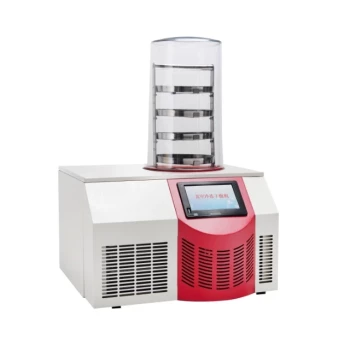
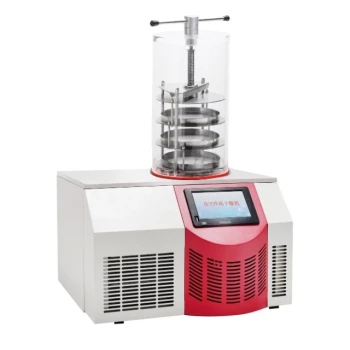
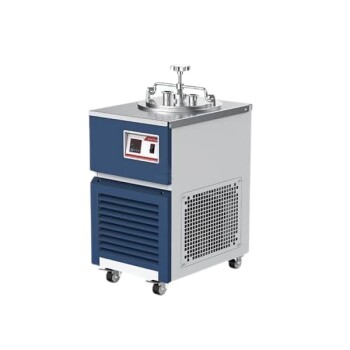
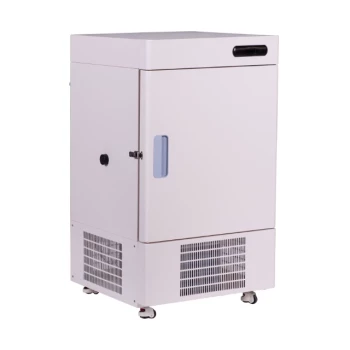
Vacuum freeze drying is essential because it removes moisture from Ferrous Sulfide (FeS) samples without exposing them to the heat or liquid water that causes degradation. Freshly precipitated FeS, specifically mackinawite, is highly unstable; using standard drying methods would trigger oxidation or phase transformations, rendering subsequent characterization data inaccurate.
Core Insight: The integrity of your characterization data depends entirely on the stability of your drying process. Vacuum freeze drying utilizes sublimation to remove water at extremely low temperatures, ensuring the sample's chemical phase and physical structure remain unchanged for analysis.
The Instability of Ferrous Sulfide
High Sensitivity to Oxygen
Freshly precipitated Ferrous Sulfide, known as mackinawite, is highly reactive. If exposed to oxygen while moist, it rapidly oxidizes, chemically altering the sample before you can analyze it.
Susceptibility to Phase Transformation
FeS is thermodynamically unstable in its initial precipitate form. Exposure to the heat associated with oven drying or even prolonged air drying can induce a phase transformation, causing the material to convert into more stable, but less representative, iron sulfide structures.
How Freeze Drying Preserves the Sample
Moisture Removal via Sublimation
Vacuum freeze drying removes organic solvents and water through sublimation. This process transitions the moisture directly from a solid (ice) to a gas (vapor), bypassing the liquid phase that often facilitates unwanted chemical reactions.
Maintaining Low Temperatures
The process operates at extremely low temperatures. This is critical for heat-sensitive materials like FeS, as it prevents the thermal energy from driving the phase changes that occur during standard evaporation methods.
Implications for Characterization
Ensuring Accurate XRD Analysis
X-ray Diffraction (XRD) identifies the crystalline structure of a material. Because freeze drying prevents phase transformation, the XRD pattern obtained reflects the true initial phase of the captured sample, rather than a byproduct of the drying method.
Preserving Morphology for SEM
Scanning Electron Microscopy (SEM) examines the surface structure and shape of the particles. Freeze drying prevents the collapse or aggregation of particles that often happens when liquid water evaporates, ensuring the initial morphology is preserved for imaging.
Understanding the Trade-offs
Equipment Complexity and Cost
While necessary for accuracy, freeze drying is significantly more resource-intensive than oven drying. It requires specialized vacuum equipment capable of maintaining low pressures and temperatures.
Time Requirements
Sublimation is a slow process compared to thermal evaporation. Preparing samples via freeze drying typically takes significantly longer, which can act as a bottleneck in high-throughput testing environments.
Making the Right Choice for Your Goal
If your primary focus is accurate Phase Identification (XRD): You must use vacuum freeze drying to prevent mackinawite from transforming into other iron sulfide phases due to heat or oxidation.
If your primary focus is Surface Morphology (SEM): You must use vacuum freeze drying to avoid the capillary forces of liquid evaporation that distort particle shape and agglomeration.
Data collected from an improperly dried FeS sample measures the drying process, not the sample itself.
Summary Table:
| Feature | Vacuum Freeze Drying (Sublimation) | Oven Drying (Evaporation) |
|---|---|---|
| Temperature | Extremely Low (Prevents Heat Damage) | High (Triggers Phase Transformation) |
| Oxygen Exposure | Minimal (Vacuum Environment) | High (Risk of Rapid Oxidation) |
| Physical State | Solid to Gas (Bypasses Liquid Phase) | Liquid to Gas (Capillary Distortion) |
| FeS Morphology | Preserved (Original Structure) | Compromised (Aggregation/Collapse) |
| XRD/SEM Accuracy | High (True Initial Phase) | Low (Measures Drying Byproducts) |
Secure Your Research Integrity with KINTEK Solutions
In the delicate characterization of unstable materials like Ferrous Sulfide, the quality of your drying equipment determines the accuracy of your results. KINTEK specializes in high-performance laboratory solutions, providing the precision cooling solutions (ULT freezers, freeze dryers) and vacuum systems necessary to prevent sample degradation.
Whether you are conducting phase identification via XRD or detailed imaging with SEM, our comprehensive portfolio—ranging from crushing and milling systems to high-temperature furnaces and advanced autoclaves—is designed to meet the rigorous demands of material science and battery research.
Don't let improper drying compromise your data. Contact our technical experts today to find the ideal freeze-drying solution for your laboratory and ensure your samples reflect their true crystalline state.
References
- Y. Liu, Mason B. Tomson. Iron Sulfide Precipitation and Deposition under Different Impact Factors. DOI: 10.2118/184546-ms
This article is also based on technical information from Kintek Solution Knowledge Base .
Related Products
- Benchtop Laboratory Vacuum Freeze Dryer
- High Performance Laboratory Freeze Dryer
- High Performance Laboratory Freeze Dryer for Research and Development
- Benchtop Laboratory Freeze Dryer for Lab Use
- Vacuum Cold Mounting Machine for Sample Preparation
People Also Ask
- What are the technical advantages of using a laboratory freeze dryer for porous carbon precursors? Preserve 3D Networks
- How do laboratory freeze dryers support scientific research? Preserve Sample Integrity for Reproducible Results
- Why is a laboratory freeze dryer preferred over traditional heating? Preserve Biochar Structure & Maximize Porosity
- What types of liquid samples can be processed using a laboratory freeze dryer? Preserve Your Sensitive Materials
- What role do laboratory freeze dryers play in the food industry? Unlock Superior Food Preservation