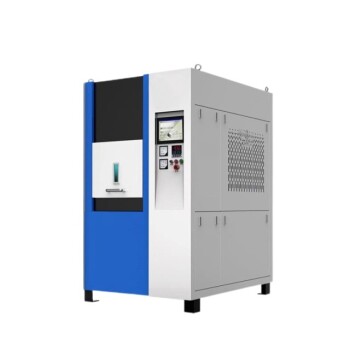
Vacuum hot pressing is typically used for stainless steel-carbon nanotube (CNT) composites because it uniquely synchronizes three critical variables: a vacuum environment, high temperature, and mechanical pressure. This specific combination prevents the oxidation of the stainless steel matrix while simultaneously forcing the material to achieve near-theoretical density, a feat difficult to accomplish with standard sintering due to the complex nature of CNTs.
The Core Insight The vacuum hot pressing furnace solves the fundamental conflict in manufacturing this composite: it protects reactive materials from degradation while using physical force to overcome the natural resistance of carbon nanotubes to densification, ensuring a cohesive, high-performance material.
The Critical Role of the Vacuum Environment
Preventing Material Degradation
Stainless steel powders are highly susceptible to oxidation at sintering temperatures.
The vacuum environment eliminates oxygen, ensuring the metal matrix remains pure and uncorrupted by oxide layers that would weaken the final part.
Removing Volatiles and Gases
Beyond preventing oxidation, the vacuum actively removes adsorbed gases and volatiles trapped between powder particles.
This "degassing" is essential for eliminating porosity, resulting in a solid, high-quality bulk specimen with superior structural integrity.
The Necessity of Mechanical Pressure
Achieving Density at Lower Temperatures
Sintering usually requires extreme heat to fuse particles, but high heat can damage delicate CNT structures.
The application of mechanical pressure provides the necessary energy to densify the material at significantly lower temperatures, preserving the integrity of both the stainless steel and the CNTs.
Overcoming CNT Agglomeration
Carbon nanotubes often resist being fully embedded within a metal matrix, creating voids.
External mechanical pressure physically forces the stainless steel matrix to flow around the CNTs, closing gaps and ensuring the composite reaches near-theoretical density.
Optimizing the Matrix-Reinforcement Interface
Creating a Load-Transfer Network
The performance of a composite relies entirely on how well the matrix transfers stress to the reinforcement.
Vacuum hot pressing strengthens the interfacial bonding between the stainless steel and the CNTs, creating an effective network that distributes physical loads throughout the material.
Enhancing Wear Resistance
A strong interface directly translates to functional performance improvements.
By securing the CNTs firmly within the matrix, the process unlocks the nanotubes' natural properties, significantly improving the composite's wear resistance and self-lubrication capabilities.
Understanding the Trade-offs
Geometry Limitations
While excellent for material quality, hot pressing applies force uniaxially (from one direction).
This generally limits production to simple shapes, such as plates or discs, making it less suitable for complex geometries without extensive post-machining.
Production Throughput
The process is inherently a batch operation rather than continuous.
Because it involves pumping down a vacuum, heating, pressing, and cooling under controlled conditions, it is time-consuming and typically more expensive than conventional pressureless sintering.
Making the Right Choice for Your Goal
If you are evaluating this equipment for your specific application, consider these factors:
- If your primary focus is mechanical strength: Prioritize this method, as the simultaneous pressure is the only reliable way to achieve the density required for effective load transfer.
- If your primary focus is material purity: The vacuum capability is non-negotiable to prevent oxidation of the stainless steel and degradation of the CNTs.
Vacuum hot pressing is not just a heating method; it is a consolidation strategy that forces two dissimilar materials to act as one.
Summary Table:
| Feature | Benefit for SS-CNT Composites | Outcome |
|---|---|---|
| Vacuum Environment | Prevents oxidation and removes adsorbed gases | High material purity and zero porosity |
| Mechanical Pressure | Forces matrix flow around nanotubes | Near-theoretical density at lower temps |
| Thermal Control | Preserves delicate CNT structures | Enhanced structural integrity and strength |
| Interfacial Bonding | Optimizes load transfer between matrix and reinforcement | Superior wear resistance and durability |
Elevate Your Material Research with KINTEK
Precise control over temperature, pressure, and atmosphere is the foundation of high-performance composite manufacturing. KINTEK specializes in advanced laboratory solutions, offering state-of-the-art hot pressing and isostatic presses alongside our industry-leading high-temperature vacuum and atmosphere furnaces.
Whether you are developing next-generation stainless steel-CNT composites or exploring advanced ceramics, our equipment is designed to deliver the near-theoretical density and material purity your research demands. From hydraulic pellet presses to vacuum sintering systems, we provide the tools needed to turn complex powders into high-performance bulk materials.
Ready to optimize your sintering process? Contact our technical experts today to find the perfect furnace or press for your specific application requirements.
References
- Chika Oliver Ujah, Victor Sunday Aigbodion. Tribological Properties of CNTs-Reinforced Nano Composite Materials. DOI: 10.3390/lubricants11030095
This article is also based on technical information from Kintek Solution Knowledge Base .
Related Products
- 600T Vacuum Induction Hot Press Furnace for Heat Treat and Sintering
- Vacuum Heat Treat and Sintering Furnace with 9MPa Air Pressure
- Vacuum Heat Treat and Pressure Sintering Furnace for High Temperature Applications
- 2200 ℃ Tungsten Vacuum Heat Treat and Sintering Furnace
- Vacuum Hot Press Furnace Heated Vacuum Press Machine Tube Furnace
People Also Ask
- What role does an induction vacuum hot pressing furnace play in sintering? Achieve 98% Density in Carbide Blocks
- What advantages does a vacuum hot press furnace provide for LSLBO ceramic electrolytes? Achieve 94% Relative Density
- What role does a Vacuum Hot Press (VHP) furnace play in the densification of austenitic stainless steel 316 composites?
- What are the advantages of a vacuum hot press furnace for W-50%Cu? Achieve 99.6% Density at Lower Temperatures
- What role does mechanical pressure play during the vacuum diffusion bonding of tungsten and copper? Keys to Solid Bonding