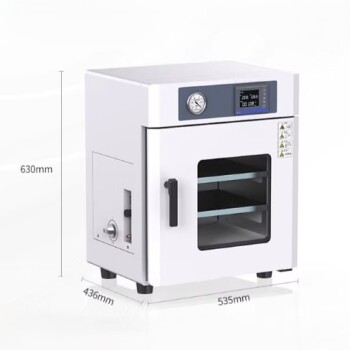
A vacuum oven is mandatory for UIO-67 activation because it creates the specific thermodynamic environment required to evacuate the material's internal pores. By maintaining a continuous dynamic vacuum at 120°C, the oven forces the desorption of residual solvent molecules like methanol, which are trapped within the crystal lattice during synthesis.
Core Takeaway: The vacuum oven serves as a "pore-clearing" tool. Without this specific activation step, the internal channels of the UIO-67 material remain blocked by solvents, making it physically impossible to impregnate them with the ionic liquids necessary to create a functional ion conductor.
The Mechanics of Activation
Removing Residual Solvents
During the synthesis of UIO-67 crystals, solvents such as methanol become trapped within the porous structure. These residual molecules occupy the empty space inside the Metal-Organic Framework (MOF).
The activation treatment is designed specifically to target and remove these contaminants. Without removal, these molecules act as physical barriers within the material.
The Role of Dynamic Vacuum
Standard heating is often insufficient to clear deep pores. The process requires a continuous dynamic vacuum.
This environment lowers the boiling point of the solvent and creates a pressure gradient. This ensures that once solvent molecules are released from the pores, they are immediately evacuated from the chamber rather than re-absorbing into the material.
Precise Thermal Management
The process relies on a sustained temperature of 120°C. This thermal energy provides the kinetic force necessary to break the interactions between the solvent molecules and the UIO-67 framework.
Combined with the vacuum, this temperature ensures the methanol is effectively vaporized and removed.
Enabling Ion Conductor Preparation
Preparing for Impregnation
The ultimate goal of this process is to prepare the material for the impregnation of ionic liquids. The result is a composite material known as a LIM (Liquid-Impregnated MOF) ion conductor.
The ionic liquids must reside inside the channels of the MOF to function. If the activation step is skipped or performed poorly, the channels remain full of methanol.
Opening the Porous Structure
The vacuum oven treatment effectively "opens" the porous structure of the UIO-67.
By clearing the channels, you maximize the available volume for the ionic liquid. This maximization is critical for the performance of the final ion conductor.
Understanding the Trade-offs
The Risk of Incomplete Activation
If the vacuum is not dynamic or the temperature drops below 120°C, activation will likely be incomplete.
This leads to "pore blocking," where residual solvent remains deep inside the crystal. This significantly reduces the amount of ionic liquid the material can hold, directly degrading the final conductivity.
Process Sensitivity
This is not a passive drying step; it is an active chemical processing step.
Deviating from the specified parameters (120°C and dynamic vacuum) compromises the structural readiness of the MOF. It renders the subsequent impregnation step ineffective.
Making the Right Choice for Your Goal
To ensure high-performance LIM ion conductors, strict adherence to the activation protocol is required.
- If your primary focus is Pore Accessibility: Prioritize a continuous dynamic vacuum rather than a static one to prevent the re-adsorption of vaporized methanol.
- If your primary focus is Material Loading: Maintain the temperature strictly at 120°C to ensure complete solvent removal without damaging the MOF structure.
Successful activation is the gateway to effective ionic liquid impregnation and superior conductivity.
Summary Table:
| Activation Parameter | Requirement | Purpose in UIO-67 Processing |
|---|---|---|
| Equipment | Vacuum Oven | Creates pressure gradient to evacuate internal pores |
| Vacuum Type | Continuous Dynamic | Prevents solvent re-adsorption into the MOF lattice |
| Temperature | 120°C | Provides kinetic energy to break solvent-framework bonds |
| Solvent Removed | Methanol | Clears internal channels for ionic liquid loading |
| Goal | Pore Accessibility | Ensures maximum conductivity in LIM ion conductors |
Maximize Your MOF Research with KINTEK Precision
Achieving the perfect activation environment for UIO-67 requires uncompromising thermal and vacuum control. KINTEK specializes in high-performance laboratory solutions designed for advanced material synthesis. Whether you need high-precision vacuum ovens, high-temperature furnaces (muffle, tube, or vacuum), or high-pressure reactors for your MOF preparation, our equipment ensures the repeatability and accuracy your research demands.
From crushing and milling systems to PTFE consumables and ceramics, KINTEK provides the comprehensive tools necessary for developing next-generation ion conductors and battery technologies.
Ready to elevate your laboratory efficiency? Contact our experts today to find the ideal solution for your application.
Related Products
- 56L Vertical Laboratory Vacuum Drying Oven
- 23L Laboratory Vacuum Drying Oven
- Dental Porcelain Zirconia Sintering Ceramic Vacuum Press Furnace
- Vacuum Heat Treat Sintering Brazing Furnace
- Ultra-High Temperature Graphite Vacuum Graphitization Furnace
People Also Ask
- Why is a laboratory vacuum drying oven recommended for rice straw residues? Protect Your Biomass Integrity
- What role does a laboratory vacuum drying oven play in the preparation of modified multi-walled carbon nanotubes?
- What is the importance of using a laboratory vacuum drying oven? Preserving Slow-Release Microcapsule Integrity
- Why is a Laboratory Vacuum Drying Oven recommended for PBAT microspheres? Protect Sensitive Polymer Integrity
- What role does a laboratory vacuum drying oven play in processing nanoparticle powder samples? Protect Sample Integrity