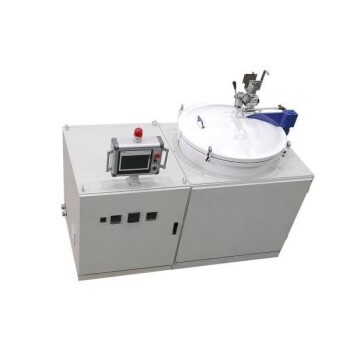
The preference for a vertical induction furnace over a horizontal configuration is driven by the strict requirement to eliminate physical contact with the billet during the heating phase. Horizontal furnaces typically rely on guide rails to transport the billet, which causes friction and surface scratching. For chromized steel, avoiding this mechanical abrasion is essential to prevent severe defects in the final product.
Core Takeaway Horizontal furnaces use guide rails that scratch the billet's surface, leading to structural failures like scabs and cavities during extrusion. Vertical furnaces eliminate these guide rails, ensuring the delicate chromized layer remains intact for high-quality tubing production.
The Mechanics of Surface Damage
To understand why the vertical orientation is superior, it is necessary to analyze how horizontal systems physically interact with the workpiece.
The Problem with Horizontal Guide Rails
Horizontal induction furnaces require a support system to move the heavy steel billet through the heating coil.
Standard designs utilize metal guide rails to facilitate this movement. As the billet slides along these rails, friction is unavoidable.
This mechanical contact creates scratches on the surface of the chromized billet. While potentially minor in appearance initially, this damage disrupts the continuity of the chromized layer.
How Scratches Evolve into Extrusion Defects
The surface damage sustained during heating does not remain static.
During the subsequent extrusion process, the billet is subjected to immense pressure and deformation.
Under these conditions, the initial scratches caused by the guide rails expand and degrade further. They frequently evolve into scabs and cavities, permanent defects that ruin the surface quality and integrity of the finished tubing.
The Vertical Advantage
Vertical induction furnaces—and strictly non-contact alternatives like chamber furnaces—solve this problem by fundamentally changing how the billet is supported.
Eliminating Mechanical Contact
The vertical design removes the need for sliding guide rails entirely.
By orienting the billet vertically, the system avoids dragging the workpiece across a stationary surface.
This elimination of mechanical contact ensures the chromized layer is not subjected to abrasion, preserving the surface quality required for successful extrusion.
Common Pitfalls to Avoid
When selecting heating equipment for coated or treated materials, it is critical to recognize the limitations of standard transport mechanisms.
The Hidden Cost of Friction
A common error is assuming that surface scratches incurred during heating will be "ironed out" during extrusion.
The opposite is true; extrusion magnifies surface imperfections.
Using a horizontal furnace with guide rails for chromized steel is a process incompatibility that inevitably leads to material rejection due to surface scabbing.
Making the Right Choice for Your Production
Selecting the correct furnace orientation is not just about heating efficiency; it is about defect prevention.
- If your primary focus is Protecting the Chromized Layer: Select a vertical induction furnace or chamber furnace to completely eliminate sliding contact.
- If your primary focus is Preventing Extrusion Defects: Avoid horizontal furnaces with guide rails, as they are the direct cause of scabs and cavities in the final tubing.
By removing mechanical friction from the heating equation, you safeguard the integrity of the finished steel product.
Summary Table:
| Feature | Vertical Induction Furnace | Horizontal Induction Furnace |
|---|---|---|
| Support Mechanism | Non-contact/Vertical suspension | Metal guide rails |
| Surface Interaction | Zero friction/No abrasion | Constant sliding contact |
| Billet Impact | Preserves chromized layer | Causes scratches and scabs |
| Extrusion Quality | High-quality, defect-free tubing | High risk of cavities and failure |
| Best For | Delicate coatings & chromized steel | Standard, non-treated billets |
Elevate Your Material Integrity with KINTEK Precision
Don't let mechanical friction compromise your extrusion quality. At KINTEK, we specialize in advanced laboratory and industrial equipment designed to protect your most delicate materials. Whether you require high-performance induction melting systems, high-temperature furnaces (muffle, tube, vacuum), or specialized crushing and milling solutions, our expertise ensures your processes remain defect-free.
From high-pressure reactors to isostatic hydraulic presses, KINTEK provides the tools needed for superior metallurgical results. Contact our technical experts today to discover how our non-contact heating solutions can eliminate surface scabbing and optimize your production workflow!
References
- A. V. Hruzevych, D. О. Derecha. Diffusion-hardening effect on the technological properties of high-temperature steel. DOI: 10.1007/s42452-020-2943-5
This article is also based on technical information from Kintek Solution Knowledge Base .
Related Products
- Vertical High Temperature Graphite Vacuum Graphitization Furnace
- Vacuum Arc Induction Melting Furnace
- Vertical Laboratory Tube Furnace
- Large Vertical Graphite Vacuum Graphitization Furnace
- 600T Vacuum Induction Hot Press Furnace for Heat Treat and Sintering
People Also Ask
- How does a vertical furnace work? Achieve Superior Uniformity in Semiconductor Manufacturing
- What is a vertical furnace? Achieve Superior Temperature Uniformity for Sensitive Processes
- What are the advantages of a vertical furnace versus a horizontal furnace? Maximize Lab Efficiency & Space
- How does a vertical furnace achieve energy-saving sintering? Harness Internal Energy for Efficient Pellet Treatment
- What is the use of graphite furnace? Achieve Extreme-Temperature Processing for Advanced Materials