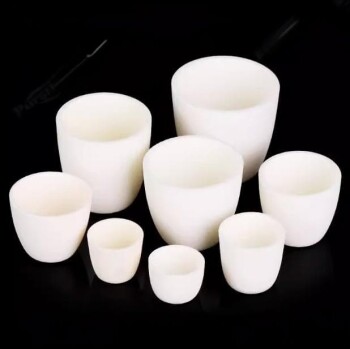
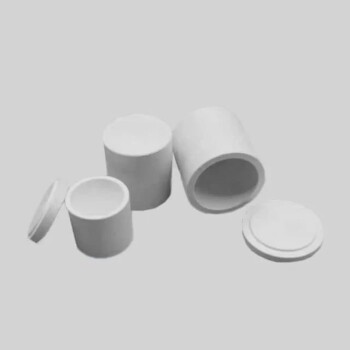
The use of a covered alumina crucible is a strategic choice to ensure chemical purity and maximize product yield. Using an alumina crucible covered with aluminum foil creates a stable, semi-closed reaction micro-environment that prevents the sublimation of volatile precursors. This setup maintains a slight positive pressure and a localized inert atmosphere, which is essential for developing the high-quality crystalline structure required for functional carbon nitride.
The combination of a chemically inert alumina vessel and a foil cover isolates the reaction from atmospheric interference while retaining gaseous precursors. This dual-layer approach optimizes the thermal polycondensation process by balancing pressure, preventing oxidation, and ensuring the structural integrity of the final material.
The Role of Alumina as a Reaction Vessel
Superior Chemical Inertness
Alumina ($Al_2O_3$) is chosen because it remains exceptionally stable and non-reactive with carbon nitrogen precursors even at high temperatures. This prevents the crucible from leaching metal ion impurities into the carbon nitride lattice, which would otherwise quench the material's luminescence and degrade its optical efficiency.
Thermal Resilience and Stability
High-purity alumina can withstand the intense heat required for carbonization and reduction reactions without cracking or degrading. It provides a consistent environment that ensures the heat-treated powder maintains its intended chemical stoichiometry and crystalline phase.
The Functions of the Aluminum Foil Cover
Minimizing Precursor Volatilization
Many carbon nitride precursors, such as melamine, are prone to sublimation and loss at high temperatures. The foil cover creates a semi-closed environment that traps these vapors, maintaining a slight positive pressure that significantly increases the final yield of the product.
Controlling the Atmospheric Micro-environment
The cover serves as a barrier against external oxygen, effectively limiting the oxygen partial pressure within the crucible. By excluding atmospheric oxygen, the process prevents the formation of unwanted C-O bonds at the edges of the carbon-nitrogen network, ensuring a cleaner chemical structure.
Promoting Crystalline Quality
By maintaining a localized reducing or inert atmosphere, the foil cover helps the precursors undergo uniform thermal polycondensation. This controlled environment is critical for the formation of the desired layered g-C3N4 nanosheets and overall crystalline quality.
Understanding the Trade-offs
The Risk of Pressure Buildup
While a semi-closed environment is beneficial, an absolute seal can be dangerous. The aluminum foil provides a "breathable" barrier that maintains pressure without the risk of a pressurized explosion that could occur with a permanently sealed rigid lid.
Potential for Trace Contamination
Using low-purity aluminum foil or improperly cleaned crucibles can introduce unwanted elements into the reaction. To maintain the performance integrity of the material, practitioners must ensure that both the vessel and the cover are of high-purity grade to avoid interfering with the carbon nitride’s electronic properties.
How to Apply This to Your Synthesis
When preparing for the thermal treatment of carbon nitride precursors, consider your primary experimental goals to refine your setup:
- If your primary focus is maximizing product yield: Ensure the aluminum foil is tightly crimped around the crucible rim to create a consistent semi-closed environment that prevents the escape of sublimated precursors.
- If your primary focus is high optical efficiency: Use the highest purity alumina available to prevent metal ion doping, which is known to cause luminescence quenching in carbon nitride.
- If your primary focus is controlling chemical bonding (e.g., reducing C-O bonds): Focus on the integrity of the foil cover to strictly limit oxygen intrusion during the heating and cooling cycles.
By carefully managing this micro-environment, you can achieve a highly crystalline, pure, and high-yield carbon nitride product suitable for advanced applications.
Summary Table:
| Component | Primary Function | Key Benefit |
|---|---|---|
| Alumina Crucible ($Al_2O_3$) | Chemical inertness & thermal stability | Prevents impurity leaching & withstands extreme heat |
| Aluminum Foil Cover | Creates a semi-closed micro-environment | Minimizes precursor sublimation & limits oxygen intrusion |
| Combined Setup | Controlled thermal polycondensation | Increases product yield & enhances crystalline quality |
Elevate Your Material Synthesis with KINTEK
Precision in thermal treatment is the key to high-performance carbon nitride. KINTEK specializes in providing the high-purity alumina crucibles, ceramics, and crucibles required to maintain chemical integrity, alongside advanced high-temperature furnaces (muffle, tube, and atmosphere) designed for stable reaction environments.
Whether you are focusing on maximizing yield or achieving superior optical efficiency, our comprehensive range of laboratory equipment—from crushing systems to vacuum furnaces—supports every stage of your research.
Ready to optimize your lab’s efficiency and product quality? Contact our experts today to find the perfect solutions for your specific synthesis needs.
References
- Cheng-Yu Peng, Anchi Yu. Unravelling the doping effect of potassium ions on structural modulation and photocatalytic activity of graphitic carbon nitride. DOI: 10.1039/d3ra00934c
This article is also based on technical information from Kintek Solution Knowledge Base .
Related Products
- Arc-Shaped Alumina Ceramic Crucible High Temperature Resistant for Engineering Advanced Fine Ceramics
- Alumina Al2O3 Ceramic Crucible Semicircle Boat with Lid for Engineering Advanced Fine Ceramics
- Engineering Advanced Fine Ceramics Alumina Crucibles (Al2O3) for Thermal Analysis TGA DTA
- Engineering Advanced Fine Ceramics Alumina Al2O3 Crucible With Lid Cylindrical Laboratory Crucible
- Engineering Advanced Fine Alumina Al2O3 Ceramic Crucible for Laboratory Muffle Furnace
People Also Ask
- Why Use Alumina Crucibles & Powder Burial for NaSICON? Ensure Phase Purity and Prevent Elemental Volatilization
- What is the primary purpose of using alumina crucibles for LLTO ceramics? Optimize Your High-Temperature Sintering
- Why are alumina crucibles and mother powder essential for LATP sintering? Optimize Your Solid Electrolyte Performance
- Why are high-purity alumina crucibles used for liquid lead corrosion experiments? Ensure Data Accuracy at 550°C
- Primary considerations for choosing alumina crucibles and quartz tubes in indium intercalation: Ensure Material Purity