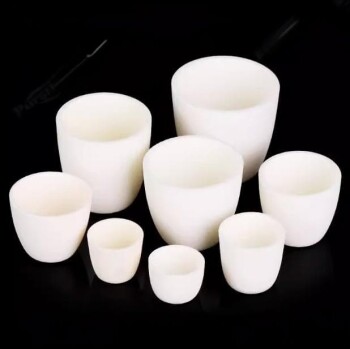
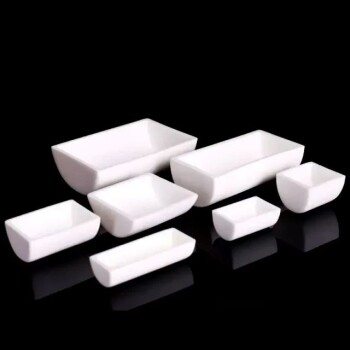
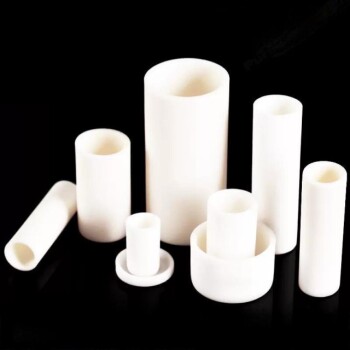
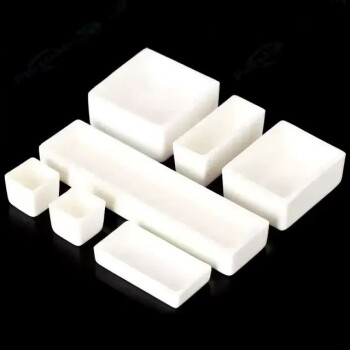
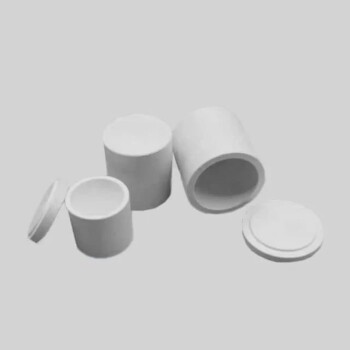
The selection of an alumina crucible is dictated by the need for extreme thermal stability and strict chemical purity. In the preparation of Silicon Carbide (SiC) coatings on graphite films, the reaction vessel must withstand temperatures reaching 1150°C while resisting attack from aggressive molten salts. Alumina provides the necessary structural integrity to survive this heat and the chemical inertness to prevent vessel degradation.
Alumina is chosen because it acts as a robust barrier against corrosive chloride salts at temperatures exceeding 1100°C. Its primary function is to prevent container erosion, which ensures that no foreign impurities leach into the reaction, thereby guaranteeing the purity and quality of the final SiC coating.
The Critical Role of Material Properties
Withstanding Extreme Temperatures
The molten salt bath method for SiC coating requires a reaction environment maintained at approximately 1150°C.
At this intensity, many standard laboratory materials would soften, deform, or melt.
Alumina crucibles possess exceptional refractoriness (heat resistance), allowing them to maintain mechanical strength and structural rigidity throughout the prolonged heating process.
Resisting Chemical Corrosion
The reaction bath typically consists of a mixture of sodium chloride (NaCl), potassium chloride (KCl), and silicon (Si) powder.
When molten, these chloride salts become highly corrosive, acting as solvents that can erode standard ceramic or metallic vessels.
Alumina remains chemically inert in the presence of these molten salts, resisting the corrosive attack that would destroy lesser materials.
Impact on Coating Quality
Eliminating Contamination Sources
The success of the coating process relies heavily on the purity of the chemical reaction.
If the crucible were to erode, elements from the vessel walls would leach into the molten mixture.
Alumina's resistance to corrosion prevents this leaching, ensuring that the reaction system remains free of impurities.
Ensuring Product Consistency
Foreign contaminants introduced during the reaction can compromise the properties of the SiC coating.
Impurities often lead to defects in the coating structure or poor adhesion to the graphite film.
By using an inert alumina vessel, you ensure the high quality and consistency required for effective SiC protection.
Understanding the Trade-offs
Vulnerability to Thermal Shock
While alumina is excellent at withstanding high steady-state temperatures, it has a limitation regarding rapid temperature changes.
It is a brittle material with relatively low thermal shock resistance.
Rapid heating or cooling can cause the crucible to crack or shatter; therefore, temperature ramps must be controlled carefully during the process.
Cost vs. Performance
Alumina is generally more expensive than standard ceramics but cheaper than exotic materials like platinum.
For this specific application, it represents the optimal balance point.
It provides the necessary performance without the prohibitive cost of more specialized high-temperature materials.
Making the Right Choice for Your Goal
When setting up a molten salt bath system, your material choice dictates your success rate.
- If your primary focus is process purity: Rely on alumina’s chemical inertness to prevent chloride salts from leaching contaminants into your coating.
- If your primary focus is structural safety: Trust alumina to maintain physical integrity at operating temperatures of 1150°C without deformation.
Ultimately, the alumina crucible is the non-negotiable standard that ensures the harsh conditions required to synthesize SiC do not compromise the integrity of the final product.
Summary Table:
| Feature | Alumina Crucible Performance | Benefit for SiC Coating |
|---|---|---|
| Thermal Resistance | Stable up to 1150°C+ | Prevents vessel deformation or melting |
| Chemical Inertness | Resists corrosive chloride salts | Prevents impurity leaching into the reaction |
| Material Purity | High-grade Al2O3 composition | Ensures high-quality, consistent SiC layers |
| Cost-Efficiency | Optimal performance-to-price ratio | Professional results without exotic material costs |
Elevate Your Materials Research with KINTEK Precision Solutions
Don't let vessel degradation compromise your Silicon Carbide (SiC) synthesis. KINTEK specializes in high-performance laboratory equipment and consumables designed for the most demanding thermal environments. Whether you are performing molten salt bath reactions or high-temperature sintering, our premium alumina crucibles, high-temperature furnaces, and ceramics provide the chemical inertness and structural integrity your research demands.
From advanced muffle and vacuum furnaces to specialized crushing, milling, and pellet pressing systems, KINTEK delivers the tools needed for superior product consistency and process purity.
Ready to optimize your lab's performance? Contact KINTEK today to discuss your specific application and get a custom quote!
Related Products
- Arc-Shaped Alumina Ceramic Crucible High Temperature Resistant for Engineering Advanced Fine Ceramics
- Alumina Al2O3 Ceramic Crucible Semicircle Boat with Lid for Engineering Advanced Fine Ceramics
- Engineering Advanced Fine Ceramics Alumina Al2O3 Crucible With Lid Cylindrical Laboratory Crucible
- Engineering Advanced Fine Ceramics Alumina Crucibles (Al2O3) for Thermal Analysis TGA DTA
- Engineering Advanced Fine Alumina Al2O3 Ceramic Crucible for Laboratory Muffle Furnace
People Also Ask
- Why Use Alumina Crucibles & Powder Burial for NaSICON? Ensure Phase Purity and Prevent Elemental Volatilization
- What is the primary purpose of using alumina crucibles for LLTO ceramics? Optimize Your High-Temperature Sintering
- Why are alumina crucibles and mother powder essential for LATP sintering? Optimize Your Solid Electrolyte Performance
- Why are high-purity alumina crucibles used for liquid lead corrosion experiments? Ensure Data Accuracy at 550°C
- Primary considerations for choosing alumina crucibles and quartz tubes in indium intercalation: Ensure Material Purity