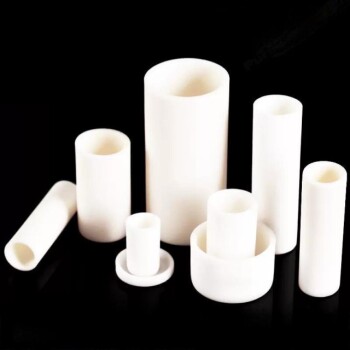
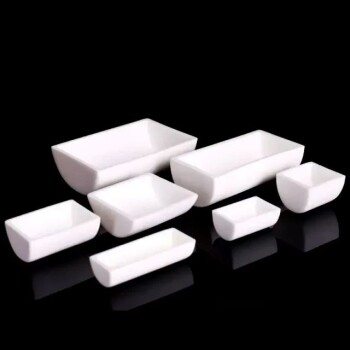
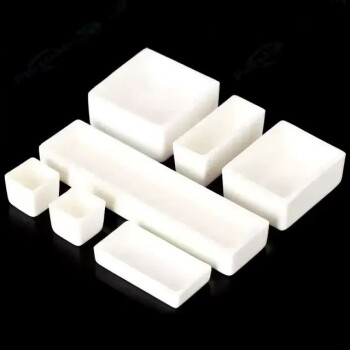
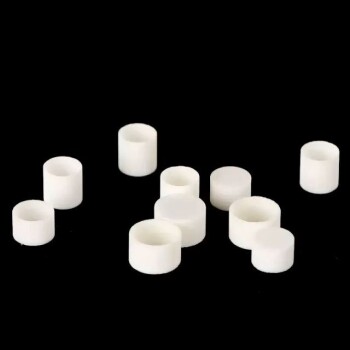
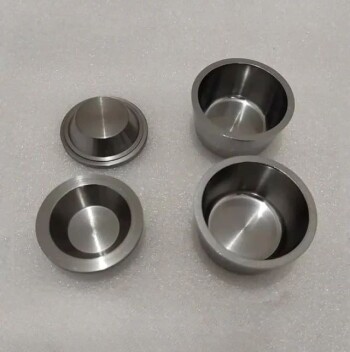
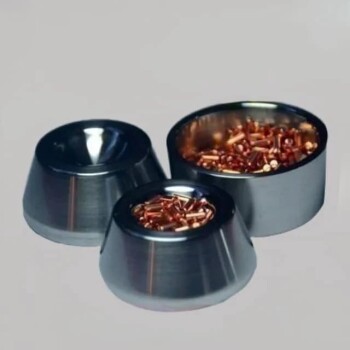
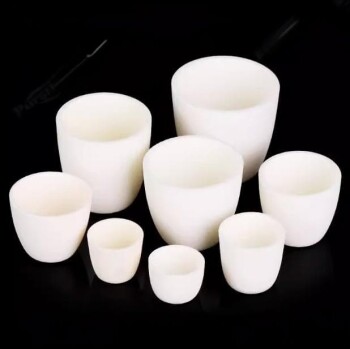
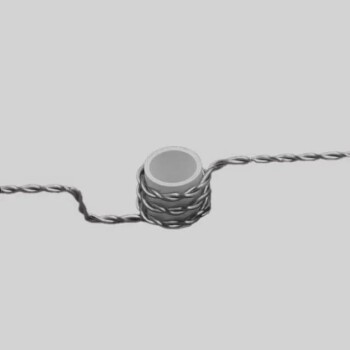
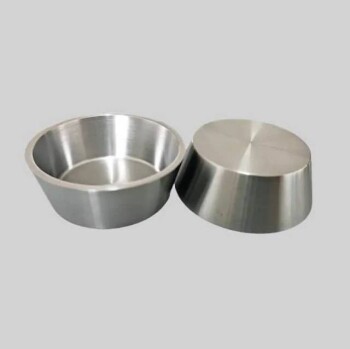
The combination of an alumina crucible and a molybdenum lid is essential for maintaining the chemical and structural integrity of uranium dioxide during high-temperature sintering. This specific pairing ensures that the sample remains isolated from impurities while the local atmosphere is strictly controlled. The alumina provides a stable, non-reactive base, while the molybdenum lid acts as a shield against trace oxygen that could otherwise degrade the doped uranium dioxide crystal structure.
This material configuration creates a dual-layer protection system: the alumina prevents physical and chemical contamination from the container, while the molybdenum lid maintains the necessary reducing environment. This synergy is vital for ensuring the precise stoichiometry and phase purity of $UO_2$ samples at extreme temperatures.
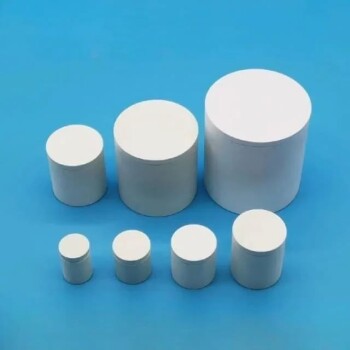
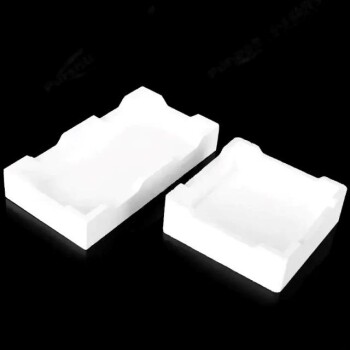
The Role of the Alumina Crucible
Superior Thermal Resistance and Refractoriness
Alumina ($Al_2O_3$) is selected primarily for its ability to withstand extreme temperatures, often reaching up to 1800°C, without deforming or melting. Its high refractoriness ensures the crucible remains structurally sound throughout the long duration of a sintering cycle. This stability is critical for maintaining the consistent geometry of the $UO_2$ samples during the densification process.
Chemical Inertness and Purity
High-purity alumina is exceptionally chemically inert, meaning it does not react with the uranium dioxide or its dopants at high temperatures. This prevents the introduction of unwanted elements into the sample, which is vital for nuclear material research where phase purity is paramount. By acting as a passive container, alumina ensures that any measured changes in the sample are due to the sintering process itself, not crucible interaction.
Prevention of Sample Adhesion
In high-temperature environments, samples can often fuse or react with their containers, leading to fractures during cooling. Alumina's properties minimize this risk, and in some applications, a layer of alumina powder is used at the bottom to provide additional physical isolation. This ensures the sintered $UO_2$ can be removed intact for subsequent analysis or use.
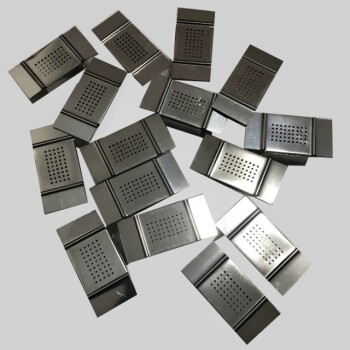
The Strategic Function of the Molybdenum Lid
Protection Against Trace Oxygen
Uranium dioxide is highly sensitive to its environment; even trace amounts of oxygen can lead to hyper-stoichiometry, altering the material's properties. A molybdenum lid acts as a physical and chemical barrier that blocks trace oxygen from entering the crucible's interior. This ensures that the $UO_2$ maintains its specific crystal structure and does not oxidize further during the heating process.
Stability in Reducing Atmospheres
Sintering of $UO_2$ typically occurs in reducing atmospheres (such as hydrogen) to maintain the desired oxidation state. Molybdenum is uniquely suited for this because it remains stable and does not degrade in these specific chemical environments at extreme temperatures. Unlike other metals, molybdenum maintains its structural integrity and protective qualities throughout the entire thermal cycle.
Maintaining Local Vapor Concentration
The lid also serves to stabilize the micro-environment within the crucible by preventing the rapid escape of volatile components. This helps maintain necessary concentration gradients near the sample surface, which is crucial for uniform grain growth. By containing the local atmosphere, the molybdenum lid ensures a more controlled and repeatable sintering outcome.
Understanding the Trade-offs and Limitations
Thermal Shock Sensitivity
While alumina is highly refractory, it is susceptible to thermal shock if heated or cooled too rapidly. This requires careful control of the furnace ramp rates to prevent the crucible from cracking and exposing the sample. Sudden temperature changes can compromise the entire experiment by failing the containment vessel.
Atmosphere Requirements for Molybdenum
Molybdenum is excellent in reducing or inert atmospheres but will oxidize rapidly if exposed to air at high temperatures. If the furnace seals fail or the atmosphere becomes oxidizing, the molybdenum lid will degrade into volatile molybdenum oxides. This creates a dependency on a strictly controlled furnace environment to protect the lid itself.
Material Compatibility
At temperatures exceeding 1800°C, even alumina may begin to approach its functional limit in certain specialized environments. Users must ensure that the specific dopants in the $UO_2$ do not form low-melting-point eutectics with the alumina. Failure to account for these chemical interactions can lead to crucible failure and sample loss.
How to Optimize Your Sintering Setup
Tailoring the Setup to Your Research Goals
Choosing the right materials depends on the specific outcome required for your $UO_2$ pellets. Consider the following recommendations based on your primary objective:
- If your primary focus is phase purity: Utilize high-purity (99.9%+) alumina crucibles to eliminate any risk of trace element migration into the $UO_2$ lattice.
- If your primary focus is oxygen-to-metal (O/M) ratio control: Ensure the molybdenum lid has a tight tolerances and consider a "getter" material to further strip trace oxygen from the local environment.
- If your primary focus is high-throughput industrial sintering: Evaluate molybdenum crucibles for temperatures above 2000°C, though alumina remains the standard for most laboratory-scale $UO_2$ research.
By combining the structural reliability of alumina with the atmospheric protection of molybdenum, you create the ideal environment for high-precision uranium dioxide sintering.
Summary Table:
| Component | Primary Function | Key Advantage in Sintering |
|---|---|---|
| Alumina Crucible | Thermal Resistance & Inertness | Prevents sample contamination and withstands up to 1800°C. |
| Molybdenum Lid | Atmospheric Shielding | Blocks trace oxygen and maintains a stable reducing environment. |
| Combined System | Synergistic Protection | Ensures precise stoichiometry and uniform grain growth for $UO_2$. |
Optimize Your High-Temperature Research with KINTEK
Precision in nuclear material research and advanced ceramics requires equipment that can withstand the most demanding thermal environments. KINTEK specializes in providing high-performance laboratory solutions tailored for high-precision sintering and material synthesis.
Whether you need a high-temperature muffle or tube furnace with precise atmosphere control, or high-purity alumina and ceramic crucibles to ensure sample integrity, our portfolio is designed to meet the rigorous standards of your laboratory. We offer a comprehensive range of:
- Advanced Furnaces: Muffle, tube, vacuum, CVD, and atmosphere-controlled systems.
- Precision Consumables: High-purity alumina, molybdenum components, and ceramic crucibles.
- Sample Preparation: Hydraulic presses, crushing systems, and milling equipment.
Ready to enhance your lab's efficiency and experimental repeatability? Contact our technical experts today to find the perfect equipment and consumable configuration for your high-temperature applications.
References
- Sonia García-Gómez, Joan de Pablo Ribas. Oxidative dissolution mechanism of both undoped and Gd<sub>2</sub>O<sub>3</sub>-doped UO<sub>2</sub>(s) at alkaline to hyperalkaline pH. DOI: 10.1039/d3dt01268a
This article is also based on technical information from Kintek Solution Knowledge Base .
Related Products
- Engineering Advanced Fine Ceramics Alumina Al2O3 Crucible With Lid Cylindrical Laboratory Crucible
- Alumina Al2O3 Ceramic Crucible Semicircle Boat with Lid for Engineering Advanced Fine Ceramics
- Engineering Advanced Fine Alumina Al2O3 Ceramic Crucible for Laboratory Muffle Furnace
- Engineering Advanced Fine Ceramics Alumina Crucibles (Al2O3) for Thermal Analysis TGA DTA
- Electron Beam Evaporation Coating Tungsten Crucible and Molybdenum Crucible for High Temperature Applications
People Also Ask
- Why are high-purity alumina crucibles used for liquid lead corrosion experiments? Ensure Data Accuracy at 550°C
- Why are alumina crucibles and mother powder essential for LATP sintering? Optimize Your Solid Electrolyte Performance
- What is the primary purpose of using alumina crucibles for LLTO ceramics? Optimize Your High-Temperature Sintering
- Why Use Alumina Crucibles & Powder Burial for NaSICON? Ensure Phase Purity and Prevent Elemental Volatilization
- Why are alumina crucibles used as containers during the tungsten diffusion coating process on diamond surfaces?