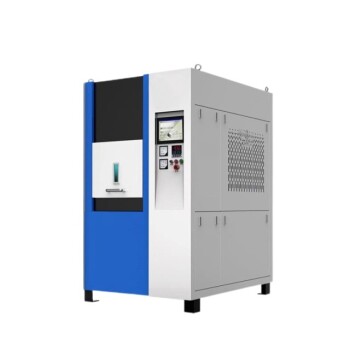
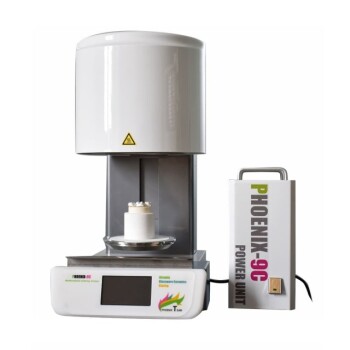
Atmosphere-controlled sintering furnaces are essential because they provide the specific chemical environment—typically high-purity nitrogen—required to trigger spontaneous infiltration. This process facilitates a critical reaction between magnesium and nitrogen to form compounds that dramatically improve the wettability of molten aluminum, allowing it to penetrate ceramic preforms via capillary action without the need for external pressure.
In pressureless infiltration, the furnace acts as a chemical reactor that modifies the surface chemistry of the materials. By precisely controlling the gas composition, the equipment overcomes the natural repulsion between molten aluminum and ceramics, ensuring a dense, high-strength composite.
The Chemical Role of Nitrogen in Infiltration
Facilitating the Magnesium-Nitrogen Reaction
In a nitrogen-rich environment, the magnesium within the infiltration alloy evaporates and reacts with the gas to form magnesium nitride. This compound is a vital intermediate that coats the surfaces of the ceramic reinforcement.
Improving Ceramic-to-Metal Wettability
The magnesium nitride eventually converts into aluminum nitride, which significantly increases the surface energy of the ceramic preform. This shift in chemistry allows the molten aluminum alloy to "wet" the ceramic, enabling it to flow spontaneously into the pores of the preform through capillary forces.
Enabling Spontaneous Infiltration
Without this specific atmosphere, the molten aluminum would bead up on the ceramic surface rather than entering it. The furnace ensures that the environment is pure enough for these reactions to occur consistently, resulting in a defect-free matrix-reinforcement interface.
Preventing Matrix and Reinforcement Degradation
Breaking the Oxide Barrier
Aluminum is highly reactive and forms a stubborn alumina ($Al_2O_3$) film when exposed to even trace amounts of oxygen. The atmosphere-controlled furnace excludes oxygen to prevent this film from forming, as it would otherwise act as a physical barrier to atomic diffusion and infiltration.
Protecting Sensitive Reinforcements
Advanced reinforcements, such as graphene or carbon nanotubes, are highly susceptible to thermal degradation and oxidation at infiltration temperatures (often between 570°C and 650°C). A controlled inert or reducing atmosphere preserves the structural integrity of these materials, ensuring they provide the intended mechanical benefits.
Ensuring Strong Interfacial Bonding
By providing a high-purity environment, the furnace ensures that the bond between the metal matrix and the reinforcement is pure and metallurgical. This prevents the formation of brittle phases or oxide impurities that would otherwise decrease the overall strength of the composite.
Achieving Structural Integrity and Density
Facilitating Atomic Diffusion
The furnace maintains a precise temperature range, typically near the melting point of the aluminum matrix, to promote atomic diffusion. This allows the metal and reinforcement particles to form strong bonds and eliminates residual pores within the structure.
Gas Elimination and Pore Reduction
In certain configurations, such as vacuum-assisted sintering, the furnace helps remove adsorbed gases from the gaps between powder particles. Eliminating these gases is essential for achieving the material’s theoretical density and ensuring high micro-hardness.
Understanding the Trade-offs
The Cost of Atmospheric Purity
Maintaining high-purity nitrogen or argon environments increases operational costs compared to standard air furnaces. The requirement for specialized seals and continuous gas flow adds complexity to the manufacturing process.
Chemical Specificity
An atmosphere that works for one alloy may be detrimental to another. While nitrogen is required for the magnesium-driven infiltration of AMCs, other composites may require a high vacuum or pure argon to prevent unwanted side reactions that could embrittle the matrix.
Selecting the Right Environment for Your Goal
How to Apply This to Your Project
- If your primary focus is achieving spontaneous infiltration: Utilize high-purity nitrogen to facilitate the magnesium-nitride reaction necessary for capillary flow.
- If your primary focus is protecting carbon-based reinforcements: Use a high-purity argon atmosphere or a vacuum to prevent oxidation and thermal degradation of the reinforcement phase.
- If your primary focus is maximizing material density: Ensure the furnace provides precise temperature control and a continuous gas flow to eliminate pores and promote clean metallurgical bonding.
By mastering the furnace atmosphere, you transform a simple heating process into a sophisticated chemical tool for creating high-performance materials.
Summary Table:
| Feature/Function | Role in AMC Infiltration | Key Benefit |
|---|---|---|
| Nitrogen Atmosphere | Triggers Magnesium-Nitride reaction | Enables spontaneous capillary infiltration |
| Oxygen Exclusion | Prevents $Al_2O_3$ oxide film formation | Eliminates physical barriers to atomic diffusion |
| Inert/Reducing Gas | Protects sensitive reinforcements (e.g., CNTs) | Preserves structural integrity and strength |
| Vacuum/Gas Flow | Removes adsorbed gases between particles | Eliminates porosity to reach theoretical density |
| Precision Control | Maintains metallurgical bonding temperatures | Ensures strong, defect-free matrix interfaces |
Elevate Your Composite Manufacturing with KINTEK
Unlock the full potential of your Aluminum Matrix Composites with KINTEK’s industry-leading thermal solutions. Whether you are facilitating magnesium-driven spontaneous infiltration or protecting delicate carbon nanotubes, our advanced atmosphere, vacuum, and CVD furnaces provide the precise chemical control your research demands.
From high-temperature reactors and autoclaves to specialized hydraulic presses and milling systems, KINTEK offers a comprehensive ecosystem of laboratory equipment and high-purity consumables (PTFE, ceramics, and crucibles) designed for high-performance material science.
Ready to achieve defect-free, high-density composites? Contact our technical experts today to find the perfect furnace configuration for your specific alloy requirements!
References
- Maxim L. Seleznev, J. L. Faust. Fabrication and tunable reinforcement of net-shaped aluminum matrix composite parts via 3D printing. DOI: 10.1038/s41598-023-43514-y
This article is also based on technical information from Kintek Solution Knowledge Base .
Related Products
- Mesh belt controlled atmosphere furnace
- Controlled Nitrogen Inert Hydrogen Atmosphere Furnace
- 1200℃ Controlled Atmosphere Furnace Nitrogen Inert Atmosphere Furnace
- 1700℃ Controlled Atmosphere Furnace Nitrogen Inert Atmosphere Furnace
- 1400℃ Controlled Atmosphere Furnace with Nitrogen and Inert Atmosphere
People Also Ask
- What are some of the reasons why a controlled atmosphere furnace is desirable in sintering? Achieve Superior Sintering Results
- What role does a controlled atmosphere furnace with argon gas flow play in the production of reduced graphene oxide (rGO)?
- Why is a furnace equipped with a controlled atmosphere necessary for the preparation of active metal catalysts?
- What is the process of a mesh belt furnace? Achieve Consistent, High-Volume Heat Treatment
- How does a mesh belt furnace work? Achieve High-Volume, Repeatable Heat Treatment