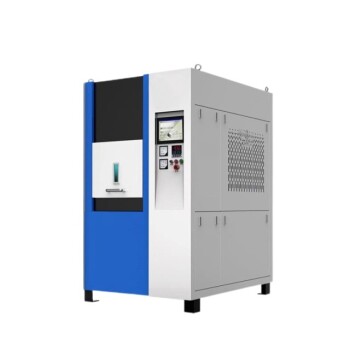
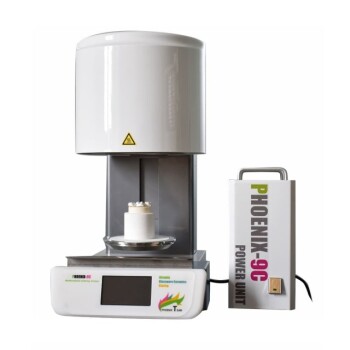
An atmosphere sintering furnace is explicitly required for this process to provide a controlled pure oxygen environment while delivering the precise thermal energy needed to crystalize the coating. Without this specific equipment, you cannot simultaneously stabilize the high-nickel chemistry of the NMC811 core and convert the precursor materials into a functional LiNbO3 protective layer.
Core Takeaway: The atmosphere sintering furnace serves as the "reaction chamber" that transforms raw chemical precursors into a dense, crystalline barrier. It effectively seals the cathode surface to prevent destructive side reactions with sulfide electrolytes, ensuring the battery functions safely and efficiently.
The Critical Role of the Oxygen Atmosphere
Stabilizing High-Nickel Chemistry
NMC811 is a "high-nickel" cathode material, which inherently suffers from instability during thermal processing.
Without a pure oxygen environment, the Nickel ions on the surface are prone to reduction, changing from stable Ni3+ to unstable Ni2+. The atmosphere furnace prevents this reduction, maintaining the correct valence state required for high capacity.
Preventing Structural Disorder
The presence of oxygen is also vital for minimizing cation mixing.
This creates an ordered arrangement of lithium and nickel atoms within the crystal lattice. If the atmosphere is not strictly controlled, the structural integrity of the NMC811 degrades, leading to a permanent loss of discharge capacity.
Driving Chemical Transformation
Converting Precursors to Crystals
The LiNbO3 coating begins as a mixture of alkoxide precursors (like sols or gels) covering the NMC811 particles.
The furnace provides the heat (typically around 400°C) necessary to decompose these organic precursors and remove residual solvents. This thermal treatment forces the remaining material to oxidize and crystallize into the final LiNbO3 buffer layer.
Ensuring a Dense Protective Layer
For the coating to work, it must be uniform and dense, acting as a physical shield.
The sintering process ensures the LiNbO3 forms a strong chemical bond with the NMC811 surface. This dense barrier effectively inhibits the side reactions that naturally occur between the cathode and sulfide solid electrolytes, which are notorious for degrading battery performance.
Understanding the Trade-offs
The Risk of Temperature Imbalance
While high heat is necessary for crystallization, there is a narrow window of operation.
If the temperature is too low, organic residues from the precursors will remain, blocking lithium ion movement. If the temperature is too high, you risk inducing unwanted diffusion between the coating and the cathode, damaging the active material.
Atmosphere Purity vs. Cost
Maintaining a continuous, high-purity oxygen flow increases operational costs compared to sintering in air.
However, attempting to sinter NMC811 in standard air is a common pitfall. The lower oxygen partial pressure in air is often insufficient to stabilize the Ni3+ ions in NMC811, leading to inferior structural stability despite the coating.
Making the Right Choice for Your Goal
To maximize the performance of your LiNbO3-coated NMC811 materials, tailor your furnace parameters to your specific performance targets:
- If your primary focus is Cycle Life: Prioritize coating density and uniformity by strictly controlling the heating ramp rate to ensure gradual and complete precursor decomposition.
- If your primary focus is Initial Capacity: Prioritize atmosphere purity, ensuring a 100% oxygen environment to maximize the retention of Ni3+ and prevent surface structural degradation.
The atmosphere sintering furnace is not just a heating tool; it is the chemical stabilizer that makes high-performance solid-state batteries viable.
Summary Table:
| Parameter | Role in Process | Impact on Material Quality |
|---|---|---|
| Pure Oxygen Flow | Prevents Ni3+ reduction to Ni2+ | High capacity and structural stability |
| Thermal Energy (~400°C) | Decomposes organic precursors | Converts sol-gel into crystalline LiNbO3 |
| Controlled Atmosphere | Minimizes cation mixing | Preserves ordered crystal lattice |
| Sintering Precision | Ensures dense coating layer | Inhibits side reactions with electrolytes |
Elevate Your Battery Research with KINTEK Precision
Unlock the full potential of your NMC811 cathode materials with KINTEK’s advanced atmosphere sintering furnaces. Achieving a high-performance LiNbO3 protective layer requires the perfect synergy of oxygen purity and thermal precision.
At KINTEK, we specialize in high-tier laboratory equipment designed for the most demanding R&D environments. Whether you are developing next-generation solid-state batteries or high-capacity storage solutions, our comprehensive portfolio—including high-temperature atmosphere furnaces, vacuum systems, and battery research consumables—ensures your materials achieve maximum structural integrity and cycle life.
Ready to optimize your sintering process? Contact our technical experts today to find the perfect furnace solution for your laboratory's needs!
Related Products
- Controlled Nitrogen Inert Hydrogen Atmosphere Furnace
- Mesh belt controlled atmosphere furnace
- 1200℃ Controlled Atmosphere Furnace Nitrogen Inert Atmosphere Furnace
- 1400℃ Controlled Atmosphere Furnace with Nitrogen and Inert Atmosphere
- 1700℃ Controlled Atmosphere Furnace Nitrogen Inert Atmosphere Furnace
People Also Ask
- Why is hydrogen used in furnaces? Achieve Superior Purity and Bright Finishes
- What is the role of a hydrogen atmosphere furnace in diamond/copper composites? Enhance Your Material Purity
- What are the characteristics and risks of a hydrogen atmosphere in a furnace? Master the Balance of Power and Control
- What role does an atmosphere furnace utilizing hydrogen gas play in Cu-Cr-Nb alloy powder pretreatment? (Key Insights)
- What is the use of hydrogen in furnace? A Key to Oxygen-Free High-Temperature Processing