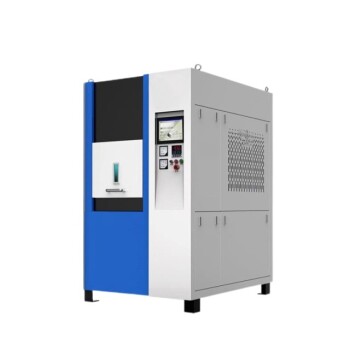
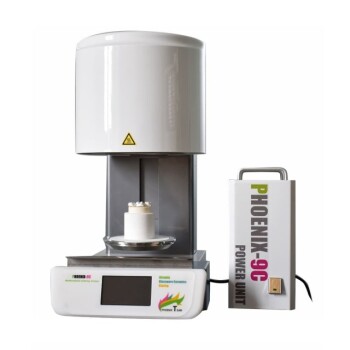
An atmosphere sintering furnace allows for precise control over the material’s defect chemistry. It is utilized for post-annealing ZnO ceramics in an argon environment primarily to eliminate amorphous phases at grain boundaries while simultaneously inducing oxygen desorption.
Core Takeaway While the heat of the furnace perfects the crystal structure and creates a dense material, the argon atmosphere specifically engineers the atomic lattice. It creates oxygen vacancies and interstitial zinc atoms, transforming the ceramic from a standard insulator into a material with high electrical conductivity.
The Role of Post-Annealing
To understand the furnace choice, one must first understand the state of the material immediately after the Cold Sintering Process (CSP).
Eliminating Structural Weaknesses
CSP is effective for initial densification, but it often leaves behind amorphous phases at the grain boundaries.
These amorphous regions act as barriers. They are electrically insulating and structurally imperfect, preventing the material from achieving its full potential.
Improving Crystallinity
Post-annealing exposes the ceramic to high temperatures (often around 1200°C).
This thermal energy forces the amorphous grain boundaries to crystallize. This process "heals" the microstructure, significantly improving the material's overall crystallinity.
Increasing Density
Heat treatment drives the final stage of densification.
While CSP achieves a baseline density (approx. 83%), post-annealing pushes the relative density to over 98%. This physical densification is critical for mechanical stability and performance consistency.
Why an Argon Environment?
The specific use of an atmosphere furnace (like a tube furnace) with argon gas addresses a deeper need: manipulating the electrical properties.
Inducing Oxygen Desorption
Standard air annealing would perfect the structure but might saturate it with oxygen.
Annealing in argon creates a low-oxygen partial pressure environment. This promotes oxygen desorption, effectively pulling oxygen atoms out of the ZnO lattice.
Creating Conductive Defects
When oxygen leaves the lattice, it leaves behind a "vacancy."
This process generates oxygen vacancies and interstitial zinc atoms. In semiconductor physics, these specific point defects act as charge carriers (donors).
Enhancing Electrical Conductivity
The combination of removing insulating amorphous barriers and creating donor defects results in a drastic change in properties.
The argon treatment significantly enhances the electrical conductivity of the ZnO ceramics, making them suitable for electronic applications where low resistance is required.
Understanding the Trade-offs
Using a specialized atmosphere furnace involves specific considerations compared to standard air firing.
Electrical vs. Ionic Conductivity
The atmosphere dictates the type of conductivity.
References suggest that while argon annealing promotes electrical conductivity (via vacancies), annealing in air (using a standard box furnace) helps remove carbon residues and may enhance ionic conductivity.
Equipment Complexity
Tube furnaces are necessary to maintain the inert argon atmosphere.
This setup is more complex than a standard muffle or box furnace, which typically operates in ambient air. You must ensure the tube seals are perfect to prevent oxygen ingress, which would negate the benefits of the argon treatment.
Making the Right Choice for Your Goal
The decision to use an atmosphere furnace with argon depends entirely on the final application of your ZnO ceramic.
- If your primary focus is high electrical conductivity: Use an atmosphere tube furnace with argon to generate oxygen vacancies and interstitial zinc.
- If your primary focus is high density and ionic conductivity: A standard high-temperature box or muffle furnace operating in air is likely sufficient and more cost-effective.
Ultimately, the argon atmosphere is the key lever that shifts your material from a dense ceramic into a highly conductive electronic component.
Summary Table:
| Feature | Cold Sintering Process (CSP) | Post-Annealing (Argon Atmosphere) |
|---|---|---|
| Relative Density | ~83% | >98% |
| Microstructure | Amorphous grain boundaries present | High crystallinity; "healed" grain boundaries |
| Atmosphere | Ambient/Pressure-based | Inert Argon (Low oxygen partial pressure) |
| Point Defects | Standard lattice | Increased oxygen vacancies & interstitial Zn |
| Main Benefit | Initial densification | High electrical conductivity & mechanical stability |
Elevate Your Material Research with KINTEK Precision
Unlock the full potential of your electronic ceramics and advanced materials with KINTEK’s high-performance atmosphere sintering solutions. Whether you need the precise gas control of our tube furnaces for argon annealing or the robust performance of our muffle and vacuum furnaces, we provide the tools necessary to engineer specific atomic defects and achieve superior crystallinity.
From high-temperature high-pressure reactors to specialized crushing and milling systems, KINTEK is the trusted partner for laboratories and manufacturers worldwide. Our comprehensive range of equipment—including hydraulic presses, electrolytic cells, and high-purity crucibles—is designed to meet the rigorous demands of battery research and semiconductor development.
Ready to achieve >98% density and peak electrical conductivity?
Contact KINTEK Today for a Tailored Equipment Quote
Related Products
- Mesh belt controlled atmosphere furnace
- Controlled Nitrogen Inert Hydrogen Atmosphere Furnace
- 1400℃ Controlled Atmosphere Furnace with Nitrogen and Inert Atmosphere
- 1200℃ Controlled Atmosphere Furnace Nitrogen Inert Atmosphere Furnace
- 1700℃ Controlled Atmosphere Furnace Nitrogen Inert Atmosphere Furnace
People Also Ask
- What are some of the reasons why a controlled atmosphere furnace is desirable in sintering? Achieve Superior Sintering Results
- What role does a controlled atmosphere furnace with argon gas flow play in the production of reduced graphene oxide (rGO)?
- Why is a furnace equipped with a controlled atmosphere necessary for the preparation of active metal catalysts?
- How does a mesh belt furnace work? Achieve High-Volume, Repeatable Heat Treatment
- What is the process of a mesh belt furnace? Achieve Consistent, High-Volume Heat Treatment