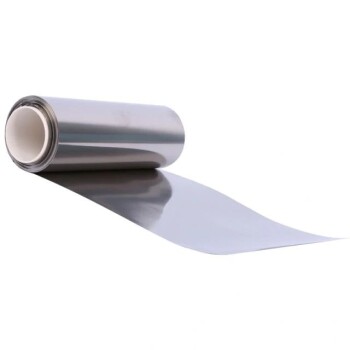
Flexible graphite foil acts as a critical interface layer within the hot pressing assembly, serving primarily to isolate the titanium powder from the mold walls. Its presence prevents the titanium from chemically reacting with the graphite mold at high temperatures, effectively mitigating the risks of severe adhesion and carbonization.
By creating a physical and chemical buffer, graphite foil prevents the fusing of reactive metals to the mold while absorbing the mechanical stresses caused by thermal expansion.
Chemical Isolation and Surface Protection
Preventing Carbonization Reactions
Titanium is highly reactive at the elevated temperatures required for hot pressing. Without a barrier, titanium powder in direct contact with a graphite mold will react to form titanium carbide.
Flexible graphite foil acts as a low-reactivity shield. It physically separates the powder from the mold wall, significantly reducing the likelihood of these unwanted carbonization reactions.
Eliminating Adhesion
When titanium reacts with the mold, it tends to stick or fuse to the surface. This adhesion can ruin the surface finish of the sintered part and damage the mold.
The foil functions as a non-stick liner. It ensures that the final consolidated part remains distinct from the tooling, preserving both the sample's integrity and the mold's reusability.
Mechanical Stability and Process Control
Managing Thermal Mismatch
Titanium and graphite have different coefficients of thermal expansion. As the assembly heats up and cools down, these materials expand and contract at different rates.
This mismatch creates significant internal stress. The flexibility of the foil allows it to act as a buffer, absorbing these stresses to prevent the sintered sample or the mold from cracking.
Compensating for Mold Irregularities
Graphite molds, even when machined well, may have minor surface imperfections.
The compressible nature of the foil allows it to conform to these irregularities. This ensures uniform pressure distribution during pressing and prevents the powder from flowing into small cracks or pores in the mold wall.
Facilitating Demolding
Removing a sintered sample from a rigid mold is a delicate process. High friction or adhesion can lead to breakage.
Because the foil prevents direct bonding, it simplifies the demolding process. The sample slides out more easily, reducing the mechanical force required to eject the part.
Understanding the Limitations
While graphite foil is essential, it is not a perfect solution for every variable. It is still a carbon-based material, meaning that at extreme temperatures or prolonged hold times, minor carbon diffusion into the titanium surface is still possible.
Furthermore, the foil adds a physical dimension to the setup. If the foil wrinkles during loading, those wrinkles will be imprinted onto the surface of the sintered part, requiring additional post-processing to remove.
Making the Right Choice for Your Goal
When designing your hot pressing assembly, consider how the foil interacts with your specific objectives.
- If your primary focus is Sample Purity: Ensure the foil is high-grade and consider minimizing hold times to strictly limit any potential carbon diffusion from the foil itself.
- If your primary focus is Mold Longevity: Prioritize the use of foil to prevent abrasive wear and chemical erosion of the mold walls, extending the life of your expensive tooling.
Using flexible graphite foil is the industry standard for ensuring clean separation and structural integrity in titanium sintering.
Summary Table:
| Feature | Function of Graphite Foil | Key Benefit |
|---|---|---|
| Chemical Barrier | Prevents titanium-graphite reactions | Stops carbonization & maintains purity |
| Non-Stick Liner | Eliminates direct metal-to-mold contact | Prevents part adhesion & mold damage |
| Thermal Buffer | Absorbs stress from thermal expansion | Prevents cracking of samples or molds |
| Surface Interface | Conforms to mold irregularities | Ensures uniform pressure distribution |
| Ejection Aid | Lowers friction during part removal | Facilitates easy, damage-free demolding |
Maximize Your Material Integrity with KINTEK Expertise
Precision in hot pressing requires more than just high-quality powders; it demands the right interface materials and equipment. KINTEK specializes in advanced laboratory solutions, offering a comprehensive range of crushing and milling systems, high-temperature furnaces, and hydraulic presses—including pellet, hot, and isostatic models—tailored for demanding metallurgy research.
Whether you are sintering reactive titanium or developing new alloys, our team provides the technical support and high-performance consumables (like graphite foils, ceramics, and crucibles) you need to achieve repeatable, high-purity results.
Ready to optimize your sintering process? Contact KINTEK today to consult with our experts and find the perfect equipment for your laboratory.
Related Products
- High-Purity Titanium Foil and Sheet for Industrial Applications
- Carbon Graphite Plate Manufactured by Isostatic Pressing Method
- High Purity Pure Graphite Crucible for Evaporation
- Double Plate Heating Press Mold for Lab
- High Purity Pure Graphite Crucible for Electron Beam Evaporation
People Also Ask
- What products are manufactured with titanium? The Ultimate Guide to High-Performance Materials
- What are the advantages of utilizing Polytetrafluoroethylene (PTFE) sheets as casting substrates? | KINTEK Solution
- In what way do portable laboratory consumables like PTFE sheets define a functional workspace? Transform Your Lab Bench
- What are the advantages of using titanium? Achieve Unmatched Strength and Corrosion Resistance
- What are the safety considerations for titanium? From Biocompatible Metal to Fire Hazard