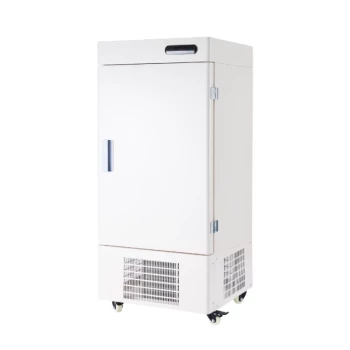
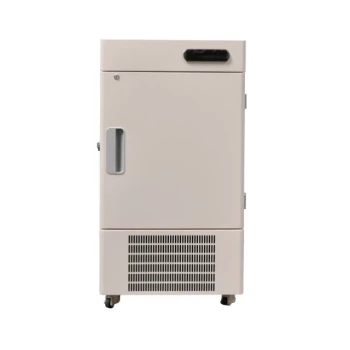
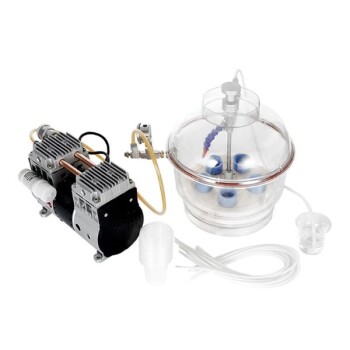
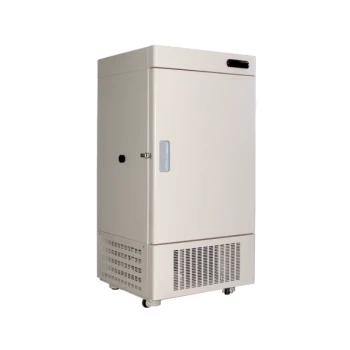
Freeze-drying is indispensable for this synthesis because it prevents the particle aggregation that inevitably occurs during traditional thermal evaporation. By removing solvents under low-temperature vacuum conditions, this method arrests solute recrystallization, locking the salt templates and precursor materials into a specific, uniform configuration required for high-quality porous carbon.
By bypassing the liquid phase during drying, freeze-drying ensures salt templates form multi-scale particles ranging from nanometers to micrometers. This specific distribution within the precursor matrix is the primary driver for achieving an ideal pore size distribution in the final 3D structure.
The Mechanism of Structural Preservation
Overcoming Thermal Evaporation Issues
Traditional drying methods rely on heat to evaporate solvents. This process typically triggers solute recrystallization.
As the solvent evaporates, the dissolved particles tend to migrate and clump together. This results in significant particle aggregation, which destroys the intended fine structure of the material.
The Role of Low-Temperature Vacuum
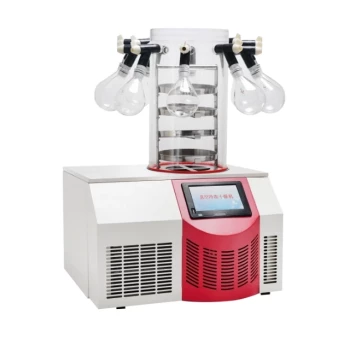
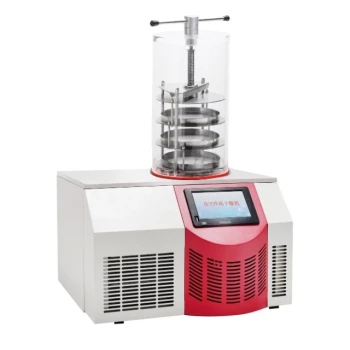
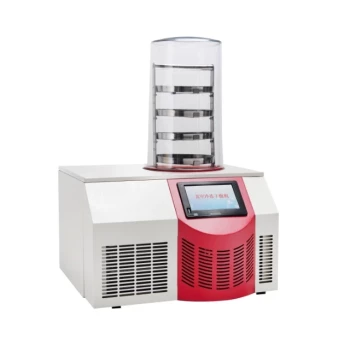
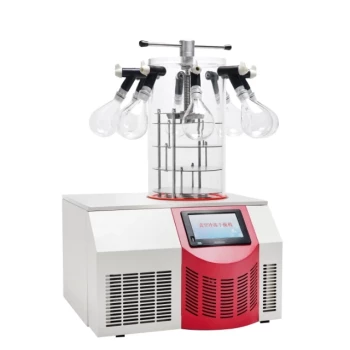
Freeze-drying equipment operates by freezing the material and then reducing the pressure to allow frozen water (or solvent) to sublime directly from solid to gas.
Because the solvent is removed without passing through the liquid phase, the structural integrity of the mixture is preserved. The components remain locked in place rather than flowing and merging.
Optimizing the Salt Template
Achieving Multi-Scale Particle Sizes
For hierarchical porous carbon, you need a variety of pore sizes. Freeze-drying facilitates the formation of salt template particles across a broad spectrum.
Specifically, it allows for the creation of particles ranging from the nanometer scale up to the micrometer scale. This diversity is essential for creating a hierarchical 3D architecture.
Uniform Distribution in the Matrix
When mixing salt templates with precursors such as glucose, uniformity is key.
The freeze-drying process ensures these multi-scale salt particles are evenly distributed throughout the precursor matrix. This homogeneity prevents "dead zones" in the material where porosity might be lacking.
The Resulting Carbon Architecture
Translating Template to Structure
The arrangement of the salt template directly dictates the structure of the carbon after carbonization.
Because freeze-drying prevents aggregation and ensures distribution, the salt acts as a perfect mold.
Ideal Pore Size Distribution
Once the carbonization is complete and the salt is washed away, the resulting voids mirror the template.
Consequently, the final material exhibits an ideal pore size distribution. This specific 3D structure is difficult, if not impossible, to replicate using standard heating methods.
Understanding the Trade-offs
Equipment Cost and Complexity
While indispensable for quality, freeze-drying represents a significant investment compared to standard drying ovens.
The equipment is more complex to operate and maintain, requiring vacuum pumps and precise temperature controls.
Processing Time
The sublimation process is inherently slower than thermal evaporation.
Researchers must account for longer cycle times to achieve the necessary dryness, which can become a bottleneck in high-throughput environments.
Making the Right Choice for Your Synthesis Goal
While freeze-drying is the superior technical choice for this specific application, understanding your project goals will help you apply it effectively.
- If your primary focus is high-performance morphology: Prioritize freeze-drying to ensure multi-scale porosity and prevent the structural collapse associated with recrystallization.
- If your primary focus is maintaining precursor integrity: Use freeze-drying to prevent the degradation of sensitive precursors, similar to how biological samples or graphene are preserved.
For 3D hierarchical porous carbon, freeze-drying is not just a drying step; it is a structural engineering tool that defines the final performance of your material.
Summary Table:
| Feature | Freeze-Drying Method | Traditional Thermal Evaporation |
|---|---|---|
| Phase Transition | Sublimation (Solid to Gas) | Evaporation (Liquid to Gas) |
| Particle Aggregation | Prevented; particles remain locked | High; prone to solute recrystallization |
| Pore Size Control | Multi-scale (nm to µm) | Limited; non-uniform |
| Structural Outcome | Uniform 3D hierarchical architecture | Collapsed or aggregated structure |
| Application Focus | High-performance morphology | Basic material drying |
Elevate your material synthesis with KINTEK's precision laboratory solutions. Whether you are developing 3D hierarchical porous carbon using the salt template method or advancing battery research, our high-performance freeze dryers, high-temperature furnaces, and crushing systems provide the structural control you need. Don't let aggregation compromise your results—leverage KINTEK's expertise in cooling solutions and thermal processing to achieve ideal pore size distributions. Contact our specialists today to find the perfect equipment for your research goals!
References
- Yinyu Xiang, Yutao Pei. Status and perspectives of hierarchical porous carbon materials in terms of high‐performance lithium–sulfur batteries. DOI: 10.1002/cey2.185
This article is also based on technical information from Kintek Solution Knowledge Base .
Related Products
- High Performance Laboratory Freeze Dryer
- High Performance Laboratory Freeze Dryer for Research and Development
- Benchtop Laboratory Vacuum Freeze Dryer
- Benchtop Laboratory Freeze Dryer for Lab Use
- Small Cryogenic Grinder Cryomill Cryogrinder with Liquid Nitrogen for Laboratory Use
People Also Ask
- What role does a laboratory freeze dryer play in the synthesis of graphene-based electrocatalysts? Preserve 3D Structures
- What are the technical advantages of using a laboratory freeze dryer for porous carbon precursors? Preserve 3D Networks
- What types of liquid samples can be processed using a laboratory freeze dryer? Preserve Your Sensitive Materials
- How do laboratory freeze dryers support scientific research? Preserve Sample Integrity for Reproducible Results
- Why is a laboratory freeze dryer preferred over traditional heating? Preserve Biochar Structure & Maximize Porosity