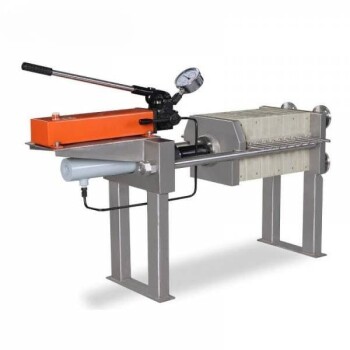
High-pressure pressing is the physiological foundation of ceramic engineering. By applying axial pressures—often reaching 300 MPa or more—a laboratory hydraulic press transforms loose, mixed powders into a cohesive "green body." This process is essential because it eliminates internal voids and maximizes particle-to-particle contact, which are the non-negotiable prerequisites for achieving full densification during subsequent high-temperature sintering.
Core Takeaway: High-pressure pressing dictates the final quality of a glass-ceramic by establishing the necessary initial density and mechanical strength. Without this critical consolidation phase, the material cannot achieve 100% relative density or survive the stresses of downstream thermal processing.
Maximizing Green Body Density
Air Elimination and Particle Rearrangement
The primary role of the hydraulic press is to force out air trapped between powder particles. Under high axial pressure, particles undergo a physical rearrangement, sliding into a more efficient, tightly packed configuration that minimizes interstitial space.
Increasing Coordination Number
High-pressure environments significantly increase the coordination number, which is the number of neighbor particles in direct contact with a single particle. This increased contact area is fundamental for the diffusion processes that occur during sintering at temperatures like 950 °C.
Achieving High Relative Density
For specialized systems, such as zirconia-filled glass-ceramics, a high initial compaction density is the only way to reach 100% relative density. This dense packing ensures that there are no large internal gaps that would otherwise remain as permanent pores in the finished product.
Establishing Structural Integrity
Mechanical Interlocking and Green Strength
The pressure applied—often several tons—induces physical interlocking between particles, such as glass powder and ball clay. This gives the green body the "green strength" required for technicians to handle and move the sample without it crumbling or cracking.
Geometric Precision and Shaping
Using high-precision steel molds, the hydraulic press establishes the basic geometric profile of the component. This provides a stable electrode or charge morphology that is critical for specialized applications like vacuum arc melting or ceramic tool production.
Controlling Final Porosity
By precisely regulating the input pressure (e.g., 100 MPa to 250 MPa), researchers can preset the initial density. This control is vital for applications requiring specific open porosity, such as creating capillary channels for molten silicon infiltration.
Optimizing Downstream Processing
Minimizing Sintering Shrinkage
A higher green density directly correlates to reduced shrinkage during the sintering phase. By consolidating the powder as much as possible before heat is applied, the risk of dimensional distortion or structural warping is significantly mitigated.
Facilitating Liquid Phase Flow
In porcelain and glass-ceramic structures, high-pressure molding ensures tight packing that facilitates liquid phase flow at lower temperatures. This allows the melting glass phase to efficiently fill any remaining micro-pores, resulting in a vacuum-tight, high-density structure.
Preparing for Advanced Densification
For composite materials, uniaxial pressing provides the physical conditions necessary for Hot Isostatic Pressing (HIP). The initial high-pressure compaction ensures the particles are close enough to undergo rapid densification when subjected to the simultaneous heat and pressure of the HIP process.
Understanding the Trade-offs
Pressure Gradients and Non-Uniformity
While high pressure is beneficial, it can lead to pressure gradients within the green body, where the density is higher near the plunger than in the center. If not managed through proper mold lubrication or double-action pressing, this can cause uneven shrinkage and internal stress.
The Risk of Delamination
Applying excessive pressure too rapidly, or releasing it too quickly, can lead to delamination or "capping" cracks. These defects occur when trapped air cannot escape or when the elastic recovery of the powder exceeds the strength of the green body upon pressure release.
Implementing Pressing Strategy for Your Project
Recommendations Based on Goal
- If your primary focus is 100% theoretical density: Utilize the highest recommended axial pressure (e.g., 300 MPa) to maximize the coordination number before sintering.
- If your primary focus is dimensional accuracy: Prioritize precise pressure regulation and high-precision molds to minimize non-uniform shrinkage during the firing stage.
- If your primary focus is controlled infiltration: Calibrate the hydraulic press to a lower, specific pressure (e.g., 200 MPa) to maintain a consistent 30% open porosity.
The laboratory hydraulic press is not merely a shaping tool, but a precision instrument that determines the ultimate physical limits and performance of the glass-ceramic material.
Summary Table:
| Key Benefit | Mechanism / Impact | Technical Outcome |
|---|---|---|
| Density Optimization | Particle rearrangement & air removal | Achieves up to 100% relative density |
| Structural Integrity | Mechanical interlocking of particles | High green strength for safe handling |
| Sintering Efficiency | Increased particle coordination number | Minimized shrinkage & dimensional warping |
| Process Control | Precise axial pressure regulation | Preset porosity for specialized applications |
| Surface Quality | High-precision mold compaction | Defined geometric profile and smooth finish |
Elevate Your Material Research with KINTEK Precision
Achieving 100% relative density and structural perfection in glass-ceramics requires more than just pressure—it requires precision. KINTEK specializes in high-performance laboratory equipment tailored for advanced materials engineering. Our comprehensive portfolio includes:
- Hydraulic Presses: Advanced pellet, hot, and isostatic presses for superior green body forming.
- High-Temperature Furnaces: Muffle, vacuum, tube, and CVD furnaces for optimized sintering and heat treatment.
- Sample Preparation: Crushing and milling systems, sieving equipment, and high-purity crucibles.
- Specialized Tools: High-pressure reactors, electrolytic cells, and cooling solutions like ULT freezers.
Whether you are a researcher aiming for theoretical density or a manufacturer seeking consistent structural integrity, KINTEK provides the reliable tools and technical expertise you need.
Ready to optimize your pressing strategy? Contact us today to find the perfect equipment for your lab!
References
- Dilara Arıbuğa, Buğra Çiçek. Effect of Al2O3 and ZrO2 Filler Material on the Microstructural, Thermal and Dielectric Properties of Borosilicate Glass-Ceramics. DOI: 10.3390/mi14030595
This article is also based on technical information from Kintek Solution Knowledge Base .
Related Products
- Laboratory Hydraulic Press Lab Pellet Press Machine for Glove Box
- Laboratory Hydraulic Press Split Electric Lab Pellet Press
- Laboratory Hydraulic Press Lab Pellet Press for Button Battery
- Automatic Laboratory Hydraulic Press for XRF & KBR Pellet Press
- Automatic Laboratory Hydraulic Pellet Press Machine for Lab Use
People Also Ask
- What is the function of a laboratory hydraulic press in W-Cu composites? Control Porosity and Material Ratio
- What is the role of a laboratory hydraulic press in the initial stages of Li6PS5Cl preparation? Key to Green Pellets
- What role does a laboratory hydraulic press play in triboelectric testing? Achieve Precision Alloy Sample Prep
- How can a laboratory hydraulic press be applied to chitosan for wastewater treatment? Optimize Pores & Strength
- How do a precision laboratory hydraulic press and specialized molds contribute to the fabrication of spherical ceramic samples? Achieving High-Density Material Precision