Mechanical stirring or shaking is a fundamental requirement in azo dye degradation to ensure accurate kinetic measurements. Its primary function is to maximize the physical contact between the solid catalyst (such as amorphous alloy ribbons) and the liquid dye solution. Without this agitation, the reaction rate becomes artificially limited by physical transport constraints rather than the actual chemical efficiency of the catalyst.
By eliminating mass transfer resistance and preventing surface passivation, mechanical agitation ensures the reaction rate is limited only by the chemical process itself, not by how fast molecules can swim to the surface.
Eliminating Mass Transfer Resistance
The most critical role of stirring is to bridge the gap between the solid and liquid phases.
Overcoming the Liquid-Phase Barrier
In a static solution, a stagnant layer of liquid surrounds the solid catalyst. Reactants must slowly diffuse through this layer to reach the active sites.
Mechanical stirring eliminates this liquid-phase mass transfer resistance. By forcing fluid movement, you constantly refresh the solution near the catalyst surface.
Ensuring Sufficient Contact
For catalysts like amorphous alloy ribbons, the surface area is the reaction engine.
Efficient shaking ensures these solids are not isolated in a pocket of depleted solution. It guarantees that fresh dye molecules are continuously brought into contact with the catalyst.
Preserving Active Surface Sites
Reaction byproducts can be just as problematic as the depletion of reactants.
Preventing Passivation Films
As the azo dye degrades, reaction products are generated at the catalyst surface.
Without agitation, these products can accumulate, forming a passivation film. This film acts as a physical barrier, blocking fresh reactants from reaching the catalyst.
Utilizing Shear Force
Stirring introduces a constant shear force across the surface of the catalyst.
This physical force effectively "scrubs" the surface, preventing the accumulation of blocking agents. This ensures the continuous exposure of active sites, allowing the heterogeneous catalytic reduction reaction to proceed at its maximum potential rate.
Ensuring System Homogeneity
Beyond the catalyst surface, stirring maintains the integrity of the bulk solution.
Eliminating Concentration Gradients
A static reactor will develop pockets of high and low concentration.
Agitation provides continuous mixing to maintain electrolyte homogeneity. This ensures that the degradation occurs uniformly throughout the reactor, rather than just in specific zones.
Achieving Adsorption-Desorption Equilibrium
Before verifying chemical degradation, one must account for physical adsorption (dye sticking to the surface).
Shaking allows the system to reach adsorption-desorption equilibrium quickly (often under dark conditions). This distinction is vital for proving that the dye is actually being chemically degraded, not just physically attached to the catalyst.
Understanding the Trade-offs
While stirring is necessary, the method and intensity must be controlled to avoid experimental errors.
Diffusion Control vs. Reaction Control
If stirring is too slow, your data measures the speed of diffusion, not the speed of the chemical reaction. This is known as the diffusion-limited regime.
Your goal is to stir fast enough to enter the reaction-limited regime, where mass transfer is no longer a bottleneck.
Physical Integrity of the Catalyst
While shear force cleans the surface, excessive agitation can be detrimental to fragile catalysts.
Care must be taken to ensure the mechanical force does not pulverize the catalyst or alter its morphology in a way that changes its active surface area during the experiment.
Making the Right Choice for Your Goal
The intensity and type of agitation should be matched to your specific experimental objective.
- If your primary focus is determining intrinsic reaction kinetics: Ensure high agitation speeds to completely eliminate the diffusion layer, so the measured rate reflects the true chemical activity of the catalyst.
- If your primary focus is separating adsorption from degradation: Use a dark-phase mixing step first to reach equilibrium, ensuring that subsequent concentration drops are due solely to the catalytic reaction.
Ultimately, consistent mechanical agitation transforms a chaotic, diffusion-dependent mixture into a controlled chemical environment where accurate data can be harvested.
Summary Table:
| Factor | Role of Stirring/Shaking | Benefit to Experiment |
|---|---|---|
| Mass Transfer | Eliminates stagnant liquid layers | Overcomes diffusion-limited reaction rates |
| Surface Active Sites | Provides shear force to 'scrub' catalyst | Prevents passivation films and byproduct buildup |
| Concentration | Maintains electrolyte homogeneity | Ensures uniform degradation and accurate data |
| Equilibrium | Accelerates adsorption-desorption | Distinguishes physical adsorption from chemical reaction |
Maximize Your Reaction Efficiency with KINTEK
Precise control over agitation is the key to transitioning from a diffusion-limited to a reaction-limited regime. At KINTEK, we specialize in providing the high-performance laboratory equipment and consumables needed to ensure experimental accuracy and consistency.
Whether you are studying azo dye degradation or advanced material synthesis, our portfolio of shakers, homogenizers, and high-temperature high-pressure reactors is designed to meet the rigorous demands of your research. We also offer essential consumables, including PTFE products and electrolytic cells, to complete your laboratory setup.
Ready to elevate your research standards? Contact our expert team today to discover how KINTEK can provide the tailored solutions and technical value your laboratory deserves.
References
- Changqin Zhang, Zhuangqi Hu. Rapid reductive degradation of azo dyes by a unique structure of amorphous alloys. DOI: 10.1007/s11434-011-4781-8
This article is also based on technical information from Kintek Solution Knowledge Base .
Related Products
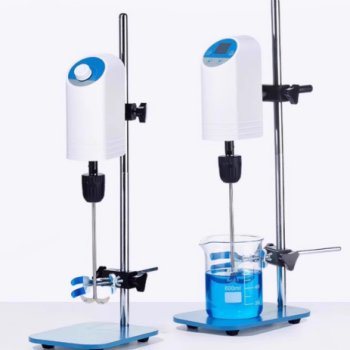
- High Performance Laboratory Stirrers for Diverse Applications
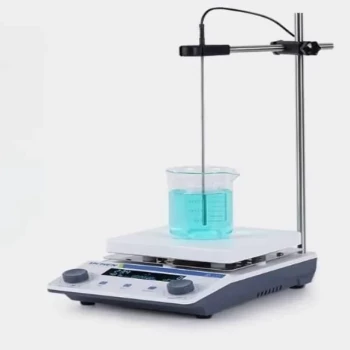
- Laboratory Small Constant Temperature Heated Magnetic Stirrer Heater and Stirrer
- Custom PTFE Teflon Parts Manufacturer for Magnetic Stirring Bar
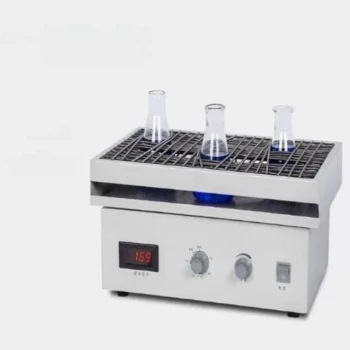
- Laboratory Multifunctional Small Speed-Adjustable Horizontal Mechanical Shaker for Lab
People Also Ask
- How does a laboratory stirrer influence MOF product quality? Master Precision in Non-Solvothermal Synthesis
- What critical role does a Laboratory Stirrer play during leaching? Enhance Titanium-Magnesium Waste Recovery
- What is the primary function of laboratory stirring equipment in the preparation of compost leachate? Optimize Extraction
- What is a laboratory mixer? A Guide to Achieving Perfect Sample Homogeneity
- What is a laboratory mixer used for? Choose the Right Tool for Liquids or Solids