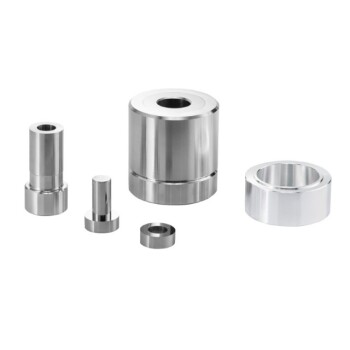
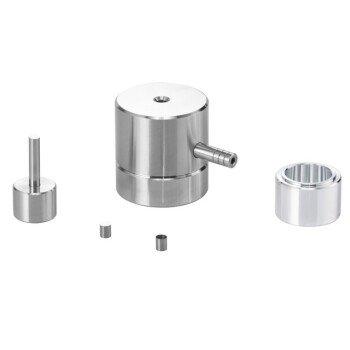
Pressure-maintaining dies are a mechanical necessity for the valid testing of all-solid-state batteries, serving as the primary defense against internal structural failure. Unlike liquid electrolytes that can flow to fill voids, solid-state components are rigid; without external pressure, the natural volume changes of electrode materials during cycling lead to physical separation and immediate performance loss.
These fixtures utilize mechanical methods, such as screw locking, to apply continuous stack pressure—often as high as 150 MPa. This external force effectively counteracts the expansion and contraction of active materials, ensuring the solid-solid interfaces remain intact for consistent ion transport.
The Core Insight In solid-state batteries, electrochemical functionality is entirely dependent on physical contact. Pressure-maintaining fixtures are not merely for containment; they are active components that compensate for the "breathing" of electrode materials, preventing delamination and high impedance that would otherwise render the battery inoperable after a few cycles.
The Mechanics of Interface Failure
Volume Expansion and Contraction
During the charge and discharge cycles, electrode materials undergo significant physical changes. Materials like lithium cobalt oxide (LCO), Sulfur, and NCM-811 experience chemo-mechanical effects that cause their volume to expand or contract.
For example, NCM-811 lattices contract during delithiation (charging), while Sulfur cathodes expand significantly.
The Consequence of Rigid Interfaces
In a liquid battery, the electrolyte flows to maintain contact with the electrode regardless of these volume changes. In an all-solid-state battery, however, the electrolyte is rigid.
When the electrode material shrinks or expands without constraint, it pulls away from the solid electrolyte. This creates physical gaps (voids) at the interface.
Immediate Performance Degradation
Once these gaps form, the contact necessary for ion movement is broken. This phenomenon, known as delamination, leads to a sharp increase in interfacial resistance (impedance) and a rapid decay in capacity.
How Pressure Fixtures Solve the Problem
Compensating for Volume Changes
Pressure-maintaining dies apply a constant external stack pressure, which acts as a mechanical buffer.
By compressing the cell components, the fixture forces the layers to remain in tight contact even as the active materials attempt to expand or contract. This effectively suppresses the physical separation that naturally occurs during cycling.
Maintaining Ion Transport Channels
Continuous pressure ensures that the active particles remain physically connected to the solid electrolyte.
This maintenance of "tight physical contact" preserves the pathways required for lithium ions to move between the anode and cathode. This is the primary factor in achieving long-term cycling stability.
Managing Lithium Deposition
For systems involving lithium metal, pressure is equally critical. It compensates for the volume changes caused by lithium deposition and stripping, ensuring that the interface remains stable and low-resistance throughout the process.
Critical Considerations in Pressure Application
Variability in Pressure Requirements
There is no single "correct" pressure setting; it is highly dependent on the battery chemistry.
While some testing scenarios (like those for LCO) may utilize high pressures around 150 MPa, others involving different chemistries or specific testing shells may operate effectively between 1.5 MPa and 17 MPa.
Matching Pressure to Chemistry
The specific mechanism of the electrode dictates the pressure strategy.
For example, testing NCM-811 requires pressure specifically to counteract lattice contraction, whereas Sulfur cathodes require pressure to manage significant expansion. Applying a "standard" pressure without regarding the specific material properties can lead to inaccurate test results.
Making the Right Choice for Your Testing
- If your primary focus is oxide-based cathodes (e.g., LCO): Ensure your fixtures can sustain high pressures (up to 150 MPa) to effectively counter the volume expansion inherent to these materials.
- If your primary focus is lithium metal stability: Target a pressure range typically between 1.5 MPa and 17 MPa to manage deposition and stripping without exerting excessive force that might damage the separator.
- If your primary focus is extended cycle life: Prioritize fixtures with robust mechanical locking (e.g., screw locking) that maintain constant pressure over time, as even minor relaxation can lead to irreversible impedance growth.
Your testing fixture must act as a dynamic containment system that actively preserves solid-solid contact against the inevitable chemo-mechanical shifts of the battery chemistry.
Summary Table:
| Feature | Impact on All-Solid-State Batteries |
|---|---|
| Primary Function | Compels physical contact between rigid solid-solid interfaces |
| Mechanism | Compensates for chemo-mechanical volume expansion/contraction |
| Pressure Range | Varies by chemistry; typically 1.5 MPa to 150 MPa |
| Core Benefit | Prevents delamination and reduces interfacial impedance |
| Failure Mode Without Dies | Immediate capacity decay due to physical separation (voids) |
Maximize Your Battery Research Precision with KINTEK
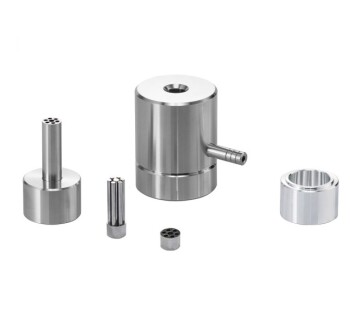
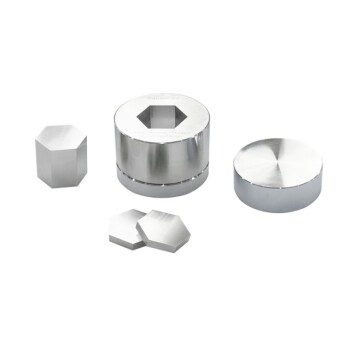
Precise pressure control is the difference between a failed test and a breakthrough. KINTEK specializes in high-performance laboratory equipment, offering specialized hydraulic presses (pellet, hot, isostatic) and custom pressure-maintaining dies engineered specifically for the rigors of all-solid-state battery cycling.
From oxide-based cathodes requiring high-pressure containment (up to 150 MPa) to lithium metal stability tests, our solutions ensure your solid-solid interfaces remain intact. Beyond battery research tools, KINTEK provides a comprehensive range of high-temperature furnaces, crushing systems, and cooling solutions to support your entire material science workflow.
Ready to stabilize your cell performance? Contact KINTEK today to find the perfect fixture for your research
Related Products
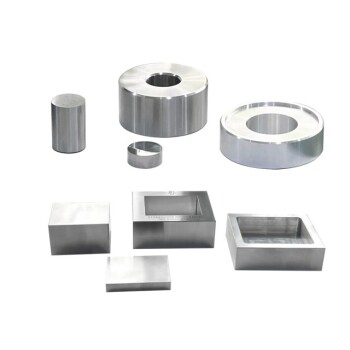
- Ring Press Mold for Lab Applications
- Special Heat Press Mold for Lab Use
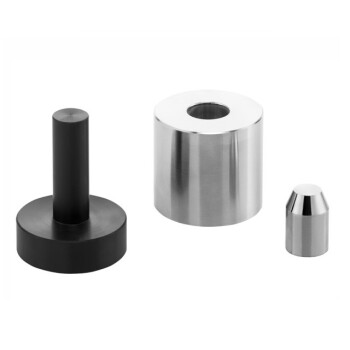
- Cylindrical Press Mold for Lab Applications
- Button Battery Tablet Press Sealing Mold for Lab Use
- Special Shape Press Mold for Lab
People Also Ask
- How to use a press mold? Master the Art of Creating Consistent Ceramic Forms
- Why are pressure molds with non-conductive resin inner walls required for battery testing? Ensure Data Accuracy
- What is the press mould method? A Guide to Consistent, Detailed Ceramic Forms
- What is the function of press molds during the preparation of SiCf/Ti-43Al-9V composites? Achieve Structural Precision
- What is a press mold used for? Achieve Repeatable Precision and Efficiency