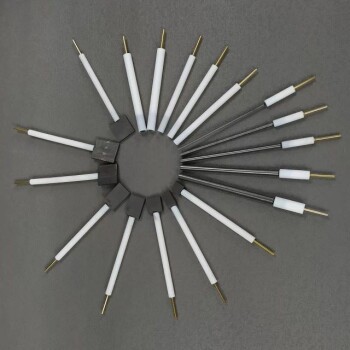
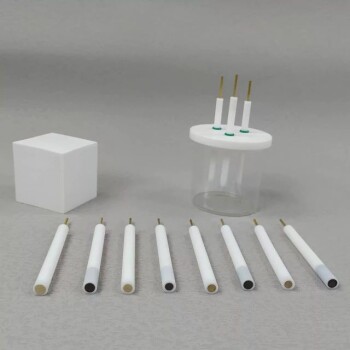
Platinum wire serves as the preferred quasi-reference electrode (QRE) in dimethylformamide (DMF) electrochemical cells due to its exceptional chemical stability and the high reproducibility of its potential in non-aqueous organic solvents. Unlike standard aqueous reference electrodes, a platinum QRE allows for precise measurements without introducing water or contaminants that could alter the solution chemistry. This stability is critical for sensitive tasks, such as accurately identifying the selective leaching peaks of complex alloys like samarium-cobalt magnets.
Core Takeaway: Platinum acts as a stable, inert anchor in organic solvents, enabling the precise distinction of electrochemical features—such as phase-specific leaching—without the contamination risks associated with traditional aqueous reference electrodes.
The Mechanics of Stability in Organic Solvents
High Chemical Inertness
The primary reason for selecting platinum wire is its resistance to chemical attack.
In organic solvents like DMF, the electrode must resist oxidation and interaction with the electrolyte to maintain a stable baseline. Platinum provides this inertness, ensuring the electrode itself does not interfere with the reactions being observed.
Potential Reproducibility
For an electrochemical measurement to be valid, the reference point must not fluctuate.
Platinum demonstrates potential reproducibility in DMF, meaning it holds a steady voltage level during experiments. This consistency allows researchers to compare data across different trials with confidence.
Enabling Precise Phase Analysis
Identifying Selective Leaching Peaks
The stability provided by the platinum QRE is necessary for resolving fine details in voltammetry data.
Specifically, it allows for the accurate identification of selective leaching peaks in complex materials. Without a stable reference, these peaks would shift or blur, making analysis impossible.
Distinguishing Magnet Phases
In the context of samarium-cobalt (Sm-Co) magnets, precision is paramount.
The platinum QRE enables the clear differentiation between distinct magnet phases, such as the 1:5 and 2:17 phases. This distinction is vital for characterizing the material's quality and magnetic properties.
Analyzing Anodic Dissolution
Beyond simple identification, the electrode facilitates the study of reaction mechanisms.
It provides the stable potential required to analyze the mechanisms of anodic dissolution. This helps researchers understand how the magnet degrades or reacts under an applied current.
Understanding the "Quasi" Distinction
The Role of Non-Aqueous Conditions
It is important to understand why a "Quasi" reference is used rather than a standard reference electrode (like Ag/AgCl).
Standard electrodes often contain aqueous solutions that can leak into the DMF, contaminating the environment. A solid platinum wire eliminates this risk, maintaining the purity of the non-aqueous organic solvent.
Limitations of Definition
While platinum is highly stable, it is termed a "quasi" reference because its potential is defined by the solution environment rather than a fixed thermodynamic reaction.
However, in the specific context of DMF and magnet analysis, its operational stability outweighs the lack of a standard thermodynamic definition, provided the environment remains consistent.
Making the Right Choice for Your Goal
To ensure you are gathering accurate electrochemical data, consider the following based on your specific objectives:
- If your primary focus is Material Characterization: Rely on the platinum QRE to resolve specific electrochemical signatures, such as the distinct phases in Sm-Co alloys.
- If your primary focus is Mechanism Analysis: Use the stability of the platinum wire to perform long-duration tests on anodic dissolution without worrying about reference drift.
By utilizing platinum wire as a QRE, you ensure that your data reflects the true behavior of your analyte rather than artifacts of electrode instability.
Summary Table:
| Feature | Benefit in DMF-based Electrochemical Cells |
|---|---|
| Chemical Inertness | Resists oxidation and prevents interference with the electrolyte. |
| Potential Reproducibility | Ensures steady voltage levels for reliable data comparison across trials. |
| Contamination Control | Eliminates water leakage risks associated with aqueous reference electrodes. |
| High Sensitivity | Enables accurate identification of selective leaching peaks in complex alloys. |
| Phase Distinction | Facilitates clear differentiation between Sm-Co 1:5 and 2:17 magnet phases. |
Elevate your electrochemical research with KINTEK’s precision-engineered solutions. Whether you are analyzing complex magnet phases or studying anodic dissolution, our specialized electrolytic cells and electrodes—including high-purity platinum wire—provide the stability and reproducibility your lab demands. Beyond electrodes, KINTEK offers a comprehensive range of high-temperature furnaces, high-pressure reactors, and battery research tools designed for the most rigorous scientific applications. Don't let electrode instability compromise your data; partner with KINTEK for reliable, high-performance laboratory equipment. Contact us today to optimize your research setup!
References
- Xuan Xu, Kristina Žužek Rožman. Electrochemical routes for environmentally friendly recycling of rare-earth-based (Sm–Co) permanent magnets. DOI: 10.1007/s10800-022-01696-9
This article is also based on technical information from Kintek Solution Knowledge Base .
Related Products
- Rotating Platinum Disk Electrode for Electrochemical Applications
- Platinum Auxiliary Electrode for Laboratory Use
- Platinum Sheet Electrode for Laboratory and Industrial Applications
- Platinum Sheet Electrode for Battery Lab Applications
- Electrolytic Electrochemical Cell Gas Diffusion Liquid Flow Reaction Cell
People Also Ask
- What is the working principle of a platinum disk electrode? A Guide to Precise Electrochemical Analysis
- What are the temperature limitations for a platinum disk electrode? The Critical Factor is the Insulating Body
- What can cause poisoning of a platinum disk electrode and how can it be prevented? Ensure Reliable Electrochemical Data
- How should a platinum disk electrode be polished? Master the Technique for Reliable Electrochemical Data
- How should a platinum disk electrode be used during an experiment? A Guide to Accurate Electrochemical Measurements