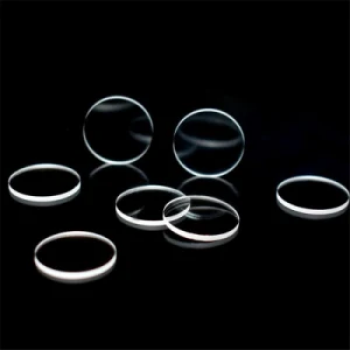
The sintering process is the defining stage in quartz resonator fabrication. It transforms a porous aggregate of quartz particles into a dense, transparent fused silica glass by facilitating atomic diffusion at extreme temperatures, typically around 1300°C. This densification is critical for eliminating internal pores that would otherwise dampen mechanical vibrations and degrade the resonator's quality factor (Q factor).
Sintering in a high-temperature muffle furnace converts porous quartz "green bodies" into high-purity fused silica glass through particle rearrangement and pore elimination. This process is essential for achieving the mechanical stability, dimensional accuracy, and high quality factor required for precision resonators.
Achieving Material Densification and Homogeneity
Particle Diffusion at 1300°C
At the extreme temperatures provided by a muffle furnace, quartz particles undergo surface and volume diffusion. This mobility allows individual grains to rearrange and fuse into a single, continuous solid mass.
Elimination of Internal Pores
The primary goal of sintering is to squeeze out the "void space" or internal pores within the porous structure. Removing these microscopic gaps is essential for creating a material that can vibrate with minimal internal friction.
Transformation into Fused Silica
This thermal treatment effectively transforms a fragile, opaque pre-form into a dense, transparent fused silica glass. This transformation ensures the material possesses the physical properties of high-purity quartz, which is the foundation of high-performance resonators.
Ensuring High-Performance Characteristics
Optimization of the Quality Factor
A high Quality Factor (Q factor) is the hallmark of a superior resonator, representing low energy loss during vibration. By eliminating internal defects and ensuring a uniform material structure, the sintering process maximizes the resonator's efficiency.
Proportional Shrinkage for Dimensional Accuracy
As the material densifies, it undergoes proportional shrinkage. The stable thermal environment of the muffle furnace ensures this shrinkage is predictable, allowing the final component to reach its precise design dimensions.
Structural Integrity and Strength
High-temperature treatment promotes the initial formation of stable phases and enhances mechanical strength. This prevents the resonator from cracking or collapsing during subsequent manufacturing stages or under operational thermal stress.
Understanding the Trade-offs and Pitfalls
The Risk of Trapped Gases and Bubbles
While a standard muffle furnace is excellent for heat distribution, it may not remove all air trapped between particles. If air is not effectively eliminated—often requiring a vacuum environment—residual bubbles can form, reducing optical uniformity and potentially impacting mechanical performance.
Critical De-binding Requirements
Sintering cannot be successful if the de-binding stage is rushed. If polymer binders are not thoroughly decomposed and discharged as gases at lower temperatures (150°C to 600°C), they can cause cracks or deformations when the furnace reaches sintering temperatures.
Managing Thermal Gradients
Rapid heating or cooling cycles in the furnace can introduce local temperature gradients. These gradients create internal stresses that may lead to structural failure or "thermal shock," particularly in complex resonator geometries.
How to Apply This to Your Project
Making the Right Choice for Your Goal
To ensure the highest quality in quartz resonator production, consider your primary performance metric:
- If your primary focus is Maximum Q Factor: Prioritize a sintering temperature of at least 1300°C to ensure total pore elimination and material homogeneity.
- If your primary focus is Optical Clarity: Incorporate a high-temperature vacuum furnace during the sintering phase to eliminate residual bubbles and enhance light transmittance.
- If your primary focus is Structural Reliability: Utilize a precisely controlled heating program to ensure the thorough removal of organic binders before the final densification begins.
By mastering the transition from porous particles to dense glass, you ensure the resonator meets the stringent demands of high-precision electronic and optical applications.
Summary Table:
| Key Sintering Aspect | Impact on Resonator Performance | Critical Control Factor |
|---|---|---|
| Densification | Eliminates internal pores; creates transparency | 1300°C Particle Diffusion |
| Q Factor Optimization | Minimizes energy loss; maximizes vibration efficiency | Material Homogeneity |
| Dimensional Accuracy | Ensures precise final design measurements | Proportional Shrinkage |
| Structural Integrity | Prevents cracking under operational thermal stress | De-binding & Gradual Heating |
| Vacuum Integration | Removes residual gas bubbles for optical clarity | Vacuum Environment Option |
Elevate Your Resonator Precision with KINTEK
Achieving the perfect Quality Factor (Q factor) and material density requires uncompromising thermal precision. KINTEK specializes in advanced laboratory solutions designed for the most demanding material science applications. Whether you need high-temperature muffle furnaces for stable air sintering or vacuum and atmosphere furnaces to eliminate gas entrapment, our technology ensures your quartz glass resonators meet industrial benchmarks.
Our extensive portfolio includes:
- High-Temperature Furnaces: Muffle, vacuum, tube, and CVD systems for precise densification.
- Advanced Processing: Crushing, milling, and hydraulic presses for flawless green body preparation.
- Essential Consumables: High-purity ceramics, crucibles, and PTFE products to maintain material integrity.
Ready to optimize your sintering workflow? Contact our experts today to discover how KINTEK’s high-performance equipment can enhance your laboratory’s efficiency and product reliability.
References
- Yahya Atwa, Hamza Shakeel. Manufacture of hemi-spherical resonators using printable fused silica glass. DOI: 10.1109/inertial56358.2023.10103948
This article is also based on technical information from Kintek Solution Knowledge Base .
Related Products
- High Temperature Muffle Oven Furnace for Laboratory Debinding and Pre Sintering
- 1800℃ Muffle Oven Furnace for Laboratory
- 1200℃ Muffle Furnace Oven for Laboratory
- 1400℃ Muffle Oven Furnace for Laboratory
- 1700℃ Muffle Oven Furnace for Laboratory
People Also Ask
- Why is the annealing treatment in a high-temperature muffle furnace critical for the preparation of an Sb-SnO2 interlayer?
- What role does a high-temperature muffle furnace play in the synthesis of manganese/cobalt-modified ceramic catalysts?
- What are the main components of a high-temperature muffle furnace? A Guide to the Core Systems
- What is the significance of integrating a high-temperature muffle furnace into an impact wear testing system?
- What is the primary function of high-temperature muffle or tube furnaces for ceramic coatings? Ensure Peak Durability