Knowledge thermal elements Why is tungsten used in furnaces? Unmatched Heat Resistance for Extreme Temperatures
Author avatar

Tech Team · Kintek Solution

Updated 3 months ago

Why is tungsten used in furnaces? Unmatched Heat Resistance for Extreme Temperatures


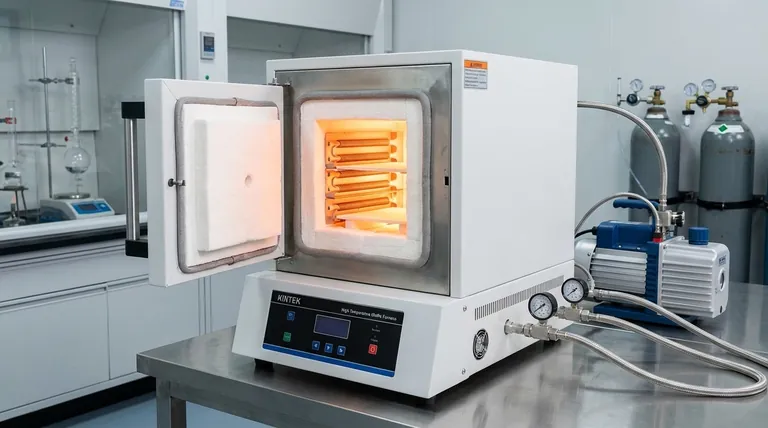
In short, tungsten is used in high-temperature furnaces because it has the highest melting point of any metal, allowing it to remain solid and structurally stable at extreme temperatures where other materials would fail. This unique property makes it indispensable for constructing the critical internal components of furnaces that must operate well above 2000°C.

The core reason for using tungsten is its unparalleled heat resistance. However, this advantage comes with a critical requirement: tungsten must be protected from oxygen at high temperatures, necessitating its use in a vacuum or an inert gas atmosphere.
Why is tungsten used in furnaces? Unmatched Heat Resistance for Extreme Temperatures

The Defining Property: Unmatched Temperature Resistance

The primary driver for selecting tungsten in furnace applications is its ability to withstand extreme heat without compromising its physical form. This thermal stability is foundational to creating environments for advanced material processing.

The Highest Melting Point of Any Metal

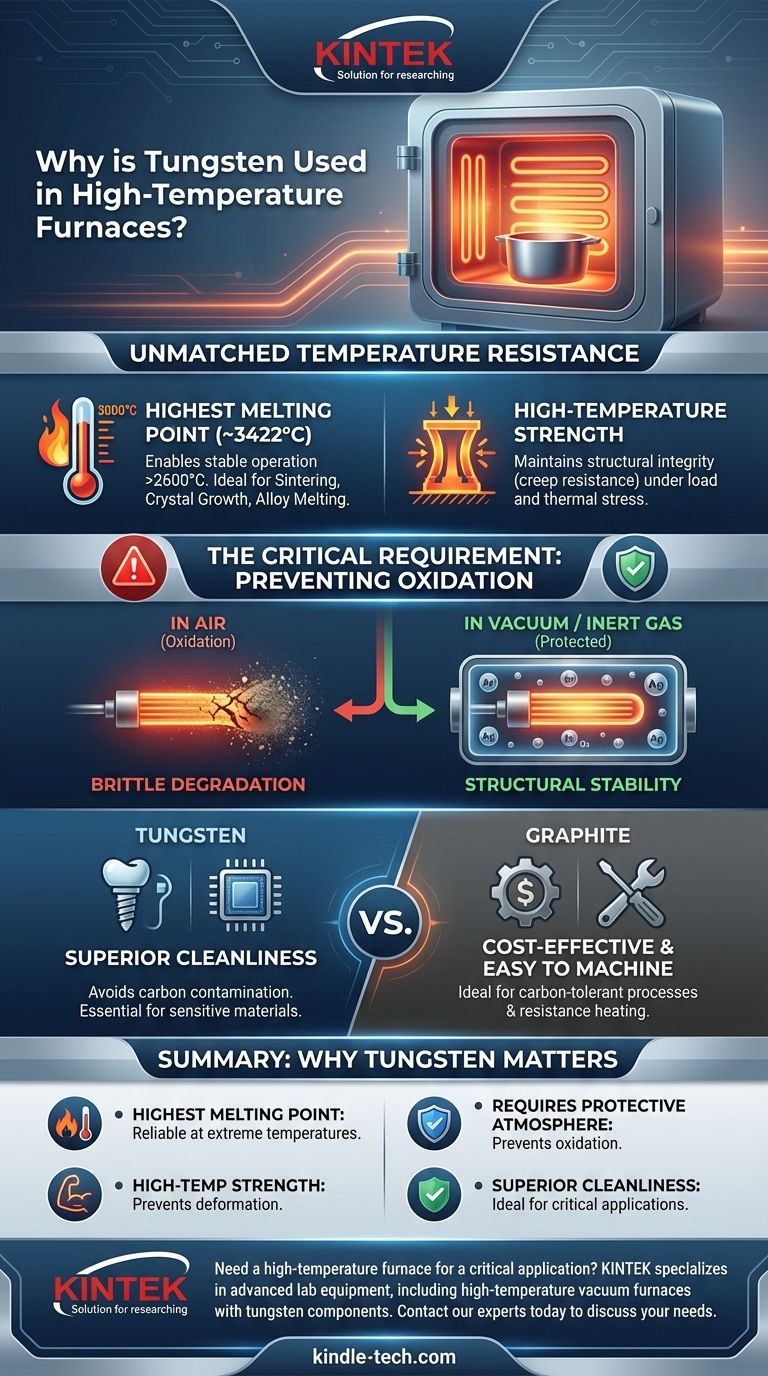
Tungsten's melting point is approximately 3422°C (6192°F), the highest of all metallic elements. This allows furnaces built with tungsten components, such as heating elements and heat shields, to reliably operate at temperatures up to 2600°C or even higher.

These extreme operating temperatures are essential for processes like sintering refractory metals, growing artificial crystals, and melting high-temperature alloys.

Maintaining Structural Integrity

Beyond simply not melting, tungsten maintains significant strength and stiffness at very high temperatures. This property, known as hot strength or creep resistance, is critical.

Furnace components like supports, racks, and heating elements must hold their shape under load and thermal stress. Where other metals would sag or deform, tungsten remains rigid, ensuring the furnace's structural integrity and operational precision.

The Critical Operating Environment

While tungsten's heat resistance is its greatest strength, it also has a significant vulnerability that dictates the entire design of a tungsten furnace.

The Achilles' Heel: Oxidation

At elevated temperatures, tungsten reacts readily with oxygen in the air. This process, known as oxidation, causes it to become brittle and rapidly degrade, completely negating its structural benefits.

Because of this, a tungsten furnace cannot be operated in a standard air atmosphere at high temperatures. The tungsten components would be destroyed.

The Solution: Vacuum or Inert Gas

To protect the tungsten, furnaces must operate in a controlled atmosphere. This is typically achieved in one of two ways.

First is a high vacuum, where pumps remove nearly all air and, critically, the residual oxygen. Second is by backfilling the chamber with a non-reactive, inert gas like argon or a reducing gas like hydrogen, which displaces the oxygen.

Understanding the Trade-offs: Tungsten vs. Graphite

Tungsten is not the only material used for high-temperature furnace construction. Graphite is a common alternative, and understanding the difference is key to material selection.

When to Choose Tungsten

Tungsten is the superior choice for applications demanding an exceptionally clean operating environment. Graphite can "outgas," releasing carbon particles or vapor that can contaminate sensitive materials.

Therefore, tungsten is preferred for processing medical implants, electronic components, and other materials where even minute contamination is unacceptable. Its high density also makes it an excellent material for heat shielding.

When to Choose Graphite

Graphite is often more cost-effective and significantly easier to machine than tungsten, which is notoriously hard and brittle.

Graphite is the ideal choice for processes where the presence of carbon is acceptable or even desirable, such as in graphitization furnaces. It is also an excellent electrical conductor, making it a very effective material for resistance heating elements.

Making the Right Choice for Your Goal

The decision between tungsten and other refractory materials depends entirely on the process requirements for temperature, cleanliness, and cost.

  • If your primary focus is maximum temperature and ultimate cleanliness: Choose a tungsten furnace to avoid carbon contamination in a high-vacuum environment.
  • If your primary focus is cost-effectiveness for a carbon-tolerant process: Choose a graphite furnace for its lower material cost and ease of manufacturing.
  • If you are sintering reactive metals or medical-grade alloys: A tungsten furnace is essential to maintain the purity and integrity of the final product.

Ultimately, understanding the properties of tungsten allows you to leverage its unmatched temperature resistance while controlling its environment to ensure reliable, high-performance results.

Summary Table:

Property Why It Matters for Furnaces
Highest Melting Point (~3422°C) Enables stable operation at extreme temperatures (>2600°C) where other metals fail.
High-Temperature Strength Maintains structural integrity (creep resistance) under load and thermal stress.
Requires Protective Atmosphere Must operate in a vacuum or inert gas to prevent oxidation at high temperatures.
Superior Cleanliness Avoids carbon contamination, ideal for sensitive processes like medical implant sintering.

Need a high-temperature furnace for a critical application?
KINTEK specializes in advanced lab equipment, including high-temperature vacuum furnaces with tungsten components. Our solutions are designed for processes requiring extreme heat and ultimate material purity, such as sintering reactive metals or growing artificial crystals.

Contact our experts today to discuss how a KINTEK tungsten furnace can provide the reliability and cleanliness your laboratory demands.

Visual Guide
Why is tungsten used in furnaces? Unmatched Heat Resistance for Extreme Temperatures Visual Guide

Related Products

People Also Ask

Related Products

2200 ℃ Tungsten Vacuum Heat Treat and Sintering Furnace

2200 ℃ Tungsten Vacuum Heat Treat and Sintering Furnace

Experience the ultimate refractory metal furnace with our Tungsten vacuum furnace. Capable of reaching 2200℃, perfect for sintering advanced ceramics and refractory metals. Order now for high-quality results.

Small Vacuum Heat Treat and Tungsten Wire Sintering Furnace

Small Vacuum Heat Treat and Tungsten Wire Sintering Furnace

The small vacuum tungsten wire sintering furnace is a compact experimental vacuum furnace specially designed for universities and scientific research institutes. The furnace features a CNC welded shell and vacuum piping to ensure leak-free operation. Quick-connect electrical connections facilitate relocation and debugging, and the standard electrical control cabinet is safe and convenient to operate.

Hemispherical Bottom Tungsten Molybdenum Evaporation Boat

Hemispherical Bottom Tungsten Molybdenum Evaporation Boat

Used for gold plating, silver plating, platinum, palladium, suitable for a small amount of thin film materials. Reduce the waste of film materials and reduce heat dissipation.

Molybdenum Tungsten Tantalum Special Shape Evaporation Boat

Molybdenum Tungsten Tantalum Special Shape Evaporation Boat

Tungsten Evaporation Boat is ideal for vacuum coating industry and sintering furnace or vacuum annealing. we offers tungsten evaporation boats that are designed to be durable and robust, with long operating lifetimes and to ensure consistent smooth and even spreading of the molten metals.

Thermally Evaporated Tungsten Wire for High Temperature Applications

Thermally Evaporated Tungsten Wire for High Temperature Applications

It has a high melting point, thermal and electrical conductivity, and corrosion resistance. It is a valuable material for high temperature, vacuum and other industries.

Tungsten Evaporation Boat for Thin Film Deposition

Tungsten Evaporation Boat for Thin Film Deposition

Learn about tungsten boats, also known as evaporated or coated tungsten boats. With a high tungsten content of 99.95%, these boats are ideal for high-temperature environments and widely used in various industries. Discover their properties and applications here.

Molybdenum Vacuum Heat Treat Furnace

Molybdenum Vacuum Heat Treat Furnace

Discover the benefits of a high-configuration molybdenum vacuum furnace with heat shield insulation. Ideal for high-purity, vacuum environments like sapphire crystal growth and heat treatment.

Laboratory Rapid Thermal Processing (RTP) Quartz Tube Furnace

Laboratory Rapid Thermal Processing (RTP) Quartz Tube Furnace

Get lightning-fast heating with our RTP Rapid Heating Tube Furnace. Designed for precise, high-speed heating and cooling with convenient sliding rail and TFT touch screen controller. Order now for ideal thermal processing!

High Temperature Muffle Oven Furnace for Laboratory Debinding and Pre Sintering

High Temperature Muffle Oven Furnace for Laboratory Debinding and Pre Sintering

KT-MD High temperature debinding and pre-sintering furnace for ceramic materials with various molding processes. Ideal for electronic components such as MLCC and NFC.

Ultra-High Temperature Graphite Vacuum Graphitization Furnace

Ultra-High Temperature Graphite Vacuum Graphitization Furnace

The ultra-high temperature graphitization furnace utilizes medium frequency induction heating in a vacuum or inert gas environment. The induction coil generates an alternating magnetic field, inducing eddy currents in the graphite crucible, which heats up and radiates heat to the workpiece, bringing it to the desired temperature. This furnace is primarily used for graphitization and sintering of carbon materials, carbon fiber materials, and other composite materials.

Vertical High Temperature Graphite Vacuum Graphitization Furnace

Vertical High Temperature Graphite Vacuum Graphitization Furnace

Vertical high temperature graphitization furnace for carbonization and graphitization of carbon materials up to 3100℃.Suitable for shaped graphitization of carbon fiber filaments and other materials sintered in a carbon environment.Applications in metallurgy, electronics, and aerospace for producing high-quality graphite products like electrodes and crucibles.

Graphite Vacuum Furnace High Thermal Conductivity Film Graphitization Furnace

Graphite Vacuum Furnace High Thermal Conductivity Film Graphitization Furnace

The high thermal conductivity film graphitization furnace has uniform temperature, low energy consumption and can operate continuously.

Large Vertical Graphite Vacuum Graphitization Furnace

Large Vertical Graphite Vacuum Graphitization Furnace

A large vertical high-temperature graphitization furnace is a type of industrial furnace used for the graphitization of carbon materials, such as carbon fiber and carbon black. It is a high-temperature furnace that can reach temperatures of up to 3100°C.

Vacuum Heat Treat and Molybdenum Wire Sintering Furnace for Vacuum Sintering

Vacuum Heat Treat and Molybdenum Wire Sintering Furnace for Vacuum Sintering

A vacuum molybdenum wire sintering furnace is a vertical or bedroom structure, which is suitable for withdrawal, brazing, sintering and degassing of metal materials under high vacuum and high temperature conditions. It is also suitable for dehydroxylation treatment of quartz materials.

1200℃ Split Tube Furnace with Quartz Tube Laboratory Tubular Furnace

1200℃ Split Tube Furnace with Quartz Tube Laboratory Tubular Furnace

KT-TF12 split tube furnace: high-purity insulation, embedded heating wire coils, and max. 1200C. Widely used for new materials and chemical vapour deposition.

Horizontal High Temperature Graphite Vacuum Graphitization Furnace

Horizontal High Temperature Graphite Vacuum Graphitization Furnace

Horizontal Graphitization Furnace: This type of furnace is designed with the heating elements placed horizontally, allowing for uniform heating of the sample. It's well-suited for graphitizing large or bulky samples that require precise temperature control and uniformity.

Graphite Vacuum Continuous Graphitization Furnace

Graphite Vacuum Continuous Graphitization Furnace

High-temperature graphitization furnace is a professional equipment for graphitization treatment of carbon materials. It is a key equipment for the production of high-quality graphite products. It has high temperature, high efficiency and uniform heating. It is suitable for various high-temperature treatments and graphitization treatments. It is widely used in metallurgy, electronics, aerospace, etc. industry.

Graphite Vacuum Furnace Bottom Discharge Graphitization Furnace for Carbon Materials

Graphite Vacuum Furnace Bottom Discharge Graphitization Furnace for Carbon Materials

Bottom-out graphitization furnace for carbon materials, ultra-high temperature furnace up to 3100°C, suitable for graphitization and sintering of carbon rods and carbon blocks. Vertical design, bottom discharging, convenient feeding and discharging, high temperature uniformity, low energy consumption, good stability, hydraulic lifting system, convenient loading and unloading.

1400℃ Controlled Atmosphere Furnace with Nitrogen and Inert Atmosphere

1400℃ Controlled Atmosphere Furnace with Nitrogen and Inert Atmosphere

Achieve precise heat treatment with KT-14A controlled atmosphere furnace. Vacuum sealed with a smart controller, it's ideal for lab and industrial use up to 1400℃.

Laboratory Muffle Oven Furnace Bottom Lifting Muffle Furnace

Laboratory Muffle Oven Furnace Bottom Lifting Muffle Furnace

Efficiently produce batches with excellent temperature uniformity using our Bottom Lifting Furnace. Features two electric lifting stages and advanced temperature control up to 1600℃.


Leave Your Message