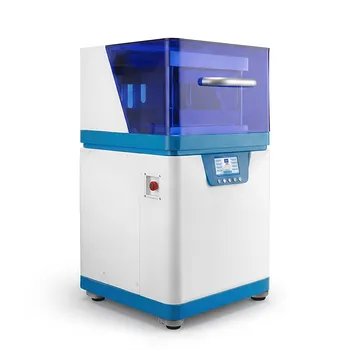
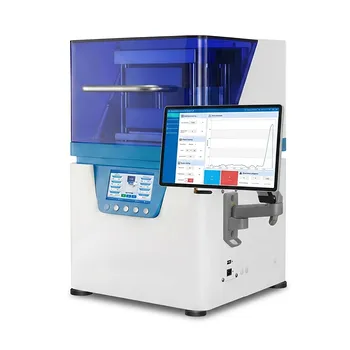
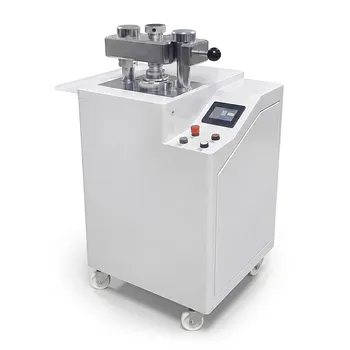
To ensure accurate conductivity measurements, a laboratory hydraulic press is required to compact loose PANI/MWCNT powders into dense, uniform pellets. This process eliminates the high contact resistance between individual particles and removes air voids that would otherwise skew electrical readings. By achieving a consistent density baseline, researchers can isolate the material's intrinsic conductivity from the physical variables of the powder state.
A laboratory hydraulic press is the critical tool for transforming loose composite powders into stable, solid specimens. This preparation phase is essential for establishing a reliable electrical percolation network and ensuring that conductivity data reflects the material's true properties rather than its packing density.
Eliminating Contact Resistance and Voids
Reducing Inter-particle Barriers
In their raw powder form, polyaniline and carbon nanotubes are separated by microscopic gaps and air pockets. These gaps act as high-resistance barriers that prevent the flow of electrons, leading to artificially low conductivity readings.
Creating a Dense Solid Matrix
The hydraulic press applies extreme, controllable pressure—often reaching hundreds of Megapascals—to force these particles into intimate contact. This compaction converts the loose material into a dense cylindrical pellet where individual components are physically locked together.
Removing Internal Air Pockets
Air is an insulator; any internal pores or voids within a sample will disrupt the electrical path. The high-pressure environment of the press eliminates internal pores and density gradients, ensuring the sample is structurally homogeneous.
Establishing the Electrical Percolation Network
Facilitating MWCNT Connectivity
Multi-walled carbon nanotubes (MWCNTs) provide conductivity by forming a three-dimensional "percolation network" through the polyaniline matrix. This network only functions if the nanotubes are sufficiently close to allow for electron tunneling or direct contact.
Establishing Robust Contact Channels
The hydraulic press ensures that the MWCNTs are packed tightly enough to establish robust electrical contact channels. This allows the measurement to reflect the high intrinsic conductivity of the graphene sheets within the nanotubes rather than the resistance of the gaps between them.
Defining the Bulk Resistivity
By compressing the material to a state of maximum practical density, the press allows for the measurement of bulk resistivity. This measurement is critical for understanding how different loading levels of MWCNTs actually improve the composite's performance.
Ensuring Scientific Repeatability
Standardizing Physical Parameters
Conductivity measurements are highly sensitive to the thickness and density of the sample. A high-precision hydraulic press provides constant and repeatable pressure control, ensuring that every sample in a study has identical physical dimensions.
Eliminating Packing Density Interference
If samples are packed by hand, variations in density will cause inconsistent results across different batches. Using a press eliminates the influence of packing density, providing a scientifically reliable foundation for comparing different experimental formulations.
Structural Integrity for Testing
Beyond electrical properties, the press ensures the specimen has the structural integrity required for handling and placement within a measurement vessel. This prevents the sample from crumbling or deforming during the actual testing process.
Understanding the Trade-offs
The Risk of Over-Compression
Applying excessive pressure can occasionally damage the structural integrity of the MWCNTs or lead to internal stresses. It is vital to determine the optimal pressure that achieves maximum density without causing mechanical degradation of the composite components.
Thermal Stress and Gradients
When using a heated hydraulic press (hot-pressing), improper cooling cycles can introduce thermal stresses or internal density gradients. These physical defects can lead to micro-cracking, which paradoxically increases resistance in an otherwise dense sample.
Material Flow and Deformation
In composites with high polymer content, the material may flow out of the mold under high pressure. Precise control is required to ensure the sample maintains its uniform thickness and does not result in a "flash" or uneven edges that complicate thickness measurements.
How to Apply This to Your Laboratory Workflow
Selecting the Right Approach for Your Goal
To achieve the most accurate conductivity data, your sample preparation protocol must be strictly standardized based on your specific research objectives.
- If your primary focus is determining intrinsic conductivity: Use a high-pressure manual or electric press (e.g., 250+ MPa) to ensure all voids are eliminated and particles have maximum contact.
- If your primary focus is comparative loading studies: Maintain a strictly constant applied pressure across all samples to ensure that changes in conductivity are due to MWCNT concentration, not density variations.
- If your primary focus is structural composite testing: Utilize a heated hydraulic press to ensure the polyaniline matrix flows adequately around the MWCNTs, eliminating internal density gradients and air bubbles.
A laboratory hydraulic press is the only way to transform inconsistent powders into the standardized, high-density specimens required for definitive electrical characterization.
Summary Table:
| Key Factor | Role of Hydraulic Press | Impact on Measurement |
|---|---|---|
| Contact Resistance | Compresses particles into a dense matrix | Eliminates artificial high-resistance barriers |
| Internal Voids | Removes air pockets and density gradients | Prevents insulation gaps in the electrical path |
| Percolation Network | Facilitates MWCNT-to-MWCNT connectivity | Allows measurement of intrinsic bulk resistivity |
| Repeatability | Ensures constant pressure and sample dimensions | Standardizes physical parameters for comparative studies |
| Integrity | Provides structural stability to specimens | Prevents sample crumbling during testing procedures |
Precision is non-negotiable in electrical characterization. KINTEK specializes in high-performance laboratory equipment, including manual, electric, and heated hydraulic presses (pellet, hot, isostatic) specifically designed to produce the uniform, high-density specimens required for PANI/MWCNT research.
Our systems ensure you eliminate contact resistance and air voids, providing the repeatable, publication-quality data your lab demands. Beyond pressing solutions, we offer a full range of high-temperature furnaces, crushing systems, and essential consumables like PTFE and ceramics to support your entire material science workflow.
Ready to elevate your sample preparation? Contact KINTEK today to find the perfect pressing solution for your composite research!
References
- Sharon J. Paul, Prakash Chandra. Probing the Electro-Chemical and Thermal Properties of Polyaniline/MWCNT Nanocomposites. DOI: 10.18596/jotcsa.1177040
This article is also based on technical information from Kintek Solution Knowledge Base .
Related Products
- Automatic Hydraulic Hot Press with 500x500mm Heating Plates and Multi Stage PLC Control for Material Sintering
- Heated Hydraulic Press Machine with Heated Plates for Vacuum Box Laboratory Hot Press
- Automatic High Temperature Heated Hydraulic Press Machine with Heated Plates for Lab
- Manual High Temperature Heated Hydraulic Press Machine with Heated Plates for Lab
- 24T 30T 60T Heated Hydraulic Press Machine with Heated Plates for Laboratory Hot Press
People Also Ask
- How do hydraulic presses facilitate material solidification in Low-Temperature LPS? Optimize Your Material Densification
- Why is 800 MPa required for TiNiPdCu alloy green bodies? Master High-Density Compaction for Superior Material Strength
- How does KBr pellet preparation facilitate FTIR of high-ash mud? Precision Sample Prep for Structural Analysis
- Why is an industrial hydraulic press with precision stainless steel molds used? For Uniform Mo-Fe Precursor Compacts.
- Purpose of Coaxial Ring Molds & Presses in EM Testing? Achieve Precise VNA Data & Fit