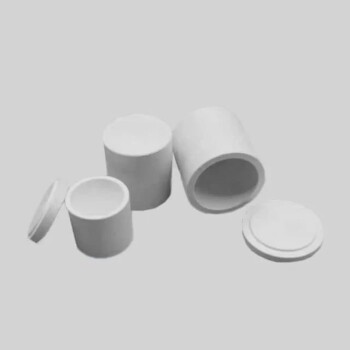
To accurately determine volatile matter, a muffle furnace must be paired with a sealed crucible to physically separate thermal decomposition from combustion. The muffle furnace provides the intense heat required to break down the biomass, while the sealed crucible prevents oxygen from reaching the sample. This isolation ensures the weight loss you measure is due to gases escaping, not the sample burning away to ash.
The tight-fitting lid creates an oxygen-deficient environment within the high-heat muffle furnace. This setup forces the biomass to undergo rapid pyrolysis—releasing organic substances as gases—instead of fully oxidizing, ensuring an accurate measurement of the fuel's ignition potential.
The Mechanics of Volatile Matter Determination
Creating an Oxygen-Deficient Environment
The muffle furnace heats the surrounding air, but that air contains oxygen which causes burning. The crucible with a tight-fitting lid acts as a physical barrier. It restricts the airflow around the biomass sample, ensuring that the environment inside the vessel remains oxygen-deficient.
Simulating Rapid Pyrolysis
By heating the sample to 550°C without oxygen, you force a specific chemical reaction called pyrolysis. This process breaks down organic compounds thermally rather than chemically reacting them with oxygen. The resulting weight loss represents only the volatile components that have turned into gas.
Preventing Full Oxidation
If oxygen were allowed to contact the heated sample, the biomass would undergo combustion (burning). This would consume the fixed carbon in the sample and leave only ash. The result would be a measurement of total combustible material, not the specific volatile matter content.
Why This Distinction Matters
Quantifying Ignition Performance
Volatile matter is a critical metric because it indicates the ignition performance of the fuel. Biomass with higher volatile matter typically ignites more easily and burns faster. The sealed crucible ensures you are measuring this specific property, rather than the fuel's total energy content or ash residue.
Controlled Thermal Decomposition
The muffle furnace is responsible for the rapid heating element of the test. It brings the sample to the target temperature of 550°C quickly. However, without the crucible's seal, this rapid heating would simply result in an uncontrolled fire.
Understanding the Trade-offs
The Risk of Improper Sealing
The most critical failure point in this process is the integrity of the crucible lid. If the lid is loose or ill-fitting, oxygen will leak into the chamber during the heating phase.
Skewed Data Through Oxidation
When oxygen breaches the crucible, partial combustion occurs alongside pyrolysis. This results in "false" weight loss, where fixed carbon is burned off and counted as volatile matter. This artificially inflates your volatile matter readings, leading to incorrect assumptions about the fuel's reactivity.
Ensuring Data Accuracy in Your Lab
To ensure your volatile matter measurements are reliable, apply the following principles:
- If your primary focus is Equipment Setup: Ensure your crucibles have precision-ground or tight-fitting lids that can withstand 550°C without warping.
- If your primary focus is Data Interpretation: Remember that accurate ignition performance data relies entirely on the successful exclusion of oxygen during the heating cycle.
The precision of your volatile matter data depends not just on the heat of the furnace, but on the integrity of the seal that keeps the oxygen out.
Summary Table:
| Component | Role in Volatile Matter Determination | Key Objective |
|---|---|---|
| Muffle Furnace | Provides intense, rapid heat up to 550°C | Facilitates thermal decomposition |
| Sealed Crucible | Acts as a physical barrier against oxygen | Prevents combustion/oxidation |
| Tight Lid | Creates a localized oxygen-deficient environment | Ensures weight loss is gas escape only |
| Biomass Sample | Undergoes rapid pyrolysis during heating | Measures ignition performance |
Elevate Your Analytical Precision with KINTEK
Reliable volatile matter determination requires more than just heat; it demands precision-engineered tools that maintain environmental integrity. KINTEK specializes in high-performance laboratory equipment, including advanced muffle furnaces and durable ceramic crucibles designed for airtight performance during rapid pyrolysis.
Whether you are conducting biomass research or industrial quality control, our comprehensive range of products—from milling systems for sample preparation to high-temperature furnaces and PTFE/ceramic consumables—ensures your lab delivers accurate, repeatable data.
Ready to optimize your thermal analysis? Contact KINTEK today to explore our laboratory solutions!
References
- Samomssa Inna, Kamga Richard. Assessment of Efficient Thermal Conversion Technologies and HHV from Compositional Characteristics of Cassava Peelings, Plantain Peelings and Corn Cobs. DOI: 10.3844/erjsp.2022.30.41
This article is also based on technical information from Kintek Solution Knowledge Base .
Related Products
- Evaporation Crucible for Organic Matter
- Evaporation Boat for Organic Matter
- Electron Beam Evaporation Coating Gold Plating Tungsten Molybdenum Crucible for Evaporation
- Boron Nitride (BN) Crucible for Phosphorous Powder Sintered
- E Beam Crucibles Electron Gun Beam Crucible for Evaporation
People Also Ask
- What are crucibles used for in the laboratory? Essential Tools for High-Temperature Processing
- What are crucibles for laboratory use? Essential Guide to High-Temperature Containment
- What are crucibles used for in lab? Ensuring Accurate, High-Temperature Sample Analysis
- What is the best solvent for cannabis extraction? Find the Ideal Choice for Your Product Goals
- What are the uses of desiccators and specific thermal regulators? Expert Insights for Vapor-Assisted Conversion