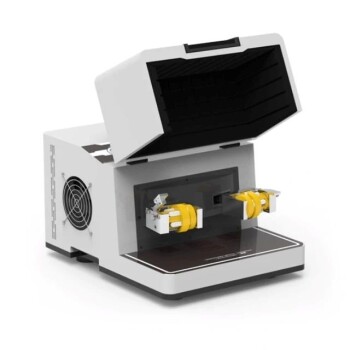
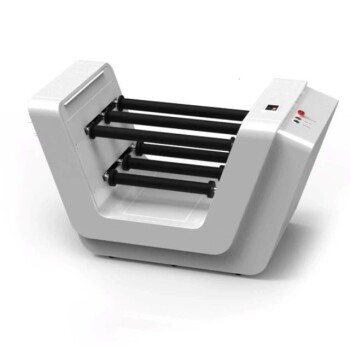
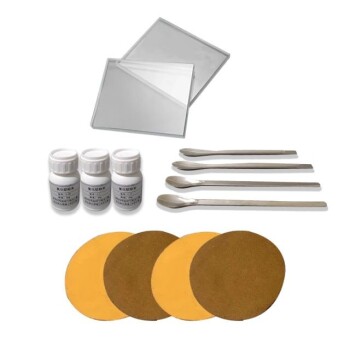
Grinding equipment or polishing consumables are strictly necessary to strip away the native oxide layers found on metal foils. Before creating AlMgTi composites, these oxide layers act as stubborn physical barriers that prevent the metals from interacting. By mechanically removing them to expose the fresh metal substrate, you enable direct contact between the materials, which is the prerequisite for successful bonding.
Surface preparation is not merely a cleaning step; it is a fundamental requirement to lower the diffusion activation energy. Without removing these oxide barriers, the atoms cannot diffuse effectively, preventing the formation of the metallurgical bonds required for a structural composite.
The Physical Barrier of Oxidation
The Nature of Metal Foils
Metals such as Titanium (Ti), Aluminum (Al), and AZ31 magnesium alloy are highly reactive with oxygen.
Even when stored carefully, they naturally develop a stable oxide skin on their surface.
Why Oxides Must Go
These oxide layers act as a shield.
They physically separate the metal atoms in one foil from the metal atoms in the adjacent foil.
If these layers remain during the manufacturing process, they block the atomic interaction necessary to create a unified composite.
Facilitating Atomic Diffusion
Exposing the Fresh Substrate
The primary goal of using grinding or polishing consumables is to reveal the fresh metal substrate.
This allows the pure metal of one layer to come into direct physical contact with the pure metal of the next layer.
Lowering Activation Energy
Removing the oxide barrier significantly impacts the physics of the bonding process.
Specifically, it reduces the diffusion activation energy required during vacuum hot pressing.
With the barrier gone, it takes less energy (heat and pressure) to initiate the movement of atoms across the interface.
Achieving Metallurgical Bonding
Promoting Intermetallic Layers
The ultimate goal of this preparation is to foster the formation of intermetallic compound layers.
These layers are formed when atoms from different metals migrate and lock together at a molecular level.
From Mechanical to Metallurgical
Without grinding, you might achieve a mechanical adhesion that is weak and unreliable.
By polishing the surfaces, you enable metallurgical bonding, creating a high-strength interface where the materials have truly fused into a single composite system.
Operational Considerations and Trade-offs
The Risk of Incomplete Removal
If the grinding process is inconsistent, patches of oxide will remain on the foil.
These patches create "dead zones" where diffusion cannot occur, resulting in localized structural weaknesses within the composite.
Timing and Re-oxidation
Exposing fresh metal substrate makes the foil highly reactive.
While the primary reference focuses on the removal mechanism, it is implied that processed foils should be moved to the vacuum environment quickly to prevent new oxides from forming before bonding can occur.
Making the Right Choice for Your Goal
To ensure the structural integrity of your AlMgTi composite, assess your preparation strategy based on your specific requirements:
- If your primary focus is bond strength: Prioritize thorough grinding to fully eliminate physical barriers, ensuring maximum surface area for intermetallic layer formation.
- If your primary focus is process efficiency: Ensure consistent polishing to lower the diffusion activation energy, potentially reducing the temperature or time required during vacuum hot pressing.
The quality of your final composite is directly determined by the thoroughness of your initial surface preparation.
Summary Table:
| Factor | Influence of Surface Preparation | Impact on AlMgTi Composite |
|---|---|---|
| Oxide Layer | Strips native oxide skin (Al, Ti, Mg) | Removes physical barriers to atomic interaction |
| Substrate State | Exposes fresh metal substrate | Enables direct metal-to-metal contact |
| Energy Requirement | Lowers diffusion activation energy | Reduces required heat/pressure during hot pressing |
| Bond Quality | Promotes intermetallic layer formation | Transitions from weak adhesion to metallurgical fusion |
| Structural Integrity | Ensures uniform surface treatment | Eliminates "dead zones" and localized weaknesses |
Elevate Your Materials Research with KINTEK
Precision in AlMgTi composite fabrication starts with flawless surface preparation. At KINTEK, we specialize in providing high-performance laboratory equipment and consumables tailored for advanced metallurgy. Whether you need robust grinding and milling systems to strip oxide layers or professional polishing consumables for substrate exposure, our solutions ensure your materials are ready for high-strength bonding.
Our portfolio extends to the critical next steps of your workflow, featuring:
- Vacuum Hot Presses and Isostatic Presses for superior diffusion bonding.
- High-Temperature Furnaces (Muffle, Vacuum, and Tube) for precise thermal control.
- PTFE and Ceramic Consumables for contamination-free processing.
Ready to optimize your composite strength? Contact KINTEK today to discover how our expert tools can streamline your laboratory processes and enhance your research outcomes.
Related Products
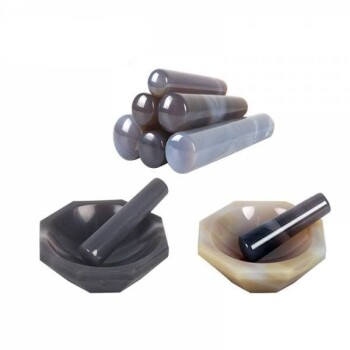
- Nature Agate Mortar and Pestle for Grinding and Mixing
- Laboratory High Throughput Tissue Grinding Mill Grinder
- Laboratory Ball Mill Jar Mill with Metal Alloy Grinding Jar and Balls
- Laboratory Jar Mill with Agate Grinding Jar and Balls
- Laboratory Disc Cup Vibratory Mill for Sample Grinding
People Also Ask
- Why are agate mortars and pestles used for grinding iron oxide? Ensure Sample Purity for XRD Analysis
- What is the function of an agate mortar and pestle? Ensure Purity in Halide Solid-State Electrolyte Synthesis
- What is the primary function of an agate mortar and pestle? Optimize VO2+ CaZn2(PO4)2 Nanopowder Pre-Treatment
- Why is an agate mortar and pestle required for grinding Zr3(Al1-xSix)C2? Ensure Maximum Sample Purity
- Why is an agate mortar and pestle preferred for grinding MAX phase? Ensure Sample Purity & Zero Contamination