Precision pressing is the foundation of reliable ceramic characterization.
Using a high-precision hydraulic press ensures that x-LNTO ceramic powder is compacted under a uniform pressure (typically 10 MPa) to create a "green body" with optimal density and strength. This process is critical because it eliminates internal voids and micro-cracks that would otherwise cause the sample to fail during the 1,450°C sintering process. Without this precise preparation, the resulting pellet would lack the structural integrity and consistent density required to yield accurate, repeatable electrical property measurements.
The central takeaway is that high-precision pressing acts as a prerequisite for both thermal stability and measurement accuracy. By establishing a dense, uniform internal structure, the press ensures the ceramic can survive high-temperature processing and that subsequent electrical data reflects the material’s intrinsic properties rather than flaws in its physical form.
The Role of Pressure in Structural Integrity
Surviving Extreme Sintering Temperatures
x-LNTO ceramics must undergo sintering at 1,450°C to achieve their final crystalline state. A high-precision press ensures the "green body" (the unsintered pellet) is dense enough to withstand the thermal stresses of this process without deforming or cracking.
Establishing Uniform Green Body Density
Applying a precise 10 MPa of pressure overcomes inter-particle friction, allowing the powder to rearrange into a tightly packed configuration. This uniformity is vital because any localized density variations will lead to uneven shrinkage during heating, compromising the physical integrity of the test specimen.
Preventing Micro-crack Formation
Precise control over the uniaxial pressure prevents the formation of internal micro-cracks. These tiny flaws are often invisible after pressing but expand rapidly under high heat, leading to mechanical failure before the electrical testing can even begin.
Eliminating Measurement Variables
Reducing Inter-particle Contact Resistance
To accurately measure electrical properties like conductivity, the particles within the pellet must be in intimate contact. High-pressure densification significantly improves particle-to-particle contact, which reduces "parasitic" resistance and allows analyzers to capture the material’s intrinsic transport properties.
Mitigating Porosity Fluctuations
Porosity is the enemy of electrical characterization, as air pockets act as insulators that skew resistance data. A high-precision press minimizes internal porosity, ensuring that measurements are consistent across different samples and not dictated by random voids within the material.
Ensuring Geometric Consistency
Electrical testing formulas rely on the precise dimensions of the sample (thickness and surface area). Precise hydraulic pressing produces pellets with consistent geometric dimensions and flat surfaces, which are essential for calculating accurate resistivity and dielectric constants.
Understanding the Trade-offs
The Risk of Over-Pressing
While high pressure is necessary, exceeding the material's limit can cause delamination or "capping," where the pellet splits into layers upon release from the mold. Finding the specific "sweet spot"—such as the 10 MPa used for x-LNTO—is critical to avoid structural failure.
Manual vs. Automatic Precision
Manual presses offer cost-effectiveness but rely on the operator’s ability to maintain a constant load; any fluctuation can lead to density gradients. Automatic presses provide superior repeatability, which is often necessary when producing a series of samples for comparative electrical studies.
How to Apply This to Your Research
Selecting the right pressing strategy depends on your specific material goals and the precision required for your electrical characterization.
- If your primary focus is thermal stability during sintering: Prioritize a press with a slow, controlled pressure release to prevent internal stress and cracking in the green body.
- If your primary focus is accurate conductivity data: Use high-precision molds to ensure perfectly flat surfaces and uniform density, which minimizes contact resistance at the electrode interface.
- If your primary focus is high-throughput sample preparation: Invest in an automatic hydraulic press to ensure that every pellet in a series is identical, eliminating "user feel" as a variable in your data.
Properly compacted pellets are the only way to ensure that your electrical characterization reveals the true potential of the x-LNTO ceramic material.
Summary Table:
| Key Benefit | Impact on Characterization | Technical Role in x-LNTO Preparation |
|---|---|---|
| Structural Integrity | Survives 1,450°C Sintering | Eliminates voids/cracks that lead to thermal failure. |
| Uniform Density | Reliable Repeatability | Overcomes inter-particle friction for consistent green bodies. |
| Reduced Resistance | Accurate Conductivity | Maximizes particle-to-particle contact for intrinsic data. |
| Geometric Precision | Precise Calculations | Ensures flat surfaces and consistent dimensions for resistivity. |
Achieve Research Excellence with KINTEK Precision
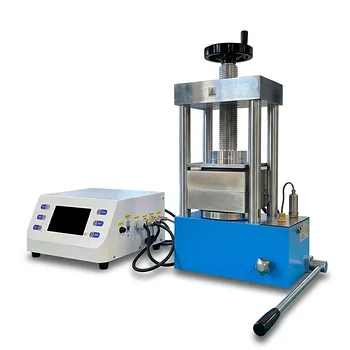
Reliable electrical characterization of x-LNTO ceramics begins with a flawless pellet. KINTEK specializes in high-precision hydraulic presses (pellet, hot, isostatic) designed to provide the uniform pressure control necessary for high-performance material science.
Beyond sample preparation, we support your entire laboratory workflow with:
- High-Temperature Furnaces: Muffle, tube, and vacuum furnaces capable of the 1,450°C sintering required for x-LNTO.
- Material Processing: Advanced crushing, milling, and sieving systems for uniform powder preparation.
- Essential Consumables: Premium ceramics, crucibles, and PTFE products for contamination-free testing.
Don't let structural flaws compromise your data. Partner with KINTEK to ensure every sample reflects its true intrinsic properties.
Contact Our Technical Experts Today
References
- Ke Su, Qifang Li. Preparation of (La + Nb)-co-doped TiO <sub>2</sub> and its polyvinylidene difluoride composites with high dielectric constants. DOI: 10.1515/epoly-2023-0021
This article is also based on technical information from Kintek Solution Knowledge Base .
Related Products
- Automatic Laboratory Hydraulic Press for XRF & KBR Pellet Press
- Automatic Laboratory Hydraulic Pellet Press Machine for Lab Use
- Laboratory Hydraulic Pellet Press for XRF KBR FTIR Lab Applications
- kbr pellet press 2t
- Laboratory Manual Hydraulic Pellet Press for Lab Use
People Also Ask
- What is the significance of applying 200 MPa of pressure with a laboratory hydraulic pellet press for composite ceramics?
- What is the role of a laboratory hydraulic pellet press and stainless steel molds in the fabrication of RuO2/NbC anodes?
- What is the necessity of using a laboratory hydraulic pellet press in the preparation of biomass fuel pellets? Guide
- How does a laboratory hydraulic pellet press contribute to SiCw/2024 aluminum composite preforms? Optimize Densification
- What role does a laboratory hydraulic pellet press play in fly ash utilization? Enhancing Adsorption and Flow Control