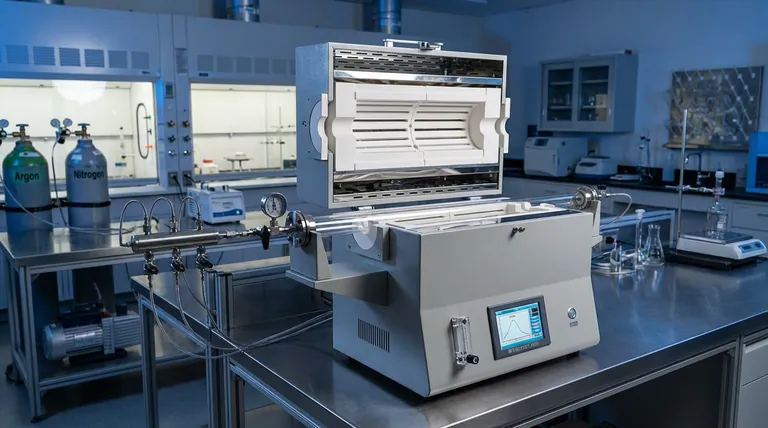
The Illusion of Simplicity
At first glance, a furnace is a simple tool. Its job is to get hot.
But in material science, "hot" is rarely enough. The real challenge isn't just generating heat; it's defeating chaos. It's about eliminating the countless variables—the stray oxygen molecules, the temperature fluctuations, the invisible gradients—that can render weeks of work useless.
This is a psychological battle as much as a technical one. It's about the deep-seated need for control and repeatability in a process that is inherently sensitive. This is where the elegant design of the tube furnace reveals its true purpose.
The Anatomy of a Controlled Universe
A tube furnace isn't just a better box. Its cylindrical geometry is a deliberate choice, engineered to create a perfect, isolated micro-environment.
The Tyranny of Temperature
Imagine trying to bake a perfect loaf of bread where one side is 20 degrees hotter than the other. The result is inconsistency—a failed experiment.
In a tube furnace, heating elements surround the tube. This radial design creates an exceptionally uniform thermal field. When combined with advanced insulation like polycrystalline fiber, you're not just heating a sample; you're immersing it in a consistent, predictable thermal bath. Perfection is not an accident. It is a design choice.
The Invisible Enemy: Atmosphere
More often than not, the thing that ruins a delicate material isn't the heat itself, but what's in the air. Oxygen is aggressive. It loves to react, turning pristine creations into useless oxides.
This is arguably the tube furnace's most critical advantage. The sealed tube is a fortress. You can:
- Evacuate: Pull a vacuum to remove every reactive molecule.
- Purge: Introduce an inert gas like argon to create a passive, protective shield.
- Activate: Introduce reactive gases to drive a specific chemical transformation.
This level of atmospheric mastery transforms the furnace from a simple heater into a true chemical reactor.
From Brute Force to Finesse
Early ovens were blunt instruments. Modern tube furnaces are precision tools, governed by sophisticated logic.
The brain of the system is the PID (Proportional-Integral-Derivative) controller. This isn't just a thermostat; it's a predictive algorithm. It learns the furnace's thermal behavior, anticipating and correcting for deviations before they happen.
This allows for complex, programmable heating profiles. You can design multi-stage recipes with precise ramps and soaks, ensuring that a process run on Tuesday is identical to one run on Friday. It removes human error and introduces the certainty of automation, often with a precision of ±1°C.
Specialization: When a Simple Tube Isn't Enough
As research demands grow more complex, the tube furnace has evolved. This is not a one-size-fits-all world. Different problems require different geometries.
| Furnace Type | Core Strength & Use Case |
|---|---|
| Vertical Furnace | Uses gravity to its advantage for uniform coating or simplified batch loading. Minimizes footprint in a crowded lab. |
| Split-Tube Furnace | A hinged design that opens like a clamshell. Essential for samples with fixed flanges or complex setups that cannot slide into a standard tube. It prioritizes access. |
| Multi-Zone Furnace | The master of thermal gradients. With multiple, independently controlled heating zones, it can create a precise temperature slope, vital for applications like crystal growth and chemical vapor deposition. |
Choosing the right design is about understanding the physical constraints of your experiment. It's about matching the tool to the specific scientific question you are asking.
The Honest Trade-Offs: Precision Over Scale
No tool is perfect for every job. The tube furnace makes a clear trade-off: it sacrifices size for control.
The tube's diameter inherently limits sample volume. For large, bulky components, a muffle furnace is the more practical choice. Furthermore, the complexity of vacuum pumps and gas lines requires a more involved setup than a simple box furnace.
This is the central decision: do you need to heat something big, or do you need to create a perfect, repeatable environment for something small? If your work depends on the latter, the precision of a tube furnace isn't a luxury; it's a necessity.
At KINTEK, we understand that breakthrough research depends on the reliability and precision of your tools. Our range of tube furnaces is engineered to provide the environmental control and thermal uniformity your work demands, turning variables into constants.
If you're ready to move beyond simple heating and take command of your material processing environment, we can help you select the right instrument for your specific challenge. Contact Our Experts
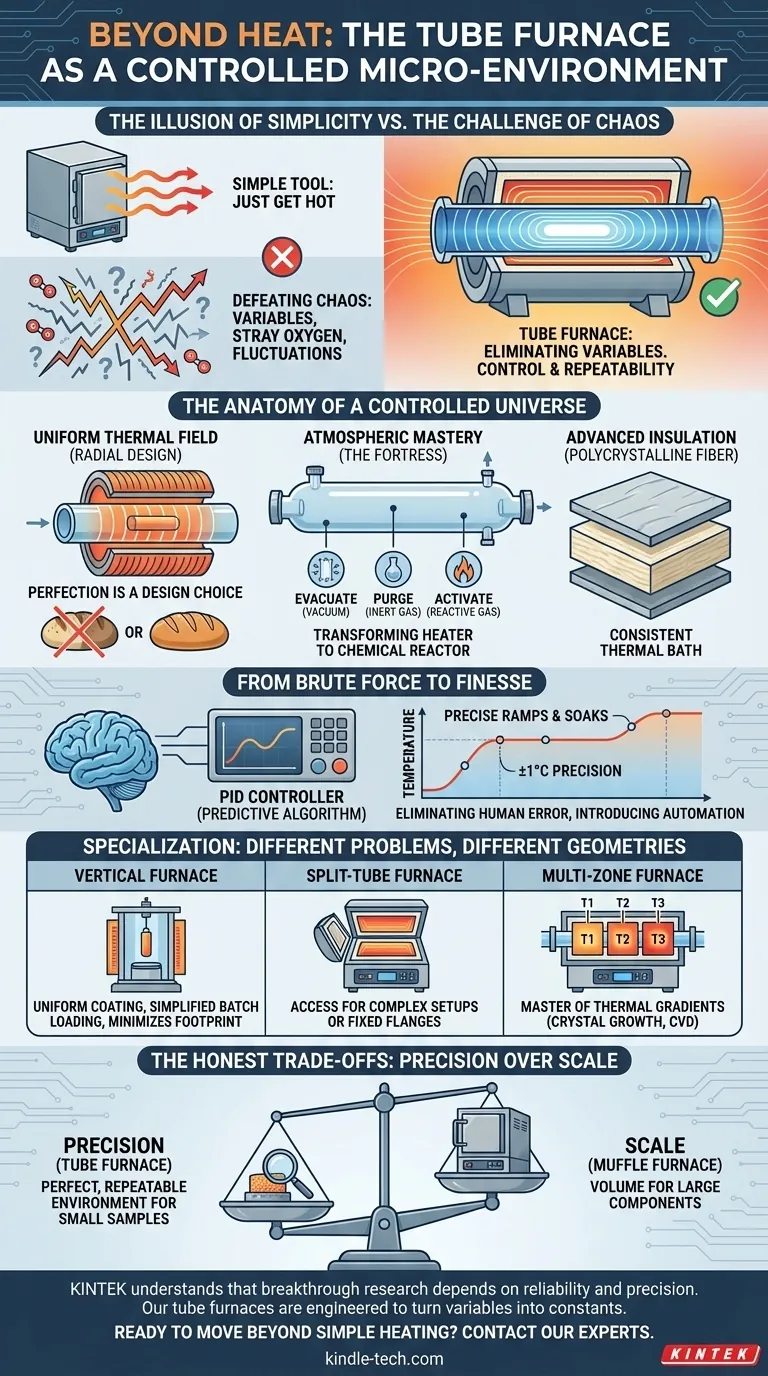
Visual Guide
Related Products
- Rotary Tube Furnace Split Multi Heating Zone Rotating Tube Furnace
- Laboratory Vacuum Tilt Rotary Tube Furnace Rotating Tube Furnace
- 1200℃ Split Tube Furnace with Quartz Tube Laboratory Tubular Furnace
- 1400℃ Laboratory High Temperature Tube Furnace with Alumina Tube
- 1700℃ Laboratory High Temperature Tube Furnace with Alumina Tube
Related Articles
- The Geometry of Heat: Why Motion Matters in Material Synthesis
- Exploring Rotary Tube Furnaces: A Comprehensive Guide
- Exploring the Functions and Advantages of Rotary Tube Furnaces
- Exploring the Benefits and Applications of Rotary Furnaces: A Comprehensive Guide
- The Physics of Perfection: How Rotary Furnaces Eliminate Randomness in Material Processing



















